Historical question about saddles: French and English. And a qn about a "horse"

Hellooo! Yes, special area of interest here. The "English" saddle would be the flat saddle (like a very old hunt or steeplechase saddle), and the French would be probably the selle a picquer (sp), not unlike the one used today by the Cadre Noir (and similar to the saddles still used in Portugal). I have an original copy of Fillis' book with illustrations, and that's what they look like to me.

The pictures of war and jousting saddles are medieval and very much too early.

I was hoping you'd chime in.

I hadn't flipped forward in the PDF to see if there were illustrations, and thumbnail views of the document are slow to generate.

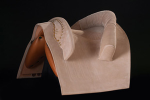
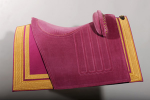
But I found the website of a saddler that shows both the "selle à piquer" and the "selle à la française" very clearly.


Selle à piquer:
1579364917926.png

Selle à la française
1579364937862.png

Fillis's text is much more readable now, if I take it to mean that he starts off a new rider in a "selle à piquer", with its two raised pieces, behind and in front, that hold the rider reassuringly in place, before moving the rider to the "selle à la française".
 
I took down off the bookshelf a facsimile of the 1741 edition of "Le nouveau parfait maréchal" by François-Alexandre-Pierre de Garsault: page 139 describes the "selle à piquer", the "selle raze" (the word "raze" meaning the same as "plate") that it says is also called the "demi-Angloise" (i.e. "semi-English") and the "selle Angloise" ("English saddle"); drawings of these and others are on plate XI (in my copy, plates are between pages 176 and 177). I've not found a downloadable file for this title, yet.

Both the "selle à piquer" and the "selle raze" in the "nouveau parfait maréchal" look like those in my post above.
 
two raised pieces, behind and in front, that hold the rider reassuringly in place, before moving the rider to the "selle à la française".
Re the above: in your first french quote.... comme emboite (can't do the accent!) a very rough translation could be "like in a box" ....... being kept safe by the raised pieces.
 
Re the above: in your first french quote.... comme emboite (can't do the accent!) a very rough translation could be "like in a box" ....... being kept safe by the raised pieces.

Yes, "emboîter" comes from the same root as "boîte", but "in a box" would be "dans une boîte" or "en boîte".

The verb (and adjectives derived from its past participle) "emboîter" means "to fit together" (e.g. "la première pièce s'emboîte dans la seconde" is "the first part fits into the second").

This is why I translated that as the rider being "locked in"; I could have tried other terms like "held fast/firmly/securely"...
 
Thanks for a fascinating thread Keith Beef. Some of those saddles look like they must belong to the king or similar they are so ornate.

the english were noted for riding in the hunting seat and used saddles with flat seat and often lined with wool or serge, the saddles were well stuffed in the panels, they were very plain looking and accommodated the forward seat, i suppose a lot of foreign saddles were used for riding in a more upright position body wise whilst schooling and also many were influenced by the military and working horse needs

I think the above post has the possibility of being read in a confusing way. Or maybe I am misunderstanding it? My limited understanding of the subject is that the English hunting seat is not the same thing as the forward seat. The English hunting seat being an upright rider with long stirrups very pushed forward feet and the forward seat being the riding position with short stirrups used for galloping today. But the old fashion hunting saddle would also accommodate the forward seat I think.

Thank you. And previous posters. Excellent thread.
Tho judging by my grandfather and friends in UK Field Artillery, British didnt ride or race cross country in forward seat till aftter WW1? And the muscles of the horse are at the front, to pull them along. The opposite of now.

I think I read somewhere that Italians were the first to use the forward seat. Maybe the French too and the English were slower to adopt it? It is all a bit confusing to me so maybe I am wrong about everything! :)
 
My quick and dirty translation would be:

I think I am the first to have used the flat saddle for schooling and for "haute école".
I always start my pupils in a flat French saddle, rather than a covered English saddle.
With the French saddle one is, as it were, locked in: as a result there is neither discomfort nor anything to fear.

Ah!
now I would read that as 2 separate statements - ie Fillis himself rode high-school in an 'english' saddle without the blocks and high cantles etc
and that secondly he used French 'baroque' saddles for his pupils.

That's how I read it. My French isn't great but I thought Keith mistranslated "Je commence toujours à faire monter mes élèves en selle française, de préférence à la selle anglaise couverte" by saying "flat French saddle". The flat saddle referred to in the previous line was, presumably, an English style saddle.

My French is non existent but I read Keith Beef's translation twice because I also thought Fillis was surely saying that he himself rode in a flat saddle but his pupils felt safer in the 'deeper' ones.

I don't like that locked in feeling at all.
 
I think I read somewhere that Italians were the first to use the forward seat. Maybe the French too and the English were slower to adopt it? It is all a bit confusing to me so maybe I am wrong about everything! :)

You are quite right Firefly, the forward seat for jumping was supposedly "invented" by Captain Caprilli, an Italian cavalry officer, in about 1912, although I'm sure there were others adopting this style around the same time.
 
You are quite right Firefly, the forward seat for jumping was supposedly "invented" by Captain Caprilli, an Italian cavalry officer, in about 1912, although I'm sure there were others adopting this style around the same time.

Thanks for giving us Caprilli's name.

Wikipedia has a quite eulogistic article about him.
 
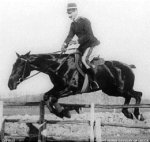
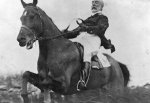
But it didnt catch on everywhere, did it. Here is the German Eduard Pulvermann in a very open saddle but I havent seen a pic of him in true forward seat. He is said to have used a military style for jumping after the First World War.

https://images.app.goo.gl/4dTdSonEDcojrnD86

Oh, I saw people using the old backwards-leaning seat out hunting in my teens (1960's/1970's), so it didn't catch on for a very long time.....and the old serge lined hunting/steeplechase/polo saddles remained very much as-you-were for a long time too. Actually Herr Pulvermann is doing pretty well there except for the legs; he's forward over the centre of gravity with a very soft hand.
 
thanks for the pics for comparison o_O
Actually Herr Pulvermann is doing pretty well there except for the legs; he's forward over the centre of gravity with a very soft hand.
I was thinking the same, the moment in that picture is not unlike the "safety" xc position that lots of riders still aspire to :) (with a bit more angle at the knee )
 
Actually Herr Pulvermann is doing pretty well there except for the legs; he's forward over the centre of gravity with a very soft hand.
Thank you so much. I welcome any input about Pulvermann as a horseman. I am writing about him but very ignorant about the equestrian side and need educating.
(But this is diverting the thread. Sorry I shouldnt have)
 
Top