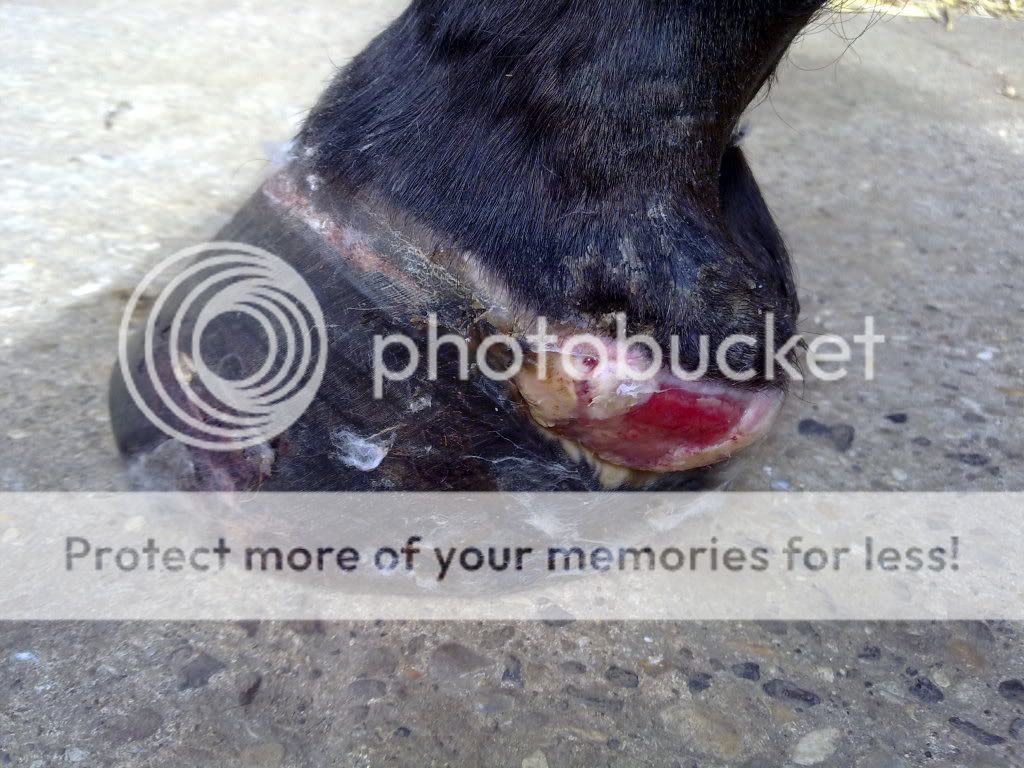
Horse with a part of hoof removed... Shoeing question?

deoni

Well-Known Member
Joined
28 August 2012
Messages
162
Visit site
My horse had a bit of his hoof removed as a yearling after getting it stuck!! So, he has been barefoot all his life. However, Ive had him a few years now and has been on and off footy and all the hacking is very stoney, boots dont seem to help much and i've done everything possible to change his diet/supplements etc! He is fine on soft surfaces or tarmac though. Has anyone shod a horse with a hoof like this? I have tried everything over the 2 years, but I can't deal with him being footy somedays and fine others and it isnt fair, but the person I bought him from said their farrier advised against shoeing the hoof. (after I bought him!) My farrier isn't due out for a while so can't discuss it yet :(, but one farrier said it would need to be remedially shod when i asked advise, but would this damage the hoof? He described the hoof as a dodgy tyre...I want to shoe him for his comfort, but I don't want to ruin his hoof! Here is a pic:

Sorry the pic is big.

2dbpeo9.jpg
 
Last edited:
Sorry, I have a couple of questions.

Firstly, was the coronet damaged as it looks complete? If the coronet is fine, I'm surprised that the hoof hasn't grown down.

Also, the hoof angle doesn't match (heel is steeper than the toe), so I'm wondering if the long toe is contributing to the footyness?
 
Sorry, I have a couple of questions.

Firstly, was the coronet damaged as it looks complete? If the coronet is fine, I'm surprised that the hoof hasn't grown down.

Also, the hoof angle doesn't match (heel is steeper than the toe), so I'm wondering if the long toe is contributing to the footyness?

His original owner said "He lost 1/4 of his hoof and fought for weeks to save it but in the end the vet said it had to come off it was the bulb, coronary band and hoof so he has no hoof on the back quarter." He was on box rest for a long time with it after it was removed! This pic was last summer, the hoof looks the same though.

Sole shot would be helpful, and pics of the other front hoof too.

Plus what he is eating......

He's eating 1/2 scoop of Fast Fibre, was on pro hoof for 8 months, but wasnt really helping, so swapped to pro balance to save money. I think you suggested yea sacc to me when i posted pics of my tbs hooves so he's on that too! And 1/2 cup of linseed. He sometimes is fine but not great (1 weeks ago) and today was quite footy so just went on the roads. I have boots fitted by my farrier, but they dont help much.
 
Last edited:
What sort of boots have you tried him in? Are you having a problem with them not fitting/rubbing/falling off or is it that he's still footy in them. If he's still footy in the boots have you tried him with pads?
 
Pain in the back of the foot? Not 100% comfortable? so not effectively loading and using heels/back of foot. Could there still be bacteria/other infection still lurking? Could it be thrushy so he isn't want to be using it so blood flow for growth and repair at the back of the foot isn't optimal? This has possibly created the long toe, and long toe could have been a cause as well as a symptom of back of foot not fully functioning. As the other comment suggested you've got two angles, one coming out the coronet band (the natural angle which is the one indicating tight connection with hoof wall and coffin bone and a second more flared angle starting lower indicating not as tight a connection. Hard to see without close up photos, and I'm sure you'll get further response from people if you can post a few more including the sole. Try to keep camera flat/balanced/straight. I usually have phone/camera gently touching floor and parallel to hoof when taking photos for front and side angle. A flat clean surface (if there are them in this weather!!) is also useful. You may see in a sole photo that the back of the foot is contracted, poss some thrush (thrush isnt always black, but mostly black goo) and possibly a stretched whiteline, (linked to the flare/or rasping the wall if no flare) and skinny overly long looking frog. If you able to gently scrub with a brush before the photo so people can see clearly. However farrier/trimmer may actually look and feel its perfectly healthy (I'm just shocked its not tightened now) as you/they'll know the hoof and history and have reasons/understanding as to why its not grown down tighter, and therefore closed, narrowed. Quarter crack I'd be thinking; health of hoof/back of foot; nutrition/diet (if it doesnt look healthy id want to be soaking/scrubbing/cleaning and putting on something topical after got it cleaning to continue the healing till it comes off (healing from outside) has hay/pasture been tested, overly sugary, are you feeding nutrients in right quantities, could you have a non typical mineral content in local soil so the minerals aren't balanced for horses needs. Is he absorbing the nutrients properly or could they be going out his body undigested? Maybe pre/probiotics etc (All this healing from the inside) have they has enough movement outside? Are other areas of the body short of nutrients/compromised/stressed in any way so that the vits/minerals you've providing him with are never actually reaching the hoof they are been used elsewhere where greater need? Have you asked your farrier/trimmer? You've prob covered this with them but I'm procrastinating over something else at the moment so thought I'd provide a few thoughts whilst in my head. There some great people on here giving feedback so they'll prob jump in with more when more photos if they spot the post.

Good luck, its horrid when things aren't 100% and not knowing what to do next.

Hope that gives few bits.

Best wishes,
Hannah
 
I'd also be looking at the balance/asymmetry of the whole horse to see if any cause or symptom. Is that the cause of a landing pattern or symptom which may mean it'll continue to pull apart. Body work, alignment exercises. I've realised your intial question was about shoeing which I've not really covered, hope useful any way, Hannah
 
Pain in the back of the foot? Not 100% comfortable? so not effectively loading and using heels/back of foot. Could there still be bacteria/other infection still lurking? Could it be thrushy so he isn't want to be using it so blood flow for growth and repair at the back of the foot isn't optimal? This has possibly created the long toe, and long toe could have been a cause as well as a symptom of back of foot not fully functioning. As the other comment suggested you've got two angles, one coming out the coronet band (the natural angle which is the one indicating tight connection with hoof wall and coffin bone and a second more flared angle starting lower indicating not as tight a connection. Hard to see without close up photos, and I'm sure you'll get further response from people if you can post a few more including the sole. Try to keep camera flat/balanced/straight. I usually have phone/camera gently touching floor and parallel to hoof when taking photos for front and side angle. A flat clean surface (if there are them in this weather!!) is also useful. You may see in a sole photo that the back of the foot is contracted, poss some thrush (thrush isnt always black, but mostly black goo) and possibly a stretched whiteline, (linked to the flare/or rasping the wall if no flare) and skinny overly long looking frog. If you able to gently scrub with a brush before the photo so people can see clearly. However farrier/trimmer may actually look and feel its perfectly healthy (I'm just shocked its not tightened now) as you/they'll know the hoof and history and have reasons/understanding as to why its not grown down tighter, and therefore closed, narrowed. Quarter crack I'd be thinking; health of hoof/back of foot; nutrition/diet (if it doesnt look healthy id want to be soaking/scrubbing/cleaning and putting on something topical after got it cleaning to continue the healing till it comes off (healing from outside) has hay/pasture been tested, overly sugary, are you feeding nutrients in right quantities, could you have a non typical mineral content in local soil so the minerals aren't balanced for horses needs. Is he absorbing the nutrients properly or could they be going out his body undigested? Maybe pre/probiotics etc (All this healing from the inside) have they has enough movement outside? Are other areas of the body short of nutrients/compromised/stressed in any way so that the vits/minerals you've providing him with are never actually reaching the hoof they are been used elsewhere where greater need? Have you asked your farrier/trimmer? You've prob covered this with them but I'm procrastinating over something else at the moment so thought I'd provide a few thoughts whilst in my head. There some great people on here giving feedback so they'll prob jump in with more when more photos if they spot the post.

Good luck, its horrid when things aren't 100% and not knowing what to do next.

Hope that gives few bits.

Best wishes,
Hannah

Thank you, I've never questioned why it hasn't grown down but I know he has always had the crack due to 1/4 of his hoof removed and no one has shod it! I will go take some pictures of his hoof. :) He is fine on the concerete and grass etc, he was trying to canter on the road yesterday, then as soon as we hit the gravel we are walking/stumbling! My farrier has never really talked about the crack or seemed worried by it, except when I asked if I shouldn't have bought him and he wasn't really clear, however he has never been lame on that foot!

I don't think it looks like he has any thrush, but will have a good look! He is out 24/7 but no grass at the min, however in summer there is quite a bit, but I put him in for a few hours and he gets worked most days including 4/5 hour hacks! So I think he is moving around enough, there is only one time last summer where he was totally fine and we could trot over the stones no bother.. but nothing had changed in routine or diet, so was confusing. We don't go down the stoney bits much, but its pretty much the only way to go so thats why I was asking about shoes :) Thank you.
 
deoni, you mention in your post that your horse had an injury as a youngster.

I am familiar with this type of problem and I can explain what is happening here, but there is, Im afraid, no completely permanent solution. However, there is no reason why your horse should be lame, if you take certain precautions.

The injury has interfered to a certain extent with the structures that create the horn, at the top of the foot. It has resulted in a weakness in the sidewall, which is being exploited by bacteria. Those bacteria arise from the soil and wet mud around the base of your horses foot, and are being drawn into the void created by the injury from the bottom, under capillary action. Because mud can access this open void and pack it, there is a permanent wet and warm area beneath and hidden by the outer section of wall.

A lot of people call this 'seedy toe', but in reality it can happen to any part of the wall that has suffered trauma or stretched so far that the white line has seperated.

What I would do, is speak to your vet and farrier together, and ask about removing the top section of the wall over the void. Normally, this will be done with bothpresent at the same time. This sounds drastic, but what it will do is allow the air to circulate across the void and allow you access to clean it every day and apply treatment such as Iodine or Oxytetracycline spray, which your vet can supply, while the hoof replaces the damage with fresh new horn.

Its very important that you try to keep the area clean and mud free as much as you can. Once the void covering is removed, it will take around 9 months to a year to replace it with fresh good horn, as the foot takes this long to grow down. It is very important during this time that the infection is not allowed to restart, or you will need to go back to square one. Under no circumstances should this be covered at all, as covering it will simply allow capillary action so draw moisture in again.

In reality, I expect these kinds of problems to recur from time to time, especially if horses are out 24/7 and more especially if they are out overnight in the summer. You need to try to avoid wet and warm conditions, which are the conditions bacteria love, and they will quickly multiply in. 2012 was a perfect year for such problems to happen, wettest on record.

Good luck!
 
My mare did this to her hoof as a over reach, this is after some of the healing I seem to have lost the worst pics, it was a complete whole and she was very lame, but with lots of TLC and thank god a dry summer and lots of blue Oxy spray she was fine after the hoof had fully grown down.

injury002.jpg
 
Over the winter the crack has closed up a bit, it changes all the time, just pick it out, dont usually notice it! However, it closes and then goes back like the original pic, it was just the only pic I had. Hope these pics are useful. Was last trimmed about 4 weeks ago.

537390_10152683921160004_560860214_n.jpg


523375_10152683920780004_326677522_n.jpg


483580_10152683922420004_313191924_n.jpg


165469_10152683922835004_1290744863_n.jpg

^ The bad hoof, you can see a bit missing.

10045_10152683923205004_217692853_n.jpg

^ The bad hoof again, the crack has closed up but it has done this before and then reopened.

45601_10152683924825004_1318148314_n.jpg

^ The good hoof

734036_10152683925695004_1328844278_n.jpg

^ The good hoof again :)
 
OP - the 'good' hoof is long in the quarters*. If the 'bad' hoof is also allowed to get long in the quarters it is pretty likely that this sort of crack may open up again.

*hoof wall in photo appears proud of hard sole plane
 
I just want to comment that it would be normal for a horse in work barefoot to grow heel to the floor in three months, not the nine that Graeme has suggested. Most barefoot working horses will grow a complete foot at the toe in under six months.
 
OP - the 'good' hoof is long in the quarters*. If the 'bad' hoof is also allowed to get long in the quarters it is pretty likely that this sort of crack may open up again.

*hoof wall in photo appears proud of hard sole plane

I don't really understand what you have wrote in the last bit, but it does open up again, sort of on a yearly cycle.But I was told the crack will always be there due to the surgery.

So, would shoeing the hoof be a bad idea then? I really would like to after trying the whole unshod thing for years, but depends if this would damage it.
 
Last edited:
I've worked on numerous far worse cracks. Shoes never been required, neither has resecting. You will need a hoof care prof who is experienced in resolving while bare
 
I've worked on numerous far worse cracks. Shoes never been required, neither has resecting. You will need a hoof care prof who is experienced in resolving while bare

Thank you. The crack is not the issue re being barefoot, it has never bothered him. It's just I have been trying all the stuff posted on here for 2 years to try and get him comfortable on the stones and he never is. :( I have front boots, may have to try backs and see, but I really don't like the boots! :o
 
I just want to comment that it would be normal for a horse in work barefoot to grow heel to the floor in three months, not the nine that Graeme has suggested. Most barefoot working horses will grow a complete foot at the toe in under six months.

Maybe you should apply a little bit of logic to that observation....

If a horse is growing a full foot in under six months (I wish!),
Average horses foot is around 5 to 6 inches in height at the toe. That means, to grow a full foot in six months, the foot is growing an inch a month! Shoeing/trimming would be necessary far more often due to the leverage and resulting deformation created, and no horse would be able to go 8 weeks because of a full two inches of growth at the toe - your vet would not be terribly impressed.

One of the main principles I abide by, is to try to make sure that the amount of healthy growth exceeds the amount of destruction and wear. This is a guiding principle, and it stands very well the test of time, because if I can remove the damaged horn at a faster rate than the damage occurs, horses end up with healthy horn, which can do its job properly. Doesnt matter if the horse is barefoot or shod, as long as more healthy horn is being created than destroyed, the horse will stay sound.

As a result of this, I have studied for thirty years the rate at which horses feet grow, because it is fundamentally important that when shoeing, destructive elements act more slowly than constructive ones, so you need to know the rate of creation. Back in the early nineties, I conducted a study of twenty different horses, both shod and unshod, by quite simply making a small mark on the foot just below the coronary band, toe and heel. Every shoeing and/or trimming, the position of the mark was reinforced (because sand and mud will abrade it) and carefully noted, as it progressed down the foot, and eventually disappeared.

The feet that were within the study renewed themselves at an average rate of 11 1/2 months. The healthier feet did grow faster, but even then the fastest of these took 9 1/2 months to complete the cycle. The very slowest took 13 months to complete.

I have never known any horse to renew its feet in six months, of the thousands of them that I have trimmed and shod in 40 years. Most feet grow in fits and starts, and will be stimulated by long daylight hours (as our own fingernails are) and times of high grass nutrition, so in summer they peak, and some then can produce an inch in a month, occasionally. But the same horses will almost always produce considerably less over the winter period, and a great many will go into what I call a 'lull', when almost no horn is produced for a month or longer. During times of a lull, some horses can go for 8 to 10 weeks with shoes on, without needing shoes or trimming at all. There has recently been a lull, and I looked at one horse today who has already been 8 weeks, and the feet looked as if they had very recently been shod, and because I attend the yard on a weekly basis, I referred him forward for a while.
 
Graeme I'm guessing you don't have any hard working barefoot horses on your books?

Did you get a chance to look at the Rockley Farm website http://www.rockleyfarm.co.uk

It's very interesting, as is their blog at http://rockleyfarm.blogspot.co.uk/

Thank you, Foxy. I have already been recommended the Rockley blog, and I promise when I get time I will visit the site and read as much as I can, but I am off to work now.

I can assure you I am a supporter of barefoot, and around 60% of all the horses on my round are. But the rest need their shoes, either on the front or all 4. For time reasons alone, I simply would not shoe if it is not necessary (my own horse has no shoes currently). I am working pretty much 7 days at present (vehicle breakdowns excepted!!)

Meantime regarding the speed of growth, maybe you could direct me to any part of the blog they refer specifically to this, pm me if you like.
 
Thank you, Foxy. I have already been recommended the Rockley blog, and I promise when I get time I will visit the site and read as much as I can, but I am off to work now.

I can assure you I am a supporter of barefoot, and around 60% of all the horses on my round are. But the rest need their shoes, either on the front or all 4. For time reasons alone, I simply would not shoe if it is not necessary (my own horse has no shoes currently). I am working pretty much 7 days at present (vehicle breakdowns excepted!!)

Meantime regarding the speed of growth, maybe you could direct me to any part of the blog they refer specifically to this, pm me if you like.

Graeme,Nic posts photos every three weeks of each rehab. You need only look back at a few pictures and you will see it. All my horses have always grown a full foot in less than six months if they are working four or more times a week.
 
Blooming eck Graeme, the horses you care for have five to six inches of toe? My 17 hand shirex hunter has just over three. And none of my renters, hunters or dressage horses has been anywhere near four, never mind five or six. With feet that high, do the horses in your care have ground bearing frogs? If not, that would be one reason they grow so slowly.
 
Last edited:
Graeme you also seem completely unaware that working barefoot feet grow at twice the rate of shod one's. Or that it is perfectly possible, and indeed most of us think very desirable, to. match growth rate with wear and leave nothing to be trimmed. Your desire to see wear rate lower than growth rate suggests to me a desire to be able to "do something". If you had bothered to take a quick look at rockleyfarm.blogspot.com you would have learnt agreat deal about the benefits of this approach to lame horses.. My faith in your posts has now, I'm sorry to say, completely gone down the drain with respect to anything about how to manage a barefoot horse.
 
Last edited:
Top