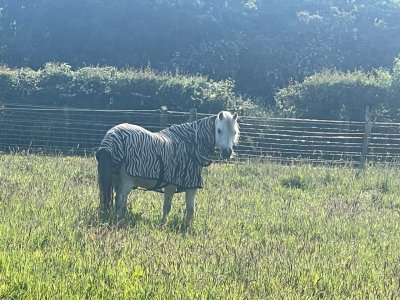
How are you managing?

We are in the process of moving to the summer fields. We couldn't move any earlier because they were flooded but still growing rapidly. I've sectioned off the smallest safe area and my 2 have built up from 20 minutes to 2 hours on it early each morning. Once it's eaten down they can move over all the time and strip graze. For now after grass time it's back to the well eaten winter paddock and soaked hay for the rest of the day. The 2 liveries in the next field are doing the same - we all work part-time or from home so we have managed to set up a moving horses rota.
Cushings boy is being exercised every day and semi-retired healthy but greedy pony around 5 times a week. This has been made more challenging by rutted hard ground everywhere.
I still really worried about lami, I'm sure my boy is fed up with having his pulses taken and being made to walk in small circles
 
Tearing my hair out over here with my little welshie companion - he was unrugged all winter, limited grazing, soaked hay in the morning and chop in the afternoon, regular in hand walking and has barely lost weight at all. Looks like he's going to drop a foal at any moment! Vet checked, bloods all normal, nothing to suggest cushings or EMS (our other one has EMS, hence the checking) but GOOD GOD this boy won't shift the pounds. They're still on their winter field as I dare not put them on the lush summer side - so instead am cutting it for hay shortly. To be fair, weight isn't going on either but seriously...literally don't know what else to do with him. I've got an instructor coming to teach him how to lunge to give me a break from flying a pony kite on the roads!

So yeah... I've got tons of grass and two native ponies who absolutely can't have it 😅
 
Both my horses were worked regularly over winter, lightly rugged and only on forage. Both came into the spring with ribs showing and they are in work doing about 30+ miles in mostly trot and canter every week. I make sure they do plenty of hill work (unavoidable) and are worked aerobically so that they actually use some calories. They are strip grazed on upland unimproved pasture and so an increase in weight has not been a problem so far. They are also yarded together for about 3 or 4 hours a day. When we finally get some rain I will reduce their bit of grass! By July, it shouldn't be hard to manage at all.
 
He'll be more upset if he gets laminitis and has to be stuck in his stable 24/7.

I thought my boy would hate his, but he took to it very easily. He wore a Thinline muzzle and Ultimate muzzle with no rubbing (mine also has a pink and white muzzle, and spent much more time on grass than yours does). You just have to make sure you buy a size large enough to allow him to chew without rubbing his chin, and you might need a fly mask as well to make it harder for him to remove the muzzle.

I really rate the ultimate muzzle; simple but effective design, tough and my native doesn't mind wearing it!
 
Out overnight in a well grazed down paddock wearing a muzzle. In 8-4 with weighed soaked hay. Can feel ribs easily but has small fat pads on shoulders that decrease in size during the day when he’s off the grass. Had 3 nights without a muzzle and came in with pulses 😔 kept him in for 48 hrs on soaked hay then back out in a muzzle. He’s maintaining his weight though not losing (managed to get quite a bit off him before summer turnout but currently unable to exercise him properly 🙄) I feel like we are constantly teetering on the edge of some form of metabolic episode and will probably resort to grass free pen when it rains as I can’t cope with the worry!
So - in answer to your question - not very well!!!
 
For those who are really struggling with shifting the weight on your ponies and horses I can thoroughly recommend sending them swimming if you have an equine pool nearby. It kick starts the metabolism which you can then keep going once home and as it’s non weight bearing it’s brilliant for recovering laminitics or those that can’t be ridden. There are people on here who don’t rate it but having sent my two for 10 days a few years ago its something I would definitely do again if they needed it.
 
My fields got absolutely trashed this winter and I’ve bought in a load of older hay. That suits the fatties really well and then the sports horses are having feed and round bale hay!
 
I’ve realised ours are actually on the mares winter field plus the 2 summer ones. Even the winter field had a decent amount of grass considering it was trashed, he wasn’t impressed coming today 🤣
 
So obviously we are all very aware of the grass and how rich it is this year. A lot of horses coming down with laminitis, even those you wouldn’t “typically” worry about. Vets are seeing 3-5 cases a day in my area some days which is very concerning.

So my question is how are you managing your grazing? especially those with native types. Spoke with a vet yesterday after helping my friend get her mare out of the field (she couldn’t move, took 8 people an hour to get her on a box to get back to the yard) and the vet said the worst thing you can do is give them time off at this point of the year. I try to ride every day especially in summer, to keep him fit and keep his weight down but despite this he is looking porky because of the abundance of grass.
 
I haven’t read all of the replies but the grass I actually at it’s richest late afternoon and at it’s lowest first thing in the morning so if you want to avoid that time I’d bring in later morning and leave in until 7/8ish.

Ive restricted the grazing for all of mine and yesterday halved my mare’s paddock again as a precaution as she has got a bit footy on stones. They also come in most days for part of the day.
 
  • Like
Reactions: PSD
My mare is being treated for Lymes. As a result I was advised to limit her grazing as exercise not an option. She, however, has gone on hunger strike being shut in. Won't touch any bucket feed after I tried to poison her with the antibiotics and bute. Won't eat soaked hay or dampened hay from a haynet or the floor. Had to get Profix as the antibiotics have upset her guts. Now had to make a small turnout area so she can go out in that instead. Banging the posts into concrete ground was fun, broke two bases on them. Battery on charge. The fun begins when the wretched youngster starts trying to dismantle it tomorrow, just because......
 
I'm on (unfertilised) dairy grazing at livery so can't control the grazing, just the time out on it. Fortunately there are a lot of horses in our field but there is still too much grass. My horse came out of winter too fat, lost weight in early spring but was still too fat, and has now piled it back on. He will be muzzled from tomorrow and I'll be exercising at both ends of the day. We lost one to laminitis last week and one other has been on box rest for a couple of months with lami. I have never seen acute laminitis before.
 
It’s really bad this year. Hearing about new cases every day. And many non typical horses struggling.

I’ve put a track round our, so far, ungrazed paddock. And then I’m strip grazing them round it, opening up a new section about each end each morning.

The two that I’m not so worried about go out at 5pm and will come in at 7am.

The other two that I am more worried about then join them at 10pm with muzzles on and also come in at 7am.

It’s like strip grazing, but with more movement as they think the other side of the track is probably better and they keep moving backwards and forwards.

Then they’re all coming onto the surfaced smaller track during the day. And I’m spreading low sugar and starch Haylage around it. With some in trickle nets.

So far working well. I’m checking pulses, heat and crests daily. And weigh taping weekly.

I’ve also started medicating the 20yr old for Cushings, despite borderline results as he’s looking a little suspect this year.
 
I am actually quite glad after reading this that I have not managed to find my next new forest and buying something at this time of year that might be carrying too much weight.

I always worried about Homey getting laminitis. However he never succumbed to it even when he was fatter than I wanted him to be. In his later years I had him tested for EMS and Cushings and he had neither. I was absolutely paranoid about him getting laminitis so I tried to keep him active in work all year round ridden 5 times a week at least and then in the spring/summer/autumn 6/7 times a week. He also wore his muzzle and was on soaked hay. During the 15 years I had him he lived out for 7 years and then for 8 years he was part stabled.

During his stabled years he went out at 7.00 and came in a 3pm ish and was on soaked hay. Every year YO would think about having them out overnight for the warmer months so they could get more turnout and then she would say no everyone is too fat it is too risky they best stick to the same routine.

I think climate change is meaning milder wet winters and hotter summers and something we are going to have to think about when managing native and cob types which are increasing in popularity. I expect the combination of high sugar grass plus the hard ground and most leisure riders not working their horses hard enough to get them slim is a time bomb for horses that are metabolically challenged.

It is very difficult if you are on a livery yard and cannot make your own track system. It then comes down to next best options which might be muzzles and other ways of restricting grass intake including more time off grass in a stable if exercise is not enough. Not everyone who has a good doer can exercise them hard enough every day to control their weight due to time constraints as it might take several hours of slower work or shorter periods of faster work and jumping which uses up more energy.

Weight management is the one thing that is a real downside with native types. Sometimes I think it would be easier to get a small TB or riding pony type and not to need to worry about this but far too sharp for me.
 
Horse is in hardstanding during day, out on grass track on our steepest hill overnight. Pony does the same, but in a muzzle. I did have a wee starvation paddock for them during the day, but fatboy kept teleporting to the other side. He’s been sulking with me for the last 3 days after his last breakout made me change management! 6E2EC503-7267-4BE1-A6F3-A8FBB21A3293.jpeg
 
Mine are on a track which has gone bare and crispy. They can slightly reach under the tape to get some of the longer stuff, but not feast on it, and there are lots of horse safe trees in the hedge row to nibble. I am worried about the grass coming back though. The young Appyx is looking good, and will cope, but my new broken re-home came to me fat, and while he is losing weight compared to where he was a month ago, he still has a bit to go. Health issues for all of us mean we are a non ridden family, and we are exercising as much as suits the individual without flaring conditions up (the track is working wonders for keeping up gentle movement), but I am worrying a bit about him putting weight back on and going backwards. Debating feeding MagOx to see if it would help mitigate and flushes 🤔
 
Two on our yard have come down with it. One a chronic laminitis that will be pts next week and the other is 17hh! So unsure on his prognosis with his size.
but both been kept in large grass paddocks and overweight...
 
Yes, it is a scary time of year.
I firmly believe that horses that are allowed to graze all year round, rather than partly stabled, are better at self regulating. I once read an article that did an experiment that weighed horses before and after a restricted time grazing to work out how much they ate, and those who were only allowed on grass for a little time each day managed to consume loads more in the same time, as though they knew their access was restricted and made the most of it.
So my technique is to allow the maximum area of grazing where they are just hungry enough to still want a bit of hay. So, if there is a big bit of their one slice of hay each left the following day their area is too big, if every morsel has been eaten, the area isn't quite big enough, if there are a few wisps left, the area is just about right.
 
I've worked really hard over the last few years to improve my grazing as it was so poor. This hard work has come to bite me in the rear end!

My 2yr old section D is doing well and could do with Dr green to properly fill out and grow. Older D, Ben is looking amazing, but Robin is huge! He's rocking the clinically obese look right now. At 3yrs and just backed I don't want to over work him. He's not grown as big as expected so I worry about being to heavy with him only being young, but I need to get the weight down, so I currently have electric fencing up strip grazing.

Even my sheep are over weight.
 
Loathe to use muzzles I know he'll be furious and hate it - but should I be trying this? Any recommendations?

I've read about the Flexible Filly but realistically I suspect there is a high chance he will have whatever I get him off. Pink and white muzzle, easily gets rubs.

I tried mine in a Flexible Filly this morning. This is a horse I couldn't catch in his box when I was using a bucket muzzle - also has a pink/white nose. He has (so far) completely accepted it, which is brilliant. It is rubbing the bridge of his nose a bit, but I am sure I can adjust it. About half my yard are now using them.
 
Yes, it is a scary time of year.
I firmly believe that horses that are allowed to graze all year round, rather than partly stabled, are better at self regulating. I once read an article that did an experiment that weighed horses before and after a restricted time grazing to work out how much they ate, and those who were only allowed on grass for a little time each day managed to consume loads more in the same time, as though they knew their access was restricted and made the most of it.
So my technique is to allow the maximum area of grazing where they are just hungry enough to still want a bit of hay. So, if there is a big bit of their one slice of hay each left the following day their area is too big, if every morsel has been eaten, the area isn't quite big enough, if there are a few wisps left, the area is just about right.
Interesting, as I'm starting to believe my little man is hanging onto every single calorie because he's been on restricted turnout for so long. He's never had lami and was previously a healthy weight, but my previous ridden horse who I lost, and now my loan horse both cannot go on turnout (loan horse has EMS). I do think he would be better off being out as he stands around on the yard all day once he's run out of food, so getting no exercise except when I take him hand walking, which clearly isn't enough.

Trouble is, even though he has no lami history, he's welsh and obese, so now I feel like i can't just turn him out to get him back to self regulating again in case it tips him over! Ignoring the fact I only have two at home and one needs to be in of course...
 
I’m on lush ex dairy but I let it get long and die off, I don’t mind the weeds and only clear these when they move onto the winter side. He’s in hard work (competing psg schooling inter 2). Schools 3/4 x a week, canters in the field 1 x a week and/or 1 x hack a week. He’s out roughly 6.30am to 4.30pm and is out later/in earlier at the weekends as generally that’s what fits in with me.

I do worry about the grass sugar content but in reality he lays down and eats his own rugs more than the green stuff which is why his paddock gets so wild so quick.
 
Interesting, as I'm starting to believe my little man is hanging onto every single calorie because he's been on restricted turnout for so long. He's never had lami and was previously a healthy weight, but my previous ridden horse who I lost, and now my loan horse both cannot go on turnout (loan horse has EMS). I do think he would be better off being out as he stands around on the yard all day once he's run out of food, so getting no exercise except when I take him hand walking, which clearly isn't enough.

Trouble is, even though he has no lami history, he's welsh and obese, so now I feel like i can't just turn him out to get him back to self regulating again in case it tips him over! Ignoring the fact I only have two at home and one needs to be in of course...
Could they both go out for a short time wearing muzzles?
Not that muzzles are a panacea - my mini became footy while wearing one so he's back off the grass entirely for now but if yours could manage a short muzzled spell in the field it would provide some variety for them and the opportunity to move around a bit
 
Yes, it is a scary time of year.
I firmly believe that horses that are allowed to graze all year round, rather than partly stabled, are better at self regulating. I once read an article that did an experiment that weighed horses before and after a restricted time grazing to work out how much they ate, and those who were only allowed on grass for a little time each day managed to consume loads more in the same time, as though they knew their access was restricted and made the most of it.
So my technique is to allow the maximum area of grazing where they are just hungry enough to still want a bit of hay. So, if there is a big bit of their one slice of hay each left the following day their area is too big, if every morsel has been eaten, the area isn't quite big enough, if there are a few wisps left, the area is just about right.
This definitely. At my previous yard I had plenty of grass and a good doer wb. From spring until late autumn he was out 24/7 with no hay. He would doze most of the day. Now I have got not a lot of grass, still feeding and hay and in at night. They have their heads down all day.
 
Top