Position of the head in dressage movements

Exactly Ester , Lola13 show us these papers and these photos you're not dealing with a load of fluffy bunnies who are going to take a fit of the vapours faced with an unpleasant photo.

Hahahaha, I am not trying to foll anyone, I just have bad experience of posting those kind of links, and I want to stay a member on this forum, people are very smart and nice, and they make a very good debate.

What I am struggling to find is complete british official dressage rulebook, not the ones that have half of the rules deleted, the complete thing. They have them in every single country in their language, only british rulebooks have half of the things deleted. Does anyone know where to find a complete one?
 
Oh, so I found the picture after trawling through several pages of that blog

It credits NHE research center for the work, good old Nevzorov so you will have to excuse me if I don't take his findings too seriously!
 
I posted now one link with website that has reposted one picture. I am not posting direct links, I have done that one time on one forum, and I have been verbaly attacked by manny people. So not doing that mystake again.
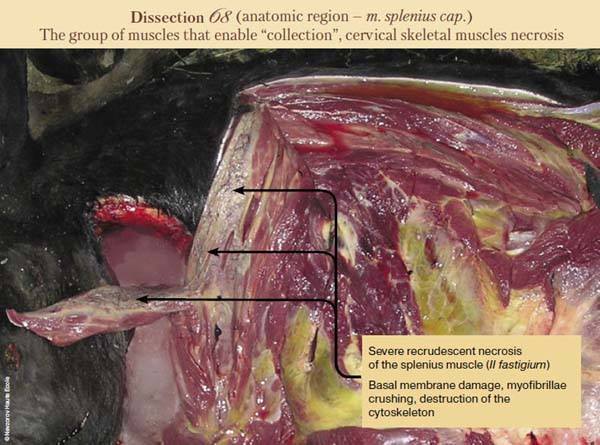
You don't need to worry about that here. Post links to the photos, rather than just posting the photos so that they automatically show. Also put a warning that they are photos from post mortems and to only click on the links if you are happy to view such images.

ETA - a link to programme showing an equine post mortem (Inside nature's giants) has been posted on this forum previously, plus there are often 'worst injury' photos and I have posted photos of minor operations and not been banned.
 
Last edited:
the photo
tumblr_mxwsrrPVHj1sexwieo1_1280.jpg


and the caption:Here is the photo of the autopsy of a horse that was considered healthy, myologically at least. On the photo, you can easily see the affected regions. In this case we see a very severe, obvious and definite chronic affectation of the splenius neck muscles. The ones that together with the trapezius and the atlas muscles-suffer most of all from forced collection. The grey mass that is perfectly seen and shown in the picture is unquestionably necrotized muscle tissue. Dead muscle tissue within the body of the living horse whom the equestrian sport community foredoomed to be ‘happy athlete’ (It is phenomenal that this term be used by the FEI in such an instance of marasmus. The term ‘happy athlete’ is used for dressage horse.)
NHE Research Center
 
Oh, so I found the picture after trawling through several pages of that blog

It credits NHE research center for the work, good old Nevzorov so you will have to excuse me if I don't take his findings too seriously!

I dont like the guy eather, but he did a lot of researches with qualified researchers:H. Strasser, dr.vet.med. ,S. Skinner, dr.vet.med.E. De Buckeler, dr.vet.med.I. Colloredo – Mannfeld, dr.vet.med. prof Zelenevskij, prof V. D. Isakov, dr.med.. prof dr B. E. Sysoev, S.M. Logatkin etc etc

If you dont trust researches saying that modern "collection" is incorrect, bring out the dressage rulebooks (complete ones) and lets compare them to the videos of the modern riders.
 
Mr Nevzorov also likes to publish in his own journals, I don't know why the rest of us scientists didn't think about doing that!
 
I dont like the guy eather, but he did a lot of researches with qualified researchers:H. Strasser, dr.vet.med. ,S. Skinner, dr.vet.med.E. De Buckeler, dr.vet.med.I. Colloredo – Mannfeld, dr.vet.med. prof Zelenevskij, prof V. D. Isakov, dr.med.. prof dr B. E. Sysoev, S.M. Logatkin etc etc

If you dont trust researches saying that modern "collection" is incorrect, bring out the dressage rulebooks (complete ones) and lets compare them to the videos of the modern riders.

I have added the complete rule book.

It doesn't matter who was doing the research if it isn't published in an independent peer reviewed manner it is pretty defunct and tells us nothing. I certainly wouldn't believe anything Strasser came up with either..
 
foredoom
fɔːˈduːm/Submit
verb
past tense: foredoomed; past participle: foredoomed
condemn beforehand to certain failure or destruction.
"the policy is foredoomed to failure"
 
Mr Nevzorov also likes to publish in his own journals, I don't know why the rest of us scientists didn't think about doing that!

I am not here to pick on or promote anyone particularely, not the riders, not the people who make researches. I just said it is interesting to see autopsy pictures. Nevzorov made a lot of mystakes in presenting himself and gets a LOT of hate. If he was a little different person he could of make a lot for horses. But his behaviour is doing quite the opposite unfortunately.
 
I have added the complete rule book.

It doesn't matter who was doing the research if it isn't published in an independent peer reviewed manner it is pretty defunct and tells us nothing. I certainly wouldn't believe anything Strasser came up with either..

I didnt said they were gods and everything they say is true, it is an interesting starting point to start a discussion, not bashing people, but talking about different bodyparts of the horse, their function and what is done to them by using different methods. Not taking a research for granted, just as a starting point for a healthy discussion.

I dont see the rulebook.
 
Work like this is much more useful and more importantly valid, although sample numbers are always a problem http://www.sciencedirect.com/science/article/pii/S0031938414000419

I am sorry but you cannot declare there to be evidence, refuse to provide the sources when that evidence has then been provided it turns out to have nothing to do with the established scientific community, work and routes to publishing, therefore making it pretty invalid.
 
the photo
tumblr_mxwsrrPVHj1sexwieo1_1280.jpg


and the caption:Here is the photo of the autopsy of a horse that was considered healthy, myologically at least. On the photo, you can easily see the affected regions. In this case we see a very severe, obvious and definite chronic affectation of the splenius neck muscles. The ones that together with the trapezius and the atlas muscles-suffer most of all from forced collection. The grey mass that is perfectly seen and shown in the picture is unquestionably necrotized muscle tissue. Dead muscle tissue within the body of the living horse whom the equestrian sport community foredoomed to be ‘happy athlete’ (It is phenomenal that this term be used by the FEI in such an instance of marasmus. The term ‘happy athlete’ is used for dressage horse.)
NHE Research Center

But surely this picture tells us nothing at all without knowing exactly what work the horse has done and when, and comparing it both with other horses which had done the same work - to prove it was not a one-off, and other horses which had NOT done any of that work - to prove that it was the work that caused it. For all we know, this was one horse that tripped over its own feet in a paddock and caused a neck injury.

I'm not a scientist but even I know that much, I think.
 
Work like this is much more useful and more importantly valid, although sample numbers are always a problem http://www.sciencedirect.com/science/article/pii/S0031938414000419

I am sorry but you cannot declare there to be evidence, refuse to provide the sources when that evidence has then been provided it turns out to have nothing to do with the established scientific community, work and routes to publishing, therefore making it pretty invalid.

I said there were researches made, I did not come here to preach, I came here for a discussion, it is a forum. What I am interested is what is peoples oppinions on the points made (correct or incorrect), riding by the rulebooks, modern riding, LDR, rollkur etc.

I want to hear the oppinion on the points made about splenius, trapezius and the atlas muscles.
 
Last edited:
And I am asking you how you deal with the young horse altering it's outline due inexperience.
I appreciate English is your second language but I am asking a straight question .why would you be asking a horse altering it's outline due to inexperience to collect .
You do own the thread you can't choose the questions that are posted .
You can of course choose not to answer and all following the thread can make what inferences they choose from that.

Every bit of work we do with our horse is geared towards collection.

Collection is not just a term for work done at higher levels. Collection is in degrees, every time we work the horses hind end to move under its body we are asking for a degree of collection.

Lola, I think your posts and your English are excellent. I'm really enjoying this thread.
 
But surely this picture tells us nothing at all without knowing exactly what work the horse has done and when, and comparing it both with other horses which had done the same work - to prove it was not a one-off, and other horses which had NOT done any of that work - to prove that it was the work that caused it. For all we know, this was one horse that tripped over its own feet in a paddock and caused a neck injury.

I'm not a scientist but even I know that much, I think.

boom, got it in one!

It could have spent all of it's life inverted doing damage too.

As I scientist it is always nice to see supporting evidence for the long term detrimental effects of hyperflexion that are proposed.
As a topic that has come up on here before it has been clear that there is very little if any, hence I may have gotten over excited of the prospect of some quality dissection with good scientific experimental design. It is disappointing to find that is not the case.
 
Last edited:
I said there were researches made, I did not come here to preach, I came here for almost ssion, it is a forum. What I am interested is what is peoples oppinions on the points made (correct or incorrect), riding by the rulebooks, modern riding, LDR, rollkur etc.

I want to hear the oppinion on the points made about splenius, trapezius and the atlas muscles.

Lola I think things are confused because you are trying to discuss three different things at once and they are only loosely related, if at all.

1. The use of severe overbending, rollkur, in training.

2. The prevalence of mildly overbent as a head carriage in training and in competition. Chosen as a preference to mildly in front of the vertical.

3. Incorrect movements which do not conform to the FEI rulebook, given high scores in top level competition.

I agree with you that 1 and 3 are an issue. I am not sure if 2 is or not, as it is now simply accepted by almost all top competitive riders that horses should be ridden like it, Hester and Dujardin included. I struggle to understand whether it is genuinely wrong, or just that things have changed from what used to be regarded as correct.
 
Last edited:
Lola I think things are confused because you are trying to discuss three different things at once and they are only loosely related, if at all.

1. The use of severe overbending, rollkur, in training.

2. The prevalence of mildly overbent as a head carriage in training and in competition. Chosen as a preference to mildly in front of the vertical.

3. Incorrect movements which do not conform to the FEI rulebook, given high scores in top level competition.

I agree with you that 1 and 3 are an issue. I am not sure if 2 is or not, as it is now simply accepted by almost all top competitive riders that horses should be ridden like it, Hester and Dujardin included. I struggle to understand whether it is genuinely wrong, or just that things have changed from what used to be regarded as correct.

I started this topic to discuss the mildly overbent and the use of it as a collection in every single movement. Rollkur topic was started by other people so it joined the discussion.

My personal oppinion is that it is wrong, but I will be happy for someone to prove me wrong.
 
It is our BD rulebook, I cannot provide you with anything else!

For those interested this is a nice pilot study paper which goes on to model and assess the relative load on the cervical vetebrae
http://onlinelibrary.wiley.com/doi/10.1111/j.2042-3306.2010.00228.x/pdf

Table 4 gives the % strains

Ok I will find some from several countries and post in english some rules from one that has the most informations, when I will have time.

Thank you for posting this, I will deffinetely read it attentively.
 
Video that is interesting to see, horses head goes from and to the vertical and in front of the vertical, and at times behind the vertical.
https://www.youtube.com/watch?v=pWpFXtXsDkM

An article about the fashion of the horse head carriage in piaffe. (This is particularely interesting to me, because in clasical dressage, most of the piaffe was done a good amount in front of the vertical, after that people started riding it slight in front of vertical, then on the vertical, and they now ride behind the vertical. -this is not in article) In this or similar articles of the study only the scores of the dressage tests were mentioned, horses health or wellbeing not even one time.
http://lusitanoportal.com/articles/shorter-reins-higher-scores/

Interesting read about -Working the Horse Behind the Vertical
http://www.ridingart.com/balance.htm

Some pictures of horse in front of the vertical and the clasical piaffe
http://lizditz.typepad.com/i_speak_of_dreams/2005/05/well_ridden_dre.html

Modern piaffe
http://www.eurodressage.com/equestr...ata/images/12_hagen_dujardin_valegro_0355.jpg
 
Every bit of work we do with our horse is geared towards collection.

Collection is not just a term for work done at higher levels. Collection is in degrees, every time we work the horses hind end to move under its body we are asking for a degree of collection.

Lola, I think your posts and your English are excellent. I'm really enjoying this thread.

Collection is at the top of the training pyramid in the young horse collection may be the eventual aim but when training the young horses collection would be very low on the things I would be thinking about .
 
Lola I am curious. Can I ask why you chose to join a British forum and write in a foreign language instead of discussing this on a horse forum in your native language? You have created a really interesting discussion and your English is really excellent, but surely it would have been easier for you to have this discussion 'at home'? You are very welcome here, I am just being nosy and it would be interesting to know the attitudes in your home country.
 
Lola I am curious. Can I ask why you chose to join a British forum and write in a foreign language instead of discussing this on a horse forum in your native language? You have created a really interesting discussion and your English is really excellent, but surely it would have been easier for you to have this discussion 'at home'? You are very welcome here, I am just being nosy and it would be interesting to know the attitudes in your home country.

In my country there is specific situation, best to describe it would be with a saying "Monkey see, monkey do" copying everything they see, without thinking is it really good or not, in a combination with very bad riding very often. Imagine lousy rider who copyes everything modern riders are doing. The situation is tragical, dressage riders on higher levels who literally cannot even sit on a horse properly, but they are doing LDR. Ruined horses everywhere with the method. Even the judges say it is very sad situation, but they dont want to say any more or do something about it, dressage brings them money. And that is just situation in dressage, in other disciplines it is much worse. :(
 
I think sports change .
Classical dressage , who turely knows what classical is or was ,now a days the Duke of Newcastles methods who have us all running for the hills screaming .
Who knows what modern dressage is the top riders ride in different ways you can't lump them all together and say they do the same thing .
I think it was Kottas who said the most important thing you look for in a performance / partnership is harmony and I think you won't go far wrong if you keep that in mind .
I find it hard to get in a sweat about things because teaching horses to go round in circles is really a stupid and esoteric way to spend your time when you look at the big picture .
So CH does things in a way that Lola13 does not like , Lola13 thinks I am not fit to train horses because my young horses lose their balance and experiment with where they put their heads and I let them get on with it .
Lola13 expects her young horses to be capable of collection and never to lose their balance as long as she never in charge of one of mine I am happy with that too .
Lola13 can compete and prove her way is better if she's so minded ,personally I can think of nothing worse than traveling round Europe doing dressage tests .

When I look at my horses I know they are happy and work willingly they have a nice life I am not deluded in this it's just how it is .
We have a harmonious time ,they enjoy life ,to me that's what matters .
I think with horses it's the big picture that counts as I get older I become less and less interested in anything more than this .
If a classical riders horse is happy in it's work that's good enough for me , Valegro ( I pick him out because he's been used on the thread as the example of bad training )does always look confident in himself and his rider.
I think what I am trying to say if the horse is happy and in harmony with it's rider ,perhaps it's my age , but that's good enough for me .
 
Top
