Sarcoids and welfare

LadyGascoyne

Still Fig-uring it out...
Joined
28 May 2013
Messages
11,239
Location
Oxfordshire
Visit site
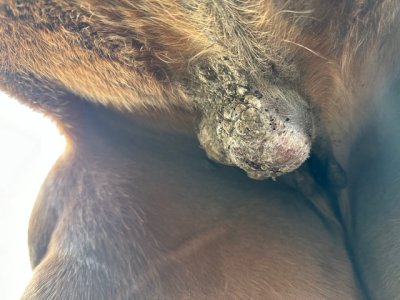
I have a horse in my care which belongs to one of our ex-freelancers, which has two large sarcoids and two smaller ones.

The horse has a few other, more acute health issues which is why the young lady who owns it has moved it to me. She hadn’t mentioned the sarcoids, I think purely due to the long list of more critical items that we are dealing with. She’s a lovely person who is doing everything she can for the horse.

The horse is 16 and currently being treated for her other medical issues at the owner’s expense - she is not insured. My vet, who is working with the owner too, has quoted about £4.5k to remove under GA. The horse would then need treatment with aldera cream and painkillers thereafter. The decision has to be leave, and watch.

I am happy to support this decision but I do have a duty of care for this horse, on our land, and I want to put into place some kind of framework for monitoring the horse and evaluating progression of sarcoids/ decline of wellbeing.

I know a few of us are in similar positions with horses. I just wondered what everyone’s thresholds are for welfare and what factors you are considering when you are working out where you are with that?
 
Mine had sarcoids which didn’t bother him in the slightest. Slightly different but when my old mare had a squamous cell tumour, my red line would have been if I couldn’t keep the flies away from it. Thankfully that didn’t happen and yellow summer fly cream was my friend. She was pts for unrelated reasons last year, well into her 30’s.

I’m guessing the mares ones are big if they need GA, because thats pretty unusual?
 
I’d be concerned that it would be getting pinched and squashed as the mare moves, or lies down/gets up. My homebred has had sarcoids in that area, and they caused her bother. They were small enough to band, though.

That would be beyond what I would accept - either remove or PTS, and if horse has other significant issues I wouldn’t put her through a difficult removal.
 
Last edited:
Yes, it doesn’t look like it’s in any form that would drop off.

She doesn’t react to them being prodded (according to the owner - I have not tried myself yet).

I can understand why she won’t treat it. It sounds like the process will be hell for the horse, and unlikely to be successful. She isn’t thinking of putting the horse down at the moment so I want to keep a handle on what deterioration looks like, and how fast that progresses.

The difficulty I have is in establishing how the horse is feeling, in relation to the sarcoids. Horses are stoic at the best of times and this horse also has a lot of other things going on. It is going to be difficult to establish what, if any, of her issues are related to the sarcoids.
 
Last edited:
Personally, I wouldn’t class that as a welfare issue that definitely needed either intervention or pts. It might evolve into that situation but on a horse with other medical issues I’m not sure I’d be rushing to surgically remove either. There will be some nuances to it though.
 
Personally, I wouldn’t class that as a welfare issue that definitely needed either intervention or pts. It might evolve into that situation but on a horse with other medical issues I’m not sure I’d be rushing to surgically remove either. There will be some nuances to it though.

I want to give her some constructive things to measure and watch. The colour, shape, size and margins on it seem like obvious ones to me. Would you have any other suggestions which might go more to comfort / pain measurements? I’ve not had one with sarcoids before so I’m not quite sure how to gauge how uncomfortable they are with them.

(Horse is lame in front and has ulcers, just finishing a course of omeprazole at the moment).
 
I have a gelding with one like this on the outer skin of his sheath. Its checked once a year by the vet under sedation. Its hard, not painful, and never been any trouble, but this time the vet may try and reduce it as its almost the size of a golfball. I wouldn't worry too much.
 
Her welfare is not compromised atm .
Treatment is not always the best option and there no black and white way always to get it right .
Thebowner will need to be prepared to PTs quickly if things change in the meantime leave well alone keep the horse as stress free as possible and in best health she can be in .
 
With the location of it my watch list would include;
The horse stifling it's movement and strides behind or lameness.
Kicking at her belly
Bleeding or injuries to the sarcoid itself
Ulceration
Flies at the sarcoid
Swelling to the area
Discharge
Change or growth of the area or sarcoid itself

Fingers crossed it doesn't cause any issues
 
This post may be of interest LG

 
My horse had a similar shaped sarcoid, but much smaller, half way along his underbelly. It became problematic in Summer with fly strike. I had to get it removed via standing operation. I think the sarcoid in the picture is very large and in a difficult location. I would be watching it like a hawk in Summer. If it becomes bloody and irritated with insect activity, then I think it will be a welfare issue.
 
I am pretty ignorant about sarcoids, but I think they are spread by flies in some way, they believe. So them that know is it important to try to stop cross spreading to OP’s horses or does that not really happen?
 
I am pretty ignorant about sarcoids, but I think they are spread by flies in some way, they believe. So them that know is it important to try to stop cross spreading to OP’s horses or does that not really happen?

I've read that it does happen, especially if the unaffected horse gets an open wound.

It's believed to be bovine papilloma virus spread by fly bite. I don't think I'd knowingly take a companion with the virus, and certainly not one that looks as if they could ulcerate and attract flies at any time. Having said that, I've had many horses with non-ulcerated sarcoids over the years and never seen them pass from one of my horses to another.
.
 
I am pretty ignorant about sarcoids, but I think they are spread by flies in some way, they believe. So them that know is it important to try to stop cross spreading to OP’s horses or does that not really happen?
This happens I have seen some awful photos where flys moved the virus from a horse in hospital to a horse with wound in the next stable .
If flys get on a sarcoid and make it raw all your horses are in danger if they get a wound so in summer you need to be very very vigilant . This also includes when the sarcoidosis is treated I have been given in the past anti viral creams to buy on sites to reduce the risk, various things have been used over the years and the protocols keep changing .
Never put anything on a sarcoid without checking with the vet or you must use nothing that encourages cell production because that’s the opposite what you need to do .
If other horses have wounds keep them covered I have used fly strike cream ( for sheep )in the past put you need to check want vets advise now because I have seen huge changes over the years as thinking changes .
Its extremely important to keep effected horses well and happy stress is the trigger for sarcoid to appear .
Thats why you hear of someone buying a horse and it arriving after a long journey with a sarcoid that everyone has missed .

I buy horses with sarcoids because I can’t bare the thought them being turned down because of something like this ,I think I was effected by Fatty who had several sarcoids when he arrived in my life he was also very very ill with a heart condition triggered by a virus . After we got Fatty well he never sprouted another because we had him happy relaxed and well.
 
My pony had one like that on his sheath, that my vet removed (cut it out) by standing sedation in his stable and sitched up the wound. I dont remember it getting infected, but he was on pain relief and antibiotics for a good week or 2. They did grow back slowly, but he was an older horse and was PTS for other reasons. Is there a reason it needs to be GA? I really dont remember my boys bleeding much.
 
I've seen an arab in a ridden class with an open sore type sarcoid red and angry about the size of the one in the picture. Was suprised it was a. Actually at the show and b. That the judge didn't send it out of the ring. But back to this horse, I don't think it is a welfare issue at the moment but it needs a close eye keeping on it and get the vet if it bleeds or becomes a magnet for flies and takes the advice of the vet.
 
What are the lameness issues? Is the horse likely to end up being pts because of those alone?

At the moment I would be listening to the advice of the vet, but tbh I would not be happy having that horse on my yard and potentially affecting my own horses. The one under her chin, for example, she could easily rub on a stable door or fence, and pass the virus that way. I never ever had problems with sarcoids until I moved to a farm which had had cattle on it for generations, but no horses since the 1930s. Practically everything sprouted sarcoids after that (the bonus was that worm counts were extraordinarily low) from fencing and buildings.
 
This post may be of interest LG

I wish I had photos of the sarcoid mine had high up on the inner thigh of his hind leg almost between his bum cheeks. It was huge and kept getting larger - not quite as large as this one but it wasn't far off tbh. 6 or so months on the oily herbs and I kid you not 3/4 of it died and fell off. It's been almost 2 years on the oily herbs and is just a small lump- less than the size of a 20p coin and continues to shrink. It is worth a try.
 
Conversely I have had horses with sarcoids that have shared fields with others for years without any spreading incidents, same as at my current yard - Dex's fieldmate is covered with them, big open angry ones and his have all disappeared *touch wood* (he popped up a few after arriving but he was on single turnout then so I think that was stress related rather than from transmission, as they wouldn't have shared anything)
 
Top