Sarcoids, your experiences good and bad please.

ycbm

Overwhelmed
Joined
30 January 2015
Messages
61,638
Visit site
There another thread running at the moment where a video has been posted with the world's leading expert in sarcoids has said that horses with sarcoids 'need treatment' and 'have no value'. He has also used pictures of the most horrendous cases I've ever seen, and the whole thing seems set up to scare people.

I thought it might help get things in perspective if we all share our experiences of horses with sarcoids . I'm very sorry if anyone has lost horses to this horrible disease. There's no doubt they can be a real problem. But the implication in the video is that they all become a real problem, and I think there may be a different perspective from the general horse owning population.

So, to get an idea of how bad a problem they really are, can people list all the horses they have known with sarcoids, how many each horse had, what treatment was given and what happened to the horse. I'll start.

A view of the attitude to sarcoids in Ireland would also be helpful, as I have repeatedly heard that they are not considered such an issue over there.


1. Multiple sarcoids on chest and front legs in 4 year old Arab. Frozen off, returned, removed chemically. Sold at seven sarcoid clear.

2. One warty one with neck on inside thigh in 4 year old tb. Twisted off, never returned. Sold at seven sarcoid free.

3. One formed on an open wound stopping it healing. 4 year old TB, Removed chemically, never returned. Still sarcoid free at nineteen.

4. Ball type in groin of 6 year old ISH. Tied off and root chemically treated. Last known at 13, sarcoid free.

5. Ball type on chest of 6 year old ISH. Tied off and root chemically treated. Sold at eleven sarcoid free.

6. Multiples on belly, inside thigh and face of 4 year old ISH. More developed over the following two years. All chemically treated and sold at eight sarcoid free for two years.

7. Two on belly of 3 year old Appyxtrotter. Chemically treated, just healing now.


Those were all mine.

Friends:

Cluster on fetlock of 7 year old WB . Chemically treated, returned, treated again. Fine three years later.

Ball type in armpit of ISH 4 year old. Never treated. Now 24 and shrunk almost to nothing.

Cluster on shoulder of 5 year old Irish cob. Chemically treated and sold.

Several on eyelid of teenage PC pony. Physically removed and pony sold.

One on sheath followed by one on groin, fibroblastic (bloody and quick growing). Both lasered off and healed. Horse died of colic following year at 23.


Sorry again if this upsets anyone who has lost a horse to them, but if you can bear to share your information then I think it will help everyone.
 
Copying from the other thread to save typing it again.


I have had, surprisingly considering how many horses I have had through the yard, very little experience of sarcoids, from memory I bought one with a couple many years ago, they were frozen, at the time it was common, the last was cut out under sedation, he was sold on so no idea whether they came back.
The second a livery, homebred with no signs of any until she moved area, they were treated with LC while they were tiny, she stayed clear of them.

The third also a livery purchased with a few tiny ones, they were treated successfully at home, he was a quality horse bought at half his value by my client, he had originally changed hands from his breeders again for well under his value and later sold by my client for less than he would have been but he still had a decent value because he did a job and was still desirable to the right buyer.
In many ways it is something that is obvious and anyone buying can make an informed decision and decide whether the benefits outweigh the risk, unlike the many other conditions that horses may have hidden away and do not get picked up on a vetting, I would consider buying one with them if it was priced right and ticked all the boxes, so I don't think they have no value, there are many other conditions I would be less willing to gamble on but maybe that is because my experiences have not been really negative. out of hundreds through my hands to have had only 2 with them is possibly unusual and makes me wonder if it is something that comes in clusters or areas for some reason.
Read more at https://forums-secure.horseandhound...-treatment-(videos)/page3#4K5psRtgQybI2CD1.99


I cannot think of any others that have been owned by me or at livery that had them and of my other clients over the years I remember one with a small one that was tied off, I forgot earlier that I did have a pony with a flat area on his side, he was not very healthy when he came and after a year or so of better food, more work it reduced to just about nothing other than a rough area under the hair, so make it 3 here not 2. I have had more colics, and lost one to melanoma at a young age.
 
I've only known of two neither I owned:

One pony with a single sarcoid in girth area. it was treated but came back and them treated successfully a second time with cream, pony competes national level in dressage and is now out for loan (owner can't bear to sell so might be a LWVTB)

One horse on the yard was repeatedly treated for multiple & returning sarcoids which needed the full chemical treatment. Horse was becoming increasingly unhappy with treatment and the levels of chemical in his body was making it more difficult to treat each time. He was sadly put down at age 9 when the sarcoids and treatment began to negatively impact his quality of life. (it became impossible to keep him comfortable and happy despite every effort)
 
I needed up buying mine for £1 because he had them. He had 9 lasered off and they came back so treated with Liverpool cream and now he has one, in his armpit and under the skin that I think was missed in the treatment. This would have been costly all together if insurance hadn’t paid. Leaving them wasn’t an option as they were regularly eaten by flies.
 
I've known (not owned) of 2 through yards I've been on.
Horse 1 had a small, flat, scaly one on the outside corner of its eye - roughly the size of a 5 pence piece. It was ignored and not treated and went away 18 months later.
Horse 2 was purchased (unseen - facepalm) without any sarcoids disclosed. It was delivered to the new owners in a full-neck rug, they removed the rug and found the horse covered in them; apparently they counted over 50. Owners started feeding tumeric and put the tumeric paste on the sarcoids too. 6 months later they'd all disappeared. Horse was sold 3 years later with no sarcoids.
 
My last horse had a tiny nodular one on his sheath - caused no issue and never changed.

Current horse has always had flat verrucoidal (sp) sarcoids in his arm pits (looks like old grey elephant skin!) and he has what looks like, again, dry elephant skin above his right eye. Sounds worse than it is! We hardly notice them! I've had him nearly 8 years and while they have spread a bit they haven't really caused any trouble. In the last couple of years he has very occasionally grown a kind of nodule sarcoid from the flat ones that quickly burst and heal, but as long as we keep them clean while they are open in the first few days they are ok (Vet has seen them when necessary and agreed). As they are dry and flat they don't seem to irritate him -I did try thuja cream under his armpits but it made the whole area pink and raw whereas the dry elephant skin, that is there when left alone, seems to cause no issues.

I'd never be put off a horse for Sarcoids as long as they weren't in an area that interferes with Tack or were very large nodular types.

I have been lucky probably and have seen some terrible sarcoids so I understand the risk in buying a horse with them but I think its wrong to say they have no value.
 
My experience with sarcoids was not good! I bought a 4 yr old section d mare in 1990. She had a small dot over one eye that the vet said was a foal wart and nothing to worry about. In six months she had growths around the eye and grey patches under her hind legs. The occult ones around her eye were surgically removed and cryosurgery was done on the hind legs. She then had bcg injections around the eye. Everywhere she had had surgery erupted with new growths. I battled with them for over 20 years with Liverpool cream, ringing,surgical removal and spent thousands of pounds. Each treatment caused more growths and by the end she was more sarcoids than horse and lost the sight in one eye. She was a lovely mare and bore it all with the patience of job. I would nowadays leave sarcoids well alone and hope for remission. Any condition that has more than one treatment shows that it doesn't work or there would be only one way to go! The only treatment I don't have experience of is laser treatment as it wasn't available.
 
I was loaned an 11 year old, grey roan ISH. He had one smooth sarcoids inside his sheath which was about the size of a pea. Over the next eight years the sarcoids proliferated and grew. They were all smooth and mostly in clusters. His sheath was visibly extended but the horse showed no discomfort or difficulty passing water. He made a great deal of that gooey, black stuff (smegma?) and his sheath would stink if I didn't keep it scrupulously clean which he did not object to at all. No treatment possible due to location of sarcoids. Horse pts last April with acute hind laminitis.
 
Two horses, one on loan, one owned.

The first one (loan) had one under his belly but not interfering with girth. Had to keep an eye on it as occasionally it bled in the summer and would attract flies. Discussed with vet, agree to monitor any size increase. Then one day it simply dropped off (after c 4 years) leaving a little pit. This was treated as a wound, healed and never came back. He also had a few small nodules on his sheath which never developed into anything bigger. PTS with colic aged 19.

Current horse (owned) was bought with a largish (21/2" by 1") occult sarcoid on his face. At that time it had raised nodules and I padded his hedcollar noseband and rode without a noseband. I then, after reading about it on here, tried the toothpaste treatment because he was headshy and I was reluctant to use anything which might make that worse. The nodules dropped off and he now has just a patch of "elephant skin" as described by the earlier poster. His headcollar is no longer padded and I ride with a cavesson noseband. He does have a flymask with a nose to keep the sun off it in the summer and just occasionally he nicks it if he's been rubbing his face on something, at which point it gets a dab of antiseptic cream. Fingers crossed but five years on, it hasn't changed. He also has a couple of small nodules on his sheath but I leave those well alone.

Brother-in-law's pony in Ireland had much larger sarcoids which eventually meant that he could not be bridled and were a contributory fact to being PTS but he was an old man by then.

ETA I recently had a fascinating conversation with my dental hygienist about the brand of toothpaste I had used. She revealed that she had used the same on her daughter's hard-to-shift veruccas and they had just dropped off!
 
Last edited:
I'm very much in the camp of - if they aren't interfering or getting in the way then leave them be. I've known horses to be creamed, surgically removed, lasered, banded etc all with varying degrees of success. I've always found that lasering leaves the least scaring.
 
My bought as a (just) 2 yr old cob developed a sarcoid on her muzzle aged 4. My vet decided that the best thing to do was excise it, which he did, at home under sedation, closing the wound with 6 stitches. 2 weeks later we removed the stitches, she has a small, barely visible scar and fortunately we have seen nothing of it since, 2 yrs later. Fingers crossed there is no recurrence.
She is the only horse that I have ever owned/known well that had a sarcoid.
 
I've had 4 horses with them. All youngsters, and IMO, lacking in immunity due to age/growing pains. They don't worry me, and I treat homeopathically/herbally to strengthen the immune system. That has worked well, although I had a friend lost a lovely 6 yr old who suddenly started erupting them everywhere.
 
There another thread running at the moment where a video has been posted with the world's leading expert in sarcoids has said that horses with sarcoids 'need treatment' and 'have no value'. He has also used pictures of the most horrendous cases I've ever seen, and the whole thing seems set up to scare people.

I thought it might help get things in perspective if we all share our experiences of horses with sarcoids . I'm very sorry if anyone has lost horses to this horrible disease. There's no doubt they can be a real problem. But the implication in the video is that they all become a real problem, and I think there may be a different perspective from the general horse owning population.

So, to get an idea of how bad a problem they really are, can people list all the horses they have known with sarcoids, how many each horse had, what treatment was given and what happened to the horse. I'll start.

A view of the attitude to sarcoids in Ireland would also be helpful, as I have repeatedly heard that they are not considered such an issue over there.


1. Multiple sarcoids on chest and front legs in 4 year old Arab. Frozen off, returned, removed chemically. Sold at seven sarcoid clear.

2. One warty one with neck on inside thigh in 4 year old tb. Twisted off, never returned. Sold at seven sarcoid free.

3. One formed on an open wound stopping it healing. 4 year old TB, Removed chemically, never returned. Still sarcoid free at nineteen.

4. Ball type in groin of 6 year old ISH. Tied off and root chemically treated. Last known at 13, sarcoid free.

5. Ball type on chest of 6 year old ISH. Tied off and root chemically treated. Sold at eleven sarcoid free.

6. Multiples on belly, inside thigh and face of 4 year old ISH. More developed over the following two years. All chemically treated and sold at eight sarcoid free for two years.

7. Two on belly of 3 year old Appyxtrotter. Chemically treated, just healing now.


Those were all mine.

Friends:

Cluster on fetlock of 7 year old WB . Chemically treated, returned, treated again. Fine three years later.

Ball type in armpit of ISH 4 year old. Never treated. Now 24 and shrunk almost to nothing.

Cluster on shoulder of 5 year old Irish cob. Chemically treated and sold.

Several on eyelid of teenage PC pony. Physically removed and pony sold.

One on sheath followed by one on groin, fibroblastic (bloody and quick growing). Both lasered off and healed. Horse died of colic following year at 23.


Sorry again if this upsets anyone who has lost a horse to them, but if you can bear to share your information then I think it will help everyone.

First mare ID/TB grew sarcoids after I purchased her - they were tied off with bands and never grew again
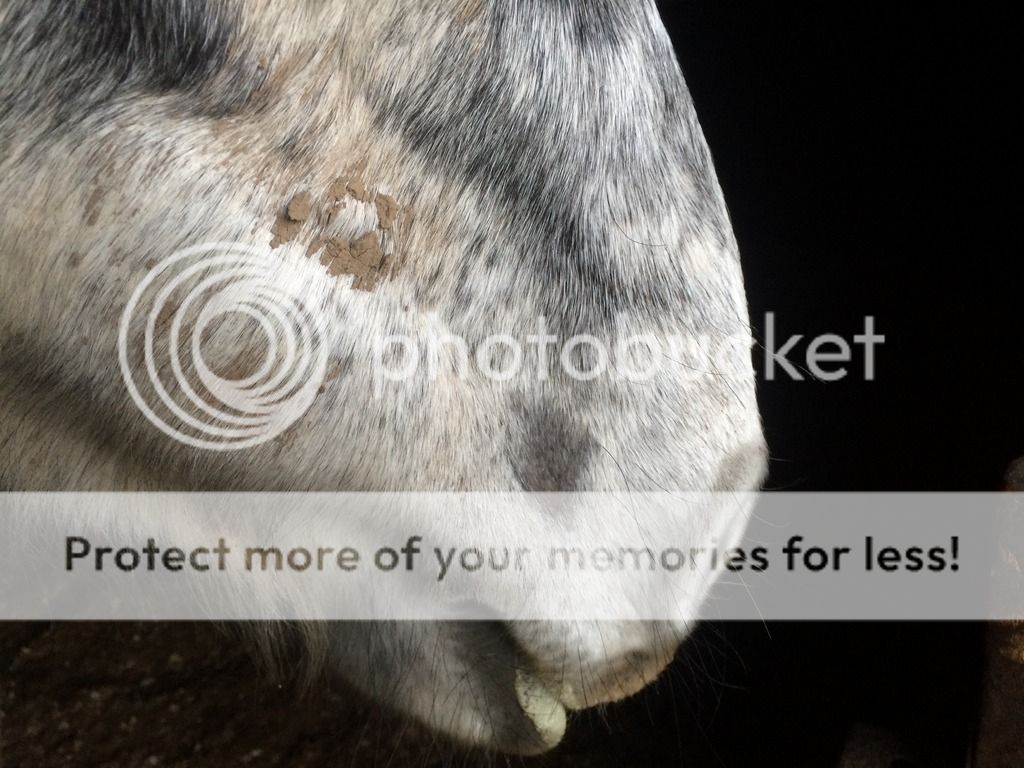
New mare ID had one on the inside of the thigh which was overlooked by the vet in the vetting , several more appeared after I bought her (unaware of the one on the inner thigh) all were treated with cream, the face one was pain to kill off and needed 3 teatments, but pleased to say it has died now and hair growing back, this was it in mid treatment. the dark circle on the side of her nose
Found_123350616_2185903_zps8inl9s7z.jpg


This one died also and was the one on the inside of the thigh
IMG_3409_zpssvumw7em.jpg


Any more that pop up will be dealt with.
 
Arthur, massive hand sized sarcoids on girth area, bleeding constantly, one on inside of hind leg. Taken off with liquid nitrogen when he was 6 (1989) one on inside of back leg made a reappearance when he was 29.

Rebel sarcoids size of a large orange on rear flank, one on inside of hind leg, one on sheath. Treated first with Liverpool cream, one on flank came back with a vengeance, lasered off two years ago. Fingers crossed and touching Wood they have not returned as yet
 
I've known quite a few that have had one or two, that were clear between 1 and 7 years after treatment by Liverpool cream (x3), laser (x1) and banding (x4), but as they weren't mine I couldn't vouch for them having stayed clear of them.

I have only owned one horse long term who had them, and still own him now. I bought him age 3 without any (that I noticed), he developed one nodular sarcoid on inner thigh in his 3yo winter that I left alone. Then developed a fairly savage fibroblastic sarcoid on his other inner thigh in his 4yo winter, which I had banded and it fell off. Then he had another fibroblastic next to the original nodular one and another nodular on his belly just in front of his sheath in his 5yo winter, both of which I had banded and they fell off. Since then the original nodular (which had always been small) has disappeared and no others have grown (he is now rising 9).

I will not treat this horse with any kind of aggressive cream as I'm pretty sure he would cope very badly. If sarcoids stop him being able to be ridden at some point then so be it - every horse gets stopped by something at some point. He also has PSSM, which for him is a far more limiting condition, but ironically the sarcoids would likely knock more off his market value.
 
We had one at work that had a ridge of wee sarcoids that ran from his whither to his knee is a single line. I clipped over it in, took the top layer of skin off- never broke the skin - and by the time the horses summer coat grew in the sarcoids had grown out and they never came back - well they havent in 7 years and the horse has never had another one.

I am sure I read of a new treatment a year or so ago where they cut off any/all sarcoids then freeze dry tiny bits of one of them before inserting them back into the horse just under the skin. This is theory is it is like a vaccine - you give a dead dose of something to build up an immunity in the system. I have no idea if it works or not. I've never seen it done. I can't even remember where I read it, it might have been in a racing magazine.
 
I had a horse on loan with a large sarcoid on a thin stalk on his stifle, we banded that off without an issue... I only kept him for about 2 years so i don't know whether he remained free of any others after that.

I know of another who developed a quick growing sarcoid in the armpit which was treated with liverpool cream and healed well (but slowly)

And a further one which a friend had the ride on, which popped up a new sarcoid every week or so it appeared. They were often in the way and bleeding :( the horse had no treatment. It was a fantastic SJ horse but heartbreaking to see really, it looked a mess. I don't know what happened in the long term.
 
horse 1 - cob gelding, bought with saroids, one one chest and inside his hind leg, ive no idea of they type, but they looked like fingers popping out of him and would bleed. He had liverpool cream on both, they dropped off after afew weeks and never came back. we lost him 15 years later to an unrelated health problem.

horse 2 - started getting them after owning him for about 10 years, with nothing. He had them in his armpit and sheath area. they where removed once with a band (armpit) and cut out on his sheath. Smaller ones did grow back after a few years, but we lost him before they caused any problems, due to an unrelated issue.

we bought and paid for both the horses, so they certainly did have a value and were the best horses money could buy :)
 
I've not had a horse with sarcoids (touch wood). I've known two though, both in England. I've not seen a horse with sarcoids here in Ireland as yet.

Horse 1 - Young cob (around 5) developed a few sarcoids on head shortly after purchase. Didn't interfere with bridle. Not treated except put on Sarcoid X supplement. Sarcoids disappeared within 6-9 months and hadn't reappeared last time I saw him (around 2 years later).

Horse 2 - Older gelding, Welsh x, maybe 13-14 yrs. Had always had a few sarcoids which didn't change and weren't touched. Developed one on his eyelid which had to be removed, first treatment (freezing I think) failed and had to go into horsepital for operation to remove which was expensive and not covered by insurance. Hadn't returned last I knew, 3 years later. Pony was outgrown and put out on loan, selling wasn't an option for owner so wasn't attempted.
 
Cob gelding who had some on his sheath. Initially they were small lumps under the skin, after consulting with vet, we left well alone as they didn’t seem to affect him. Stayed like that for 3-4 years. Then one erupted and became like a ball on a thread. Vet considered treatments with us, and given age, location and fact horse was good in himself, we didn’t treat. Flies were the issue, and keeping the area covered and fly free was the biggest challenge. Fine over winter, but didn’t ant another battle with flies. Booked vet to band, but it was too big. Vet advised to leave. Decided to try sar-x. 6 months later it fell off and left really neat wound (no idea if sar-x helped or if it would have come off anyway). There are still further lumps under the skin but they haven’t changed - that it was ruled out more aggressive treatments as the concern was it would aggravate the other ones. Horse happy and at 22 still going well.

I suspect that there are as many sarcoid stories as there are sufferers. And there is no doubt that for some this is fatal. It doesn’t write off every horse that gets them though.
 
The 4 we've owned over approx 25 years and 35 horses horses and ponies...

1. 8YO ex racer developed large nodular one on the withers, she also proved herself to bolt at tannoys at the same time so retired to being someones pet. She lived a normal length life but was never able to carry a saddle again- wasn't treated in any form.
2. 6yo welsh A, 1x nodular under where driving collar goes at centre of a whorl, tied off, failed, banded off, failed, liverpool cream, went and so far (sold at 10, still in contact) no more.
3. nodular on 14yo welsh A sheath, liverpool cream, removed it, tbh he's semi retired now and grey so I've not looked at him that hard to know if any have come back but was competing for team GB last season without bother.
4. mixed sarcoid on welsh type 6yo upper eyelid, high dose radiation, failed, repeated and so far touch wood.... There is no plan B for him.
 
One first hand experience of sarcoids. My TB mare would have a few nodular sarcoids, usually they would grow to the size of a marble then drop off. One then developed at the inside top of her off hind leg. It did grow rather rapidly over a couple of months so she was treated with Liverpool Cream. Small amount of scarring and it looked worse before it looked better during the treatment. That was 4 1/2 years ago and to date she's had none return.
 
I think I've only known one in all my time about horses, multiple between back legs and he used to have them surgically excised every couple of years or so.

I'm mostly mentioning it because I was surprise when I thought about it how few I think I've known with them.
 
Ok here’s mine

Bought horse small area of disturbed skin on sheath I looked vet looked and decided if was probably a small scar turned out it was probably the site of a sarcoid removal because a sarcoid popped up there six months later treated with Liverpool cream never had an issue again .
Tb got sarcoid on an op site ( tie back ) surgically removed no further issue later got a small sarcoid on tummy treated with Liverpool cream no further issues there to date .
WB one sarcoid on sheath Liverpool cream no further issues to date .
Fatty came with one nodular sarcoid which dropped off before treatment was soon back and also several others all removed with laser except on his stifle which was cut out because of the site .
He had four further bouts of lasering over a few years and had some sort of immune booster injections and has not had one in five years fingers crossed .
 
Ok here’s mine

Bought horse small area of disturbed skin on sheath I looked vet looked and decided if was probably a small scar turned out it was probably the site of a sarcoid removal because a sarcoid popped up there six months later treated with Liverpool cream never had an issue again .
Tb got sarcoid on an op site ( tie back ) surgically removed no further issue later got a small sarcoid on tummy treated with Liverpool cream no further issues there to date .
WB one sarcoid on sheath Liverpool cream no further issues to date .
Fatty came with one nodular sarcoid which dropped off before treatment was soon back and also several others all removed with laser except on his stifle which was cut out because of the site .
He had four further bouts of lasering over a few years and had some sort of immune booster injections and has not had one in five years fingers crossed .

GS - I am interested in the immune booster injections Fatty had. The guy I use for laser is world renowned and he hasn't mentioned this for my horse, but i'm keen to explore as a possibility.
 
Ones I have owned/loaned myself

A teenage mare I loaned whose owner had her from a 6yo. She had ulcerating nodular ones in her groin - in the time I knew her they were never treated, they would grow a bit, go manky and pop out, heal over and then the cycle would repeat.
She was put down mid 20’s for unrelated reasons and worked into her late teens.

My dressage mare I suspect had a flat one on an inner thigh. It might not have been. It never changed, never caused a problem and I never treated or even showed the Vet.

My current horse I bought with 2 sarcoids. One nodular ball type with a clear neck, on his midline just in front of sheath. I had that banded, no sign of regrowth but early days. The other is a small nodular on an inner thigh, no bleeding/ulceration and no change of shape. If I were keeping him I wouldn’t touch it unless it grew, in which case I’d do whichever treatment the Vet suggests. As he is for sale I might need to consider removing it which I’m loathed to do.

Of ones that weren’t mine only one was horrific, it was a livery that was put down fairly young due to sarcoids that kept erupting all over his body
 
Mine is grim I’m afraid. 10yo TB had no evidence of sarcoid when I bought him, however after about 1 year I noticed he had trouble urinating. On investigation it was discovered he had small sarcoid right up on his willy. It was surgically removed and all healed well, however about 2 years further on another one appeared high up in his groin which grew very fast. We tried the lamb ring but although it dropped off it kept growing, so we consulted Professor Knottenbolt and used the cream.

Although it stopped the growing, the area never healed properly and after several months we had an open (not deep) wound about 2” diameter which then erupted with lots of small growths round the edges. It gradually increased in size at which point I felt that although the horse was well otherwise, he was finding it increasingly uncomfortably and decided that I would PTS as summer approached. This was February time.

Unfortunately, about a week after I’d made that decision I went to bring him in from the field and discovered that he was standing in a pool of blood and very reluctant to move. I called the vet and said that he needed to come out immediately and PTS, brought my lovely boy in and the deed was done. It transpired that somehow the wound had ruptured causing catastrophic loss of blood - something to do with the root of the sarcoid.

I am well aware that all sarcoids behave differently, but that experience was so horrific I will never take the risk again.
 
Ok, so I bought my boy about three years ago . ISH 5 year old, blue and white in colour. no signs of any sarcoids on vetting, but within a year grew two in the wrinkles inside front leg "armpits" one each side. the flies seemed to gather there and aggravate them as they were in the wrinkly folds of the skin. They never affected his ridden work and he didn't show any particular discomfort. but when he got hot and sweaty particularly after work or turned out in hot summer the flies were attracted there and seemed to make them bleed( sort of eating them ?) i have heard they can cause sarcoids to spread this way ?

I used a thick sunblock called filtabac cream to cover them when he was turned out. one side was just a small grey flat one and other was a sort of nodule with a small stem, I gave him thuja tablets and cream for several months and the flat one shrunk and disappeared. the nodular one shrunk but didn't go away, so one day i popped a rubber band round its stem and a few days later it dropped off, left a small wound which i treated with antiseptic and and again covered with Filtabac cream. that was a while ago and ( touch wood) they have not returned. I do wonder if sarcoids often could be result of a compromised immune system or stress as my boy came from ireland from a dealer , quite poor and "shut down" when i got him and while i know i can't guarantee they wont return he is now fit and healthy- and i do check him regularly for signs of return.
when he had his vaccinations last year i told my vet what i had done and showed her the site where they had been and she didn't seem to worried and said to just keep eye on him ( although I realised i could have made it worse by banding it myself)

Another at same yard, not my horse, a little welsh C mare had a huge one under her tummy by her "udders" owners had her treated with liverpool cream around same time I was treating my boy and it shrunk and then dropped off but it took several months and the wound took a while to heal, i believe she is now sarcoid free as well.
 
Last edited:
I do wonder if sarcoids often could be result of a compromised immune system or stress

My one with multiples used to chuck out another when stressed by a move of home, or a three day camp, for example. Lots of people report new sarcoids appearing shortly after buying a horse. I think you are right on both counts. Horses with a strong immune system can seal them off and hold them at bay.

I've been looking up quarter horses and appys because I've only ever had two with multiples, and they were those breeds, which are closely related. There does seem to be evidence of a higher predisposition in both those breeds, and apparently lower in standardbreds. I guess my appyxstd picked up the wrong set of genes!

This is really useful information, thanks everyone. Sorry everyone who has lost a horse to this foul disease. I would certainly never recommend anyone to buy a horse with multiples, they seem to be a lot more of a problem than singles. It took two years to get mine clear, he just kept popping up another in a new place. Or one with anything near the eyes, just too risky.
 
Top