
Boodles
Well-Known Member
I have a 4yo who is both coloured and spotted.
His sire is a loud leopard spot who is also coloured (a minimal tobiano, just a couple of white patches on his neck and he has stockings). He in turn is by a few spot Appaloosa stallion out of a coloured mare, so could only have had one copy of the spotty genes - importantly for my question (which I will write much later on down when I've given the preamble!) the PATN gene. (Unless his dam was hiding a copy of the PATN gene which I suspect is unlikely.)
My 4yo's dam is a dark bay (seal brown) solid-coloured mare with no history of colour or spots even generations back as she's a registered native pony.
So my 4yo's colourful genes can only have come from his sire - so he can only be heterozygous for anything colourful.
He is heterozygous for the cream gene, the coloured (tobiano) gene and for the spotted (Lp) gene.
BUT... I am unsure how to class him and hypothetically predict what colours he may produce spot-wise (he is a stallion and I intend to use him on two of my mares, not for resale) with regards to the PATN gene which of course governs the production of spots.
Hypothetically he could've inherited the PATN1 gene from his sire (he passed it to several of his foals in addition to the Lp gene making them leopard spots or near-leopard spots.)
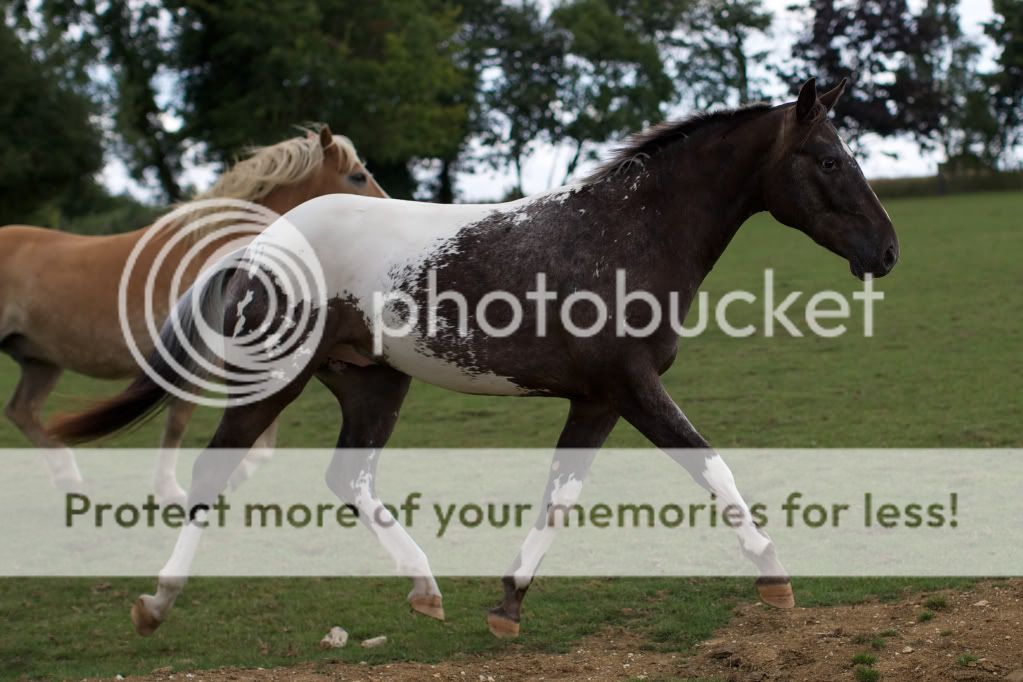
But it's my understanding that he should be spotty over at least 60% of his body if he has both the Lp gene and the PATN1 gene. And he's not. He had a small patch of frosting on his quarters as a foal, and as the varnish roaning has spread as he's aged, it's uncovered a few black spots - and they are definately black, not the colour of his coat - which weren't so visible when he was younger.
Without the presence of these black spots, I'd accept he was just exhibiting one copy of the Lp gene, no PATN gene, and was a varnish roan. But I'm sure I'm right in thinking that to have different coloured spots, they can't just be due to the Lp (varnish roan) gene itself?
As they are only found over a small area of his body, I'd class him as a blanket spot rather than a leopard spot (although the white he had as a foal isn't underneath the spots, the ApHC still class that as an Appy marking, the black spots) so I'd say he is exhibiting a copy of the hypothetical PATN (or PATN2 depending on what model you listen to) gene to code for blanket spot over a smaller area than the leopard spots (PATN1) exhibit their spots.
BUT! As his sire is likely to have only had one copy of the PATN gene, and this is proven in his phenotype to be PATN1 as he is a leopard spot, is my 4yo actually showing the PATN1 gene in his coat, just in a repressed state?!n Because where could he have got a PATN2 gene from?!
I love colour genetics and am really interested in them hypothetically as well as in relation to what he may or may not pass on to any foals.
Not a great picture, but the most recent one I have of him...

Sorry this got so long! Obviously I'm discounting his tobiano patches from all of this, I find them totally straightforward to distinguish and predict inheritance of!!!
Thank you so much if you got to here!!!
His sire is a loud leopard spot who is also coloured (a minimal tobiano, just a couple of white patches on his neck and he has stockings). He in turn is by a few spot Appaloosa stallion out of a coloured mare, so could only have had one copy of the spotty genes - importantly for my question (which I will write much later on down when I've given the preamble!) the PATN gene. (Unless his dam was hiding a copy of the PATN gene which I suspect is unlikely.)
My 4yo's dam is a dark bay (seal brown) solid-coloured mare with no history of colour or spots even generations back as she's a registered native pony.
So my 4yo's colourful genes can only have come from his sire - so he can only be heterozygous for anything colourful.
He is heterozygous for the cream gene, the coloured (tobiano) gene and for the spotted (Lp) gene.
BUT... I am unsure how to class him and hypothetically predict what colours he may produce spot-wise (he is a stallion and I intend to use him on two of my mares, not for resale) with regards to the PATN gene which of course governs the production of spots.
Hypothetically he could've inherited the PATN1 gene from his sire (he passed it to several of his foals in addition to the Lp gene making them leopard spots or near-leopard spots.)
But it's my understanding that he should be spotty over at least 60% of his body if he has both the Lp gene and the PATN1 gene. And he's not. He had a small patch of frosting on his quarters as a foal, and as the varnish roaning has spread as he's aged, it's uncovered a few black spots - and they are definately black, not the colour of his coat - which weren't so visible when he was younger.
Without the presence of these black spots, I'd accept he was just exhibiting one copy of the Lp gene, no PATN gene, and was a varnish roan. But I'm sure I'm right in thinking that to have different coloured spots, they can't just be due to the Lp (varnish roan) gene itself?
As they are only found over a small area of his body, I'd class him as a blanket spot rather than a leopard spot (although the white he had as a foal isn't underneath the spots, the ApHC still class that as an Appy marking, the black spots) so I'd say he is exhibiting a copy of the hypothetical PATN (or PATN2 depending on what model you listen to) gene to code for blanket spot over a smaller area than the leopard spots (PATN1) exhibit their spots.
BUT! As his sire is likely to have only had one copy of the PATN gene, and this is proven in his phenotype to be PATN1 as he is a leopard spot, is my 4yo actually showing the PATN1 gene in his coat, just in a repressed state?!n Because where could he have got a PATN2 gene from?!
I love colour genetics and am really interested in them hypothetically as well as in relation to what he may or may not pass on to any foals.
Not a great picture, but the most recent one I have of him...
Sorry this got so long! Obviously I'm discounting his tobiano patches from all of this, I find them totally straightforward to distinguish and predict inheritance of!!!
Thank you so much if you got to here!!!


 As people either love him or hate him! Not sure how to post pictures though!


