Spotty Genetics Help Needed Please!

Boodles

Well-Known Member
Joined
31 March 2010
Messages
62
Visit site
I have a 4yo who is both coloured and spotted.

His sire is a loud leopard spot who is also coloured (a minimal tobiano, just a couple of white patches on his neck and he has stockings). He in turn is by a few spot Appaloosa stallion out of a coloured mare, so could only have had one copy of the spotty genes - importantly for my question (which I will write much later on down when I've given the preamble!) the PATN gene. (Unless his dam was hiding a copy of the PATN gene which I suspect is unlikely.)

My 4yo's dam is a dark bay (seal brown) solid-coloured mare with no history of colour or spots even generations back as she's a registered native pony.

So my 4yo's colourful genes can only have come from his sire - so he can only be heterozygous for anything colourful.

He is heterozygous for the cream gene, the coloured (tobiano) gene and for the spotted (Lp) gene.

BUT... I am unsure how to class him and hypothetically predict what colours he may produce spot-wise (he is a stallion and I intend to use him on two of my mares, not for resale) with regards to the PATN gene which of course governs the production of spots.

Hypothetically he could've inherited the PATN1 gene from his sire (he passed it to several of his foals in addition to the Lp gene making them leopard spots or near-leopard spots.)

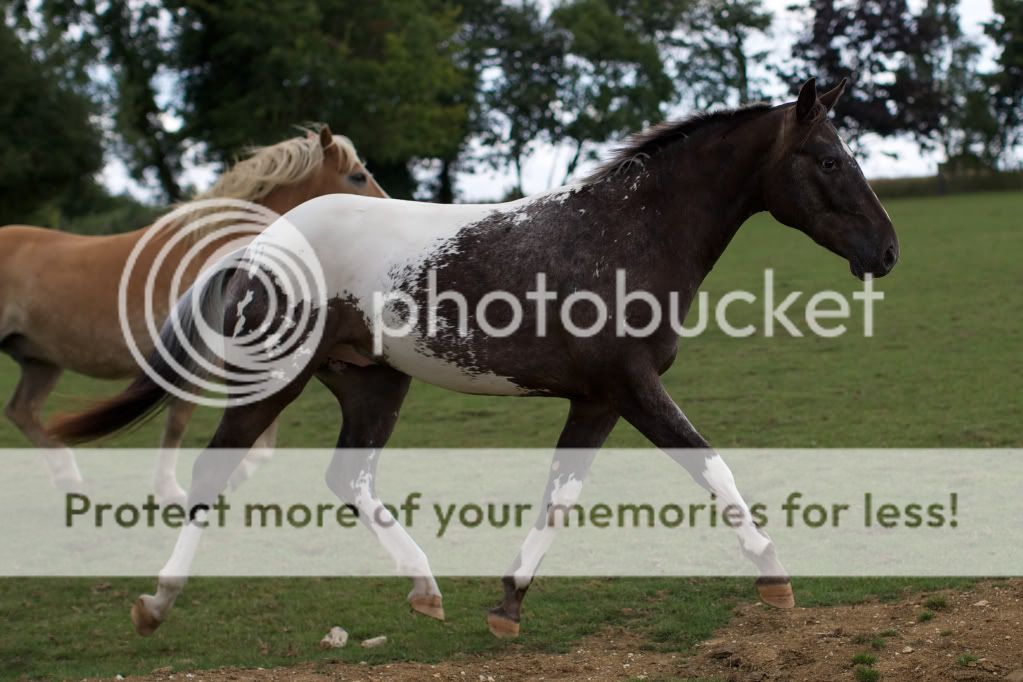
But it's my understanding that he should be spotty over at least 60% of his body if he has both the Lp gene and the PATN1 gene. And he's not. He had a small patch of frosting on his quarters as a foal, and as the varnish roaning has spread as he's aged, it's uncovered a few black spots - and they are definately black, not the colour of his coat - which weren't so visible when he was younger.

Without the presence of these black spots, I'd accept he was just exhibiting one copy of the Lp gene, no PATN gene, and was a varnish roan. But I'm sure I'm right in thinking that to have different coloured spots, they can't just be due to the Lp (varnish roan) gene itself?

As they are only found over a small area of his body, I'd class him as a blanket spot rather than a leopard spot (although the white he had as a foal isn't underneath the spots, the ApHC still class that as an Appy marking, the black spots) so I'd say he is exhibiting a copy of the hypothetical PATN (or PATN2 depending on what model you listen to) gene to code for blanket spot over a smaller area than the leopard spots (PATN1) exhibit their spots.

BUT! As his sire is likely to have only had one copy of the PATN gene, and this is proven in his phenotype to be PATN1 as he is a leopard spot, is my 4yo actually showing the PATN1 gene in his coat, just in a repressed state?!n Because where could he have got a PATN2 gene from?!

I love colour genetics and am really interested in them hypothetically as well as in relation to what he may or may not pass on to any foals.

Not a great picture, but the most recent one I have of him...

1525170_10152071975801014_1014113153_n.jpg


Sorry this got so long! Obviously I'm discounting his tobiano patches from all of this, I find them totally straightforward to distinguish and predict inheritance of!!!

Thank you so much if you got to here!!!
 
I'm sorry but I really can't see the justification for breeding from a spotted horse which is unregisterable with either of the Appaloosa societies, so to me the question is moot.
 
Hey, sorry can't help with the Genetics side of things but just wanted to say how much he looks like my boy!! :O What is his breeding?! My boy's colour is classed as Pintaloosa (which is basically the result of crossing a coloured (Paint) horse with an Appaloosa if that's any help. I will post you a photo of my boy in a moment. :)
 
The genetics thing just took a complete detour round me, as I find it far too confusing, but I couldn't not say what lovely looking horses they both are!
 
Thank you Wheels and spotty_pony :-) .

s_p he's by an Appaloosa x coloured native-type stallion called Murphy who ran on the nature reserve in Christchurch in Hampshire for 4 years until 2010 (first crop of foals 2008, last crop 2011). Murphy's sire is Cockaroost Pazaz who has sired quite a few part-bred Appys in the New Forest area, although he passed away a couple of years ago I believe. And his dam was a coloured native-type pony.

My 4yo (pictured) is out of a New Forest mare who's by Farrier's Rambler. Murphy ran with a herd of (solely I think) New Forest mares, so all his progeny (I think) are half NF.

Love to see a pic of your boy!

Pearlsacarolsinger - I'm not really interested in registering any horses with the ApHC or BAPS - as they are less than 50% Appaloosa BREED then as you quite rightly say, they're not eligible (though the BSPS (British Spotted Pony Society) WILL register any horse with spots, regardless of parentage, AND will licence any stallion with spots. They don't offer a grading system, just a licencing one.)

I wasn't asking whether I SHOULD breed from my boy, am just interested in the colour genetics side of things. I like spotty horses, and coloured ones, and as the likelihood is that the only foals I will breed from him will be for me to keep forever and ever, surely that is my own perogative?

I think the biggest reasons not to breed from a horse are poor conformation, poor movement and a poor temperament. Not whether the colour produced will be eligible for any particular breed/type society. Unless that's what's being aimed for - if I was wanting to breed horses to take part in part-bred Appy classes then no, there wouldn't be any purpose in breeding from my boy as he wouldn't produce horses to fit that criteria unless he was bred back to a 100% Appy. And I have no reason to do that.

I think each to their own :-) .
 
I think horses who are coloured and spotted are a bit like Marmite - some love them, some hate them!

Your boy is lovely s_p :-) . He looks a little like an appiano/pintaloosa I had with me a couple of years ago. How is your boy bred?

JustKickOn - thank you! And I love color genetics BECAUSE it's complicated LOL!!! And it's really interesting working out what gene does what and how to predict possible colour outcomes. Some might say it's a bit geeky to think about all that though LOL!!!
 
Photo is now above! Yours is lovely :) Mine is from Ireland, and I don't know anything about his breeding unfortunately and so I doubt he could be related to yours in any other way.
 
Even if he were to be bred back to '100%' Appy' the progeny would not be eligible for registration as they are not allowed to be patched.
The BSPS also say that ponies with piebald and skewbald markings are not eligible for registration, although as with the horse societies solid coloured offspring of 2 registered parents are eligible. Unfortunately the terms 'Appiano/Pintaloosa' are comparable to 'Labradoodle' in the dog world, just a fancy name for an expensive unregisterable cross-breed.

I agree that conformation should be the deciding factor when choosing to breed. Are you really intending to keep your horse entire just for a couple of foals for yourself?
 
Last edited:
Pearlsacarolsinger - My boy is heterozygous for the tobiano gene (dam is a dark bay NF) so there's a 50% chance of not passing on the gene. Obviously I wasn't suggesting I'd try to register an appiano with an Appaloosa society, heaven forbid LOL!!!

I actually spoke to the lady from the BSPS a few weeks ago so I'm happy that my information is up to date - they have an Appiano Register.

Horses can be gelded at any point in their life - although obviously there are greater risks with the procedure when older, and they can occasionally find it difficult to adjust to life as a gelding. So I have no qualms about keeping my boy entire to breed just two foals and then gelding him if I decide to not breed again from him. I think it would be worse to keep him entire forever and never let him satisfy his natural urges. I see that as quite an unfair way for a horse to live.

His sire, Murphy, has approximately 45 offspring and ran semi-feral with his herd of mares year-round. He is now a gelding and lives with my geldings herd - there are currently 8 of them together - but he has run with Harley and his full brother who is a 2yo colt with no worries too. He has been over the fence from mares with no problems. I don't tend to mix my mares and geldings.

I think there are far bigger travesties in the horse world in this country and worldwide than breeding two foals who will be well loved and will have massive sentimental meaning to me for the whole of their lives.

I do my fair share of taking on unhandled foals and showing them that people are nice and finding them good homes. I have also worked with my fair share of 'troubled' older horses and done what I can to put them on the right tracks and into appropriate homes. I think it is perfectly acceptable to produce two horses of my own who I will keep forever.

Thank you for your comments.
 
s_p - thank you! He's such a lovely and gentle boy too, all his progeny have such wonderful temperaments too I'm told - I have personal experience with 4 of them and am in touch with quite a few other owners too.

It's a shame that you don't know more about your boy's breeding, but as long as he's happy I don't think it matters too much :-)
 
I'm sorry but I really can't see the justification for breeding from a spotted horse which is unregisterable with either of the Appaloosa societies, so to me the question is moot.

Sorry OP, but I agree with this. I have been told by many people that I should have kept my boy entire to breed from, but I think in this market it is unjustifiable. I know my boys genetics thoroughly and know that he is homozygous for appaloosa traits so would have absolutely loved to have seen one of his baby's some day...

4b368569156c5938c0513ecefd9d0c19_zps027aeed0.jpg


However.....Not judging at all, each to their own and all that, and if you have the time, money and resources to do so and you enjoy it then fair enough. But I wouldn't want my boy to go through the possibility of becoming 'difficult' (yes, I know not all stallions are, bit there is a good chance...) and losing his wonderful sweet character. And if I had 2 beloved mares I don't think I could put them through the risks of foaling. Perhaps if I thought there wold be a purposeful use and market for them afterwards, but not just for sentimental reasons. You never know what may change in the future and if you will always have a secure home for them all.

Ps. Love your boy, I am very partial to Appy's/appy crosses, and your man looks very special!
 
Thanks MasterBenedict, your boy's gorgeous!!!

I have some horses who will never leave me, and some who will move on to new homes. I am prepared with all my 'forever' horses that they will go to heaven before they leave me. I have promised them that because of the experiences they've had in life, and issues both behavioural and physical that they have.

And I'm sure people may pick up on this and say that's unfair to them, they deserve a chance somewhere else, but I think if more people stood up and did right by their horses there'd be far less being passed from pillar to post and ending up in very unpleasant situations. I have made mistakes in the past with almost going against my better judgement because I thought I was being too idealistic and putting my own management and understanding of the particular horse on a pedestal compared to how others would deal with that horse, but have sadly been proven right. And I have first-hand knowledge of other horses having very unpleasant journies through their lives when I've been called in to assess them by an owner they've been lucky to fall into the hands of.

I do my best by every horse I meet, and I don't think it unreasonable to want to breed two for myself.

I don't tend to see my horses as needing a purpose - I love them because of who they are and what they mean to me, they don't owe me anything back. Obviously from a business point of view it's different, nobody and no horse can live on thin air, but this isn't about a business venture. It was a post requesting help with spotty genetics, not ethics of breeding!!!

I'm disappointed this thread's gone off at several quite negative tangents which aren't particularly appropriate given the nature of the original post, and that nobody with any deeper spotty genetics knowledge can help, but thank you to all for their replies.
 
I think horses who are coloured and spotted are a bit like Marmite - some love them, some hate them!

Your boy is lovely s_p :-) . He looks a little like an appiano/pintaloosa I had with me a couple of years ago. How is your boy bred?

JustKickOn - thank you! And I love color genetics BECAUSE it's complicated LOL!!! And it's really interesting working out what gene does what and how to predict possible colour outcomes. Some might say it's a bit geeky to think about all that though LOL!!!

I have a coloured/spotted (that really is one of life's mysteries) and he is called Marmite ;) As people either love him or hate him! Not sure how to post pictures though!
 
DSCN3257.jpg

That is the colouring on his back. His nose, eyes and mane are very apploosa-ish and he is roan everywhere else and getting greyer every year. He is so strange and we have no idea of his breeding or how he got to be the colour he is! I've never seen another with the solid patch on his back (which the appaloosa society say is definitely solid and not like blanket type appaloosa colour) but would love to know if anyone else has one?!
:)
 
He's awesome Spuddles!

The roaning you'll see is from the Lp gene I suspect - called varnish roan. All horses with any Appaloosa colouring are varnish roan (current model for thinking anyway) and it comes from the Lp gene - that's what the gene does along with give the Appy 'characteristics'. If the horse has a PATN gene too, that's responsible for the typical leopard spot or blanket spot patterns and the roaning doesn't affect these spots, even if the horse whites out over the rest of his body over time. So it's not always obvious that all Appaloosas are varnish roan at the base of their colour because it can be masked by the leopard spot pattern, and as it is (usually) a progressive roaning, it can be harder to tell with younger horses that they carry it in their coat too.

The frosting could just be a maximal expression of the Lp gene or something similar - have you had him tested to see if he carries the tobiano gene? It doesn't look like a typical tobiano mark, that's all. My 4yo had a smaller patch similar to this one when he was a foal on his quarters - distinctly different in shape and edging from his tobiano patches. I'll see if I can dig out a photo...

Are his legs dark or with stockings?
 
Not the clearest picture, but hopefully good enough! This is from when he was a 2yo I think - the yearling and foal pictures I have don't show the marks off particularly well. I'd say the white marks he has are not dissimilar to your boy's, just they're not found on such a big area. I do think the edging looks quite different to his tobiano patches - although your boy could have another gene at work in conjunction with the Lp (varnish roan) - possibly sabino or similar, but I don't know enough about these yet to suggest them properly x.

PIC_0880_zps79b0e7ec.jpg
 
The sire looks near leopard to me? PATN2 has been dropped now as there is no evidence for it. PATN can be hidden in any breed, you wouldn't know it was there unless Lp came along to make it visible. Not sure if any of that helps!
 
Ah OK, good to know about PATN2, thank you:-) . I should really register with the Appaloosa Project but that will have to wait until another day. Although I'm sure there are just as many who would dispute some of their findings - as is always the case with anything!!!

A test for PATN would be great...!

His sire definately carries the tobiano gene as well as the Lp and PATN - and cream gene in actual fact! - towards the top of his neck there is a small tobiano patch which crosses his mane and the top three (I think from memory) plaits are white rather than silvery. He also has stockings which is often a giveaway... But the biggest thing is that he has produced tobianos from plain coloured mares who absolutely are not minimal tobianos themselves - he was put to several different NF mares over the course of 4 years.

Good job he himself is a minimal tobiano though, otherwise his beautifully multi-coloured spots would be more obscured!
 
Not sure if this shows his white patch off any more clearly - I was wrong, his top plait is silvery, next two are white where the tobiano patch crosses into his mane, then the rest of his plaits are silvery.

62bbd444-de9f-48e8-b9ba-5d9f038a6653_zpsf125d142.jpg
 
Sorry, should've said it DOES help!

I guess I'm sort of hoping that simple Lp can't be responsible for the black spots my 4yo has. Because if they ARE due to PATN then he has the PATN gene in some way, shape or form. And that would be great. (In a very childish sort of way!)

But if Lp CAN produce black spots then he probably doesn't carry a PATN gene.

I have wondered whether the PATN genes can be like the Agouti genes coding for bay - there are 3 of those aren't there, A, A+ and At. And a less dominant form can be obscured by a more dominant form, so a horse can carry A whilst looking like a seal brown (At). (From the best of my memory.)
 
I have little more than zero knowledge, but if they have the greying gene, they end up white.

And no good horse is a bad colour, handsome is as handsome does!
 
Lol Starbucks!!!

And tankgirl1, that point's been debated a little and put to bed from my point of view - I've discussed my reasons a little earlier and can't really see the point of reiterating it all now LOL - but basically I'm not really too fussed about registering with either BApS or the ApHC, but thanks for your input :-)

As I put earlier, this thread's about spotty genetics, not the justifications or ethics behind breeding, although it goes without saying that those must of course be considered at all times.
 
I think the biggest reasons not to breed from a horse are poor conformation, poor movement and a poor temperament. Not whether the colour produced will be eligible for any particular breed/type society. Unless that's what's being aimed for - if I was wanting to breed horses to take part in part-bred Appy classes then no, there wouldn't be any purpose in breeding from my boy as he wouldn't produce horses to fit that criteria unless he was bred back to a 100% Appy. And I have no reason to do that.

I think each to their own :-) .

Actually, I would think that the BIGGEST reason not to breed is that the equine world is at crisis point with all the horses due to over breeding predominantly from 'home breeders' like yourself. Were it a different climate, I wouldn't judge too harshly but there are not enough homes to go around as it is, I realise you are predominantly planning on breeding to keep but he is not going to produce something you can't buy somewhere else and for pennies at the moment, to me, anyone breeding for the sake of breeding when they know how dire the equine community is at the moment is irresponsible and whether or not they intend to keep the offspring are only contributing to an already awful and devastating situation. In the last two years five thousand horses have been destroyed in Ireland, steps are being taken in Wales to pass a law that will allow the same, I'm hoping (albeit with a great sadness in my heart that it has come to this) that England follows suit soon. And then we have people like you, wanting to breed a few more for fun!!!!! when the hell will people learn?! This is not the time for anyone to be considering breeding, I don't care if its registered, a unicorn or cr aps diamonds, we are killing healthy horses because we don't have room, open your eyes and have him gelded and go out and buy two more.
 
If you knew what I do for a living you would not have written that post!!!!!

And WHEN have I said I am planning to breed right now?

I haven't. I have asked a genetics question about inheritance of particular genes when hypothetically breeding from a horse because the topic interests me.

The biggest contributors to the over-population of the equine world at the moment are NOT 'home breeders' breeding one or two foals in any one human lifetime, it is the breeders who put a stallion in a field with tens of mares, let them get on with it, then don't really give a damn about where those foals end up.

I cannot possibly post my whole life story on here, and certainly have no wish to either, but it would be prudent that, before judging others with misguided opinions, one has all the facts at their disposal, or kindly say nothing at all unless a welfare issue is clearly at stake. Which it cannot possibly be in a hypothetical situation!!!

Good grief, have people got nothing better to do with their time than pick hypothetical faults with others?!
 
Fab, I didn't know about any of that!
He has 4 black legs, that are black all the way to the hoof but then white feet and no other white on him (apart from the roanyness). I've not had him tested for anything, I've never really thought too much about it all apart from having a laugh with people when they ask me what colour I call him ;) He came from the sales with absolutely no background history apart from being terrified of everyone so probably not a great background...
He is 13.2 and everyone calls him a small horse rather than a pony and he is very athletic although has quite an upright shoulder and short stride and there's not much in front of you when you ride him. So who knows where he comes from ... !!
 
Top