Sycamore in hay field

Muddy unicorn

Well-Known Member
Joined
17 June 2018
Messages
834
Visit site
Help me get my head round what the risks really are of any stray sycamore seedlings in a hay field. The field is about 5.5 acres, gently sloping, gets lots of sunshine and is quite open as we have dry stone walls so it is our best bet grass-wise for using for hay. However, there is a large sycamore on one side of the field … we moved here in the autumn when it had already shed its leaves/seeds and to be honest I never gave it a second thought as there weren’t sycamores anywhere near the grazing we’ve been on before. A few weeks ago thousands of seedlings popped up virtually overnight and I’ve been waging a war on them ever since. I’ve fenced off the worst-affected part of the field and have opened up a couple more sections of grass on the far side of the field so the horses aren’t tempted to go anywhere near where there might be seedlings. I can’t take them off it completely because the fencing on the summer fields needs repairing and that’s not starting until next week.

I’m pulling up every seedling I see and roping in friends and family but we are bound to miss the odd one. What are the actual risks of then using this field for hay? Where the grass is starting to come through, the seedlings that are left are starting to die off as they’re being out-competed so they’re only about 2-3 inches high at most and if they die completely they’ll be at ground level.

I can understand the risks of horses ingesting seedlings at the same time as grass as the plants are currently a similar size, but once the grass is tall enough to cut for hay, then surely there won’t be any seedlings in the bit that gets cut and baled? Or am I missing something?

Obviously I’m continuing to check and pull anything I see but realistically I’m going to miss the odd one especially as the grass gets longer.
 
I'm busy pulling seedlings each day from the one small sycamore tree in my winter field. I was told that they would die off once the grass grew taller but I don't really want to chance it. Horses are now in the summer fields so it isn't time critical for me so I am pulling a pocketful each day.
 
My friend's horse died because of mature sycamore seeds in the hay. She didn't notice them. I think quite a few have probably died this way and never thought it could have been that. People are now questioning if this is diagnosed as grass sickness when in fact it has been sycamores.
 
I have 7 trees around my track, it was covered in the dam things even though I cut a lot of the branches down last summer and collected thousands of seed pods. I joined a very useful FB page which has some sound advice from vets and those whose horses have died as to what works, what doesn’t and what to watch out for. My own vets are also reporting more deaths than usual to AM and this is what I have learnt so far.

Sycamore seedlings can still be toxic six months after first appearing, withering and appearing dead so being swamped by grass doesn’t stop the danger from poisoning. Mowing right down to the base and collecting all cuttings in a grass box which stops them regrowing or pulling the whole shoot out are the only ways to eradicate them completely. You can spray with a combination of Grazon and Envy but unless you remove all the dead seedlings which are still toxic you still run the risk of poisoning. Testing seedlings, leaves and pods can show whether the sample is toxic however you can test every single seedling from a tree and get different results. A tree with a high level of toxicity one year may show little or no toxicity the next year. Testing costs a fortune and as every tree will have some level of toxin anyway it’s easier to just assume all seedlings are going to be poisonous.

The only way to eradicate seed production is to cut the trees down or pollard them to reduce how much they produce.

I hope that helps a bit, it’s not something to be ignored and my two are still on their winter field.

Edit to add. Our stockman assures me cattle are the best way to get rid of the seedling by cross grazing and ours will be on the hay fields before they are cut in the summer but it would be prudent to check all hay this year.
 
Last edited:
Thanks - I’m not minimising the danger at all but I’m just trying to understand the mechanism of how dead seedlings could get in the hay that they’d eat as presumably it won’t be cut that far down?
 
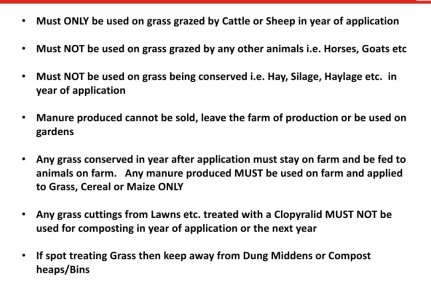
FYI, you can no longer use Graze On herbicide on horse pasture.
This is a new directive in last couple of weeks.
 

Attachments

  • Screenshot_20230428_132045_Microsoft 365 (Office).jpg
    Screenshot_20230428_132045_Microsoft 365 (Office).jpg
    213.6 KB · Views: 72
Thanks - I’m not minimising the danger at all but I’m just trying to understand the mechanism of how dead seedlings could get in the hay that they’d eat as presumably it won’t be cut that far down?

I walked my track yesterday after mowing 3 weeks ago. The seedlings I missed were very tall and would have easily ended up in hay if cut. As it is they were easy to see because of the height and I just plucked them out.
 
This is what I’m thinking - I’m still checking and pulling and if any survive I’ll be able to spot them - it’s the ones that don’t survive and wither - I appreciate they’ll still be potentially toxic but I’m struggling to see how they’d get into the hay?
 
FYI, you can no longer use Graze On herbicide on horse pasture.
This is a new directive in last couple of weeks.
Do you have a website for this info? We’ve always used it (and have some here that was about to be used). A quick google shows lots of sites still selling it for pastures, I can’t seem to see any changes anywhere other than your post. Just interested, as surely there will be lots of people like me that still have stock and don’t know about this now.
 
This is what I’m thinking - I’m still checking and pulling and if any survive I’ll be able to spot them - it’s the ones that don’t survive and wither - I appreciate they’ll still be potentially toxic but I’m struggling to see how they’d get into the hay?
We have a supplier who bales so close to the ground, we get mud and stones etc in our hay (it’s the reason I stopped using his dry haylage, as there was always soil in it). Either they’re doing the same, or could it be a cut when the trees are dropping and it’s landing on the hay whilst it’s awaiting bailing? It’s not just the UK, we have seen unbelievable levels of seeds this year, I’ve lost two paddocks, as theres that many seeds I can’t clear them.
 
So if I keep checking the field to remove any survivors and ask the contractor not to go too close to the ground would the hay be ok to use on the balance of probabilities?
 
Do you have a website for this info? We’ve always used it (and have some here that was about to be used). A quick google shows lots of sites still selling it for pastures, I can’t seem to see any changes anywhere other than your post. Just interested, as surely there will be lots of people like me that still have stock and don’t know about this now.

Yes I still have some and I am about to use it as a spot weeder same as every year. Is there a link anywhere to why they are now saying not to be used on horse pasture? :oops:
 
So if I keep checking the field to remove any survivors and ask the contractor not to go too close to the ground would the hay be ok to use on the balance of probabilities?

There are a lot of people asking exactly the same thing and as far as I can see nobody actually knows the answer as this year has been unprecedented for levels of toxin.
 
when you have the hay done, get the contractor to set the blade height high so it is not collecting rubbishy bits on the ground, seeds, seedlings etc. Explain the issue, they are good at knowing their machines. If in doubt, leave the dodgy areas of the field. IME they either grow on to be small trees and are really obvious, or they die off once they get to about 2", go flat and wither/rot. Gives you a bit less hay, but safer.
 
Thanks - I’m not minimising the danger at all but I’m just trying to understand the mechanism of how dead seedlings could get in the hay that they’d eat as presumably it won’t be cut that far down?

It can only be assessed at hay crop cutting time, how tall the seedlings have grown. If just 2 inches tall, the cutter can be set to cut higher, but also the tedding machinery would also need to be tedding higher - its the tedding which can claw-up bits and pieces from lower soil levels. Also the baler sweeps up and would need setting higher.

It’s doable IF the seedlings remain miniature and all equipment making hay is set well above the seedlings.
 
Do you have a website for this info? We’ve always used it (and have some here that was about to be used). A quick google shows lots of sites still selling it for pastures, I can’t seem to see any changes anywhere other than your post. Just interested, as surely there will be lots of people like me that still have stock and don’t know about this now.

I work in a farm store that's sells herbicides.
This was a cpd literally last week. We have to ask where they are going to use it now. There will be a 100ml graze on for spot spraying.
Its too do with how long it stays in the ground, and if you poo pick, this manure cannot be sold/given to gardeners, as it will prevent root crops growing.
 
This is one of the reasons I have to source unsprayed hay, as I use our manure on our veg (not to mention the fact that I don't really want the ponies having this kind of stuff pass through their bodies, I honestly think some people assume grass doesn't take these chemicals up!)
 
if we have the probability of the seeds being in hay fields what about fields of straw (grain) and fields cut for grass pellets, loose grass and the various forms of alfalfa.
 
I would get the tree cut down asap and not risk cutting hay off it this year. Could you rent that paddock to some sheep or something to graze it down? Then try using it for hay next year. I’ve heard of too many sycamore deaths and it’s not worth the risk imo. I don’t envy you though as I’ve dealt with rented land occupying sycamore before and it’s so stressful trying to pick up every last one! If you own the land then get it chopped down asap- will save you so much stress
 
Do you know why? I wonder what the difference is between horse/sheep pasture and cattle/goat?
It appears that the chemical remains in the grind/poop.
As many poo pick, it will be there in the muck pile. If this is subsequently spread out prevents root crops growing.
Farmer's do not pick up sheep/ cattle poops.

You can no longer take hay/ silage off a field treated with that chemical, that year. The following year It can be cropped, but the crop only used on that farm. It cannot be sold.
 
It appears that the chemical remains in the grind/poop.
As many poo pick, it will be there in the muck pile. If this is subsequently spread out prevents root crops growing.
Farmer's do not pick up sheep/ cattle poops.

You can no longer take hay/ silage off a field treated with that chemical, that year. The following year It can be cropped, but the crop only used on that farm. It cannot be sold.
It says you can’t use it on sheep or horse fields, but can on cattle or goat.
As you say, farmers don’t tend to pick
up after cattle, but nor do they pick up after sheep?
 
Top