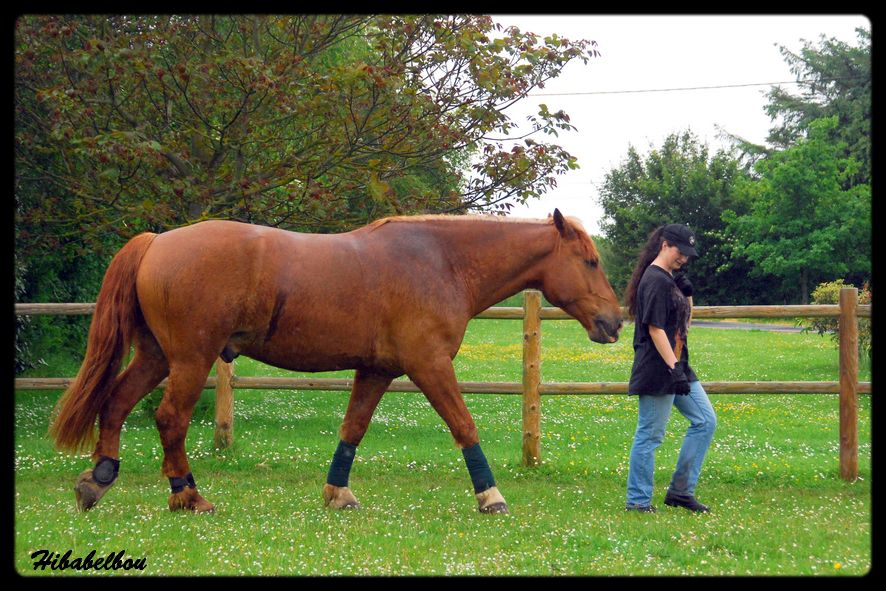
Vocabulary... I'm confused

That one is not a question, but a comparison between french and english, as you seemed to be interested by the topic. ;)

There's a word I don't really like in your language.
"To break a horse".
Not a very nice image...

So I wanted to tell you the french word.
We say: "débourrer" or the "débourrage" for the noun.

It comes from the word "bourre" that designate the foal's fury coat. So litteraly, it means to take away the foal's coat to make a grown horse of it.
 
That one is not a question, but a comparison between french and english, as you seemed to be interested by the topic. ;)

There's a word I don't really like in your language.
"To break a horse".
Not a very nice image...

So I wanted to tell you the french word.
We say: "débourrer" or the "débourrage" for the noun.

It comes from the word "bourre" that designate the foal's fury coat. So litteraly, it means to take away the foal's coat to make a grown horse of it.

O, that is nice. A much better way of describing it .Thank you for sharing :)
 
That one is not a question, but a comparison between french and english, as you seemed to be interested by the topic. ;)

There's a word I don't really like in your language.
"To break a horse".
Not a very nice image...

So I wanted to tell you the french word.
We say: "débourrer" or the "débourrage" for the noun.

It comes from the word "bourre" that designate the foal's fury coat. So litteraly, it means to take away the foal's coat to make a grown horse of it.

Thats lovely!

I always use "Start" when talking about breaking a horse to be ridden because I think starting sounds nicer than breaking
 
I like the French way too.
My 7yr old is as impressed as I with the word 'hipposandles' & wants to tell her teacher when they have their French lesson.
 
I've lived in France for four years now, and I'm more familiar with the French terminology... though some of it I don't see the logic behind lol! (though that may be the Alsacien influence ;) )

Erzie, can you let me know what you understand to be a <<double-poney>> I've always thought it was a poney about 148cm tall (au garrot), but not entirely sure.

Regarding Cobs... I call Pinto (in my signature) a cob-type, but he is recognised as a basic cheval de trait (origine inconnue) :D
 
I can tell you the french words, of course.

So the first boots are "boots" because it's an english word.
The second ones "bottes".
The tird ones "guêtres"
Then "cloches"
and "hipposandales".
The two lasts one are confusing for me because the overreach boots could have been name hoff boots as well, couldn't they?
And in french, sometimes we use "chaussures" for the last ones, that would be shoes in english, but horse shoes are something else for you.

Do you see my problem now? :D

I love "hipposandales" lol.
 
Erzie, can you let me know what you understand to be a <<double-poney>> I've always thought it was a poney about 148cm tall (au garrot), but not entirely sure.

To be honest, it doesn't really mean anything. It used to designate a cross between horses and ponies, but it doesn't really make sense because some breeds of ponies can be taller than the official 148 cm. And most people use it for tall ponies, but they can be purebred. So, in the end, it's mostly used by neophyts, and it tends to confuse them as well. :D
 
Also - forgive me - I work as an EFL teacher and you did ask for help. Its Doesn't. Remember that the comma is being used to shorten does not. Its one of my pet hates for Native English speakers as well :)

It's an 'apostrophe', not a 'comma' ;)

EDIT: haha, noticed at the same time ^^^^
 
I thought that the "comma" meant what stands in for the apostrophe... :confused:

(I'm not quite sure that my sentence is correct by the way)
 
A comma is "," and an apostrophe is " ' ". Comma's break sentences up where apostrophe's are used to replace letters when two words are put together - so the ' would replace the "i" in it is to make it's.
 
This thread is interesting. I'd never realised how complex the English language actually is until now! :)

Neither did I! Not until I started to home educate my then young daughters :eek:

So many words have different meanings and sometimes the same spellings, which really doesn't help lol :rolleyes:

It is quite a fascinating language though, at least I think so :D

There's a famour French man (so famous I've forgotten his name!) that had to learn English. He was not in favour, as well as fearing it was going to be too hard, especially the spoken word - after his first lesson his fears were allayed as, in his words, English spoken is just badly pronounced French :cool::D
 
Hi
I'm English but have lived in Belgium for many years, so much of my equine vocabulary is French, rather than English! I have a brilliant book called "The International Horseman's Dictionary" by JA Allen, which has never failed me yet. It includes English,French, German, Italian and Spanish, and is never far from me!
Often at the yard, I will ask my daughter : "Where are the guêtres?", and she'll reply : "In the armoire." Makes people smile lol
 
New question!

I've been reading a thread about "turn out".
I finally understood that it was about horses that go to the field during the day.
But I have a few questions. Is that expression used only for horses who sleep in stables? How would you say that a horse lives outside all the time?
Do you have other words that "field" to describe the place where horses graze?

And is there a lot of people in your country that only have a field with a shed for their horse, and no stables, no sand school, etc... ?
 
New question!

I've been reading a thread about "turn out".
I finally understood that it was about horses that go to the field during the day.
But I have a few questions. Is that expression used only for horses who sleep in stables? How would you say that a horse lives outside all the time?
Do you have other words that "field" to describe the place where horses graze?

And is there a lot of people in your country that only have a field with a shed for their horse, and no stables, no sand school, etc... ?

Turn out means to put the horse in the field, from wherever it was before (most often a stable). It is mainly only used for stabled horses or horses that have been taken out of the field to be ridden and are then being put back into the field. For a horse that lives out all the time we would just say he lives out, if we brought the horse in to the stable area to ride then we would turn him out into the field afterwards until he is next ridden. We usually use field to describe where our horses graze as we do not have the range of landscapes that exist in france for example you have sand corrals, meadows etc and we tend to just have fields of grass , also known as a paddock (though this is mainly an american term). I myself have a field with a shelter for my horse and no stables or sand school and there are a few of us who are limited to this set up but most people prefer to have sand schools and stables etc so they keep their horses at livery yards.

Let me know if you need any more translations - I'm a fellow frenchie and speak fluent english and french so I can translate :)
 
Turn out means to put the horse in the field, from wherever it was before (most often a stable). It is mainly only used for stabled horses or horses that have been taken out of the field to be ridden and are then being put back into the field. For a horse that lives out all the time we would just say he lives out, if we brought the horse in to the stable area to ride then we would turn him out into the field afterwards until he is next ridden. We usually use field to describe where our horses graze as we do not have the range of landscapes that exist in france for example you have sand corrals, meadows etc and we tend to just have fields of grass , also known as a paddock (though this is mainly an american term). I myself have a field with a shelter for my horse and no stables or sand school and there are a few of us who are limited to this set up but most people prefer to have sand schools and stables etc so they keep their horses at livery yards.

Let me know if you need any more translations - I'm a fellow frenchie and speak fluent english and french so I can translate :)

Your English is fab :)
 
Your English is fab :)

Thank you - the benefits of having an english father and french mother. I moved to England at a young age which definitely helps but as I get to flit between the two countries now I can maintain both languages (I'm currently sat in my apartment in Marseille - its 32 degrees outside hehe)
 
See a comma and take a quick breath but carry on reading imediately

An apostrophe is use to shorten a word (replace missing letters) in most cases

WAS NOT can be WASN'T or in these times can be WEREN'T (WERE NOT)

It WAS NOT done that way
Change WAS NOT for any of the above

There is another way now commonly used instead of a comma and that is "-"
 
New question!

I've been reading a thread about "turn out".
I finally understood that it was about horses that go to the field during the day.
But I have a few questions. Is that expression used only for horses who sleep in stables? How would you say that a horse lives outside all the time?
Do you have other words that "field" to describe the place where horses graze?

And is there a lot of people in your country that only have a field with a shed for their horse, and no stables, no sand school, etc... ?

Yes, quite a lot. There's also a lot of yards with stables and grazing but no sand school.


A cob is just a fat horse. I'm joking of course :p
 
A cob is just a fat horse. I'm joking of course :p

My cob IS a fat horse! :D

130591.jpg
 
Just to confuse things 'turn out' can also be the way a horse is presented for competitions, hunting etc. For example non-native types are to have their mane plaited, tail pulled (or plaited).
 
And what do you mean by "non native types"?
Native ponies are (for the UK) Dartmoor, Exmoor, Shetland, Welsh, Connemara etc, they are native to this country. Non native types would be TB's, WB's, Friesians etc.

If I may I'm going to ask my own question as it's been bugging me! What is it called when a word has been shortened from an expression? For example Three Pence becomes Thrupnce
 
Erzie, fields are sometimes referred to as "grazing" . Eg. I'm not moving to that livery yard because they don't have enough grazing to allow 24/7 turnout. Grazing also means eating grass, or in humans grazing means frequently snacking throughout the day rather than eating 3 big meals. Then there's the graze which is an injury, where some skin is scraped off leaving a wound that may be large but not deep, often as a result of a fall in humans or a kick in horses. English is such a confusing language!
 
And in french, sometimes we use "chaussures" for the last ones, that would be shoes in english, but horse shoes are something else for you.

I thought chaussure was chicken stew! that's what happens when mucking about with 'orses instead of turning up at school!
 
Top