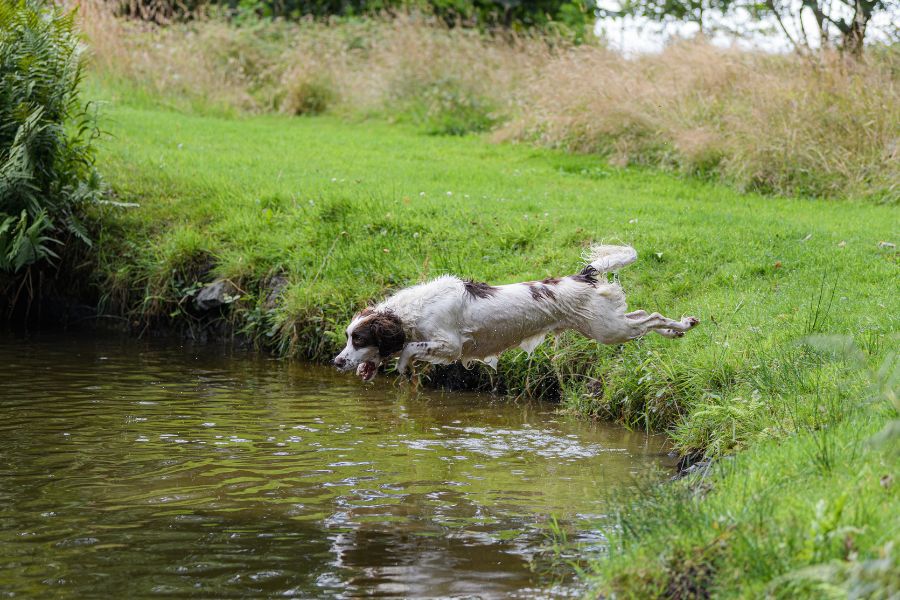
Walking pup

Status
Not open for further replies.
No she isn't in a busy household, quite the opposite. We both work so she gets plenty of sleep time in her crate when we are not there. She is out for 2 hours or so before work, 1 hour at lunch then is in and out of the crate during the evening depending on how tired she gets. She gets a variety of ' walking', garden, trips out to paddle in the reservoir. We try and keep everything very low key. No jumping etc. Play limited with other dogs. Training at a venue once a week, last week was her first session. I would never properly walk 40 mins.
Tbh I am very neurotic and thought after I typed my replies yesterday that I’m probably OTT. We probably walk for 20/30 minutes if you include standing and staring while they sniff and potter.
And puppy has learned to roll in fox poo. Gross!
 
Tbh I am very neurotic and thought after I typed my replies yesterday that I’m probably OTT. We probably walk for 20/30 minutes if you include standing and staring while they sniff and potter.
And puppy has learned to roll in fox poo. Gross!

Ours tries to eat rabbit and deer poo!! It's such a fine line when you want to do your very best for them but still giving them their puppyhood!
 
I wouldn’t take the 5 minute thing as an absolute rule (it’s not particularly evidence based), just be sensible and don’t expect a pup to do the same intensity of “work” as an adult. Things like repetitive ball chasing, jumping up & down from a height (ie to get in & out of a car boot) & flights of stairs are things I’d be more concerned about.

I wouldn’t say that 40 minutes of constant marching along at a good pace would be appropriate for a puppy of that age but shorter bursts of walking interspersed with sniffing, stopping to sit & watch the world go by, mini training sessions etc so that you’re out of the house for longer but maybe don’t actually cover a large distance shouldn’t cause harm. What you don’t want is long periods of forced exercise with no chance for a break (or to set off on a 10 mile hike)

Would definitely agree that lots of short training sessions throughout the day may be easier to keep her attention for than 1 big one
 
Last edited:
Ours tries to eat rabbit and deer poo!! It's such a fine line when you want to do your very best for them but still giving them their puppyhood!
It so is. I look at herbivore muck as being like yakult for dogs 🤣.
I just did a 10 min walk up the road and back (quiet lane). With a little off lead spin in a small field. She’s shattered now. It is windy and the trees were creaking 😳
 
Can I just point out that my dog that jumps in/out of my car boot is almost 5yrs old. I wasn't suggesting that a pup should be doing it!
 
Can I just point out that my dog that jumps in/out of my car boot is almost 5yrs old. I wasn't suggesting that a pup should be doing it!

You've heard of degenerative joint disease?

Jumping down from a vehicle is hard on a dog's forelimbs, the weight of his body increases the stress on his elbows and shoulders.

Buying a ramp is cheaper than paying for the treatment needed to keep a dog comfortable when he has arthritis in his elbows.
 
You've heard of degenerative joint disease?

Jumping down from a vehicle is hard on a dog's forelimbs, the weight of his body increases the stress on his elbows and shoulders.

Buying a ramp is cheaper than paying for the treatment needed to keep a dog comfortable when he has arthritis in his elbows.
Yes, I'm aware of the condition. He sits with me on the sofa every night. Do you think he'll be OK jumping down from there or should I lift him off?
 
Canine Arthritis Management. May '21

Do you let your dog jump in and out of the car?? You might not after reading this!!
😮


A study has shown that when jumping from the boot of a car, six times the dogs body weight will pass through the joints of the front legs... SIX TIMES their body weight. Imagine that on already painful joints!
But out of habit and due to lack of other options your dog will still do it!

So lets try and give them another choice!
By training your dog to use a ramp or to be lifted into and out of the car you can spare them a lot of pain and perhaps even help slow the progression of their disease
 
Yes, I'm aware of the condition. He sits with me on the sofa every night. Do you think he'll be OK jumping down from there or should I lift him off?
I think we can all accept that dogs (many dogs anyway) are quite capable of jumping up and down, in and out. And on any given day this may happen several times.

Snarky response to @skinnydipper aside though, if we can help prevent unnecessary injury and help prolong limb health then why wouldn't you?

Of course, do what you want with your own dog, but don't criticise those who like to assist their own.
 
I agree with Amymay. And I wasn't criticising anyone. Most normal healthy dogs are more than capable of jumping into and out of the boot of a car. If your dog is incapable of doing so, then fine - lift them in/out or let them use a ramp. My dog is fit & healthy, within his perfect weight range. He jumps over certain obstacles when I'm out walking him and he loves it. If jumping out of the boot of my car is really that bad, I feel sorry for all the dogs that do any kind of agility training. Especially Fly-Ball.
 
I agree with Amymay. And I wasn't criticising anyone. Most normal healthy dogs are more than capable of jumping into and out of the boot of a car. If your dog is incapable of doing so, then fine - lift them in/out or let them use a ramp. My dog is fit & healthy, within his perfect weight range. He jumps over certain obstacles when I'm out walking him and he loves it. If jumping out of the boot of my car is really that bad, I feel sorry for all the dogs that do any kind of agility training. Especially Fly-Ball.
No......
 
I agree with Amymay. And I wasn't criticising anyone. Most normal healthy dogs are more than capable of jumping into and out of the boot of a car. If your dog is incapable of doing so, then fine - lift them in/out or let them use a ramp.

It’s not about the dog being incapable. It is about being proactive in trying to preserve joint health.
 
I agree with Amymay. And I wasn't criticising anyone. Most normal healthy dogs are more than capable of jumping into and out of the boot of a car. If your dog is incapable of doing so, then fine - lift them in/out or let them use a ramp. My dog is fit & healthy, within his perfect weight range. He jumps over certain obstacles when I'm out walking him and he loves it. If jumping out of the boot of my car is really that bad, I feel sorry for all the dogs that do any kind of agility training. Especially Fly-Ball.

Jumping out of a car puts a different strain on forelimbs to agility . My , admittedly small, dog competes in agility but is lifted in and out of the car as advised by the physio he sees monthly .
 
I don't do agility but there's a 1m jump and a scaling wall in our programme and I've spent a lot of time teaching dogs to jump cleanly/safely/correctly.
Then manage them carefully elsewhere in their lives and help them in their youth/old age.
Genetics/environment - which includes stairs, sofas, vehicle entry and exit, floor surfaces/fitness/nutrition are all factors in soundness. Jumping style is often genetic or they can fall into bad habits due to lack of training or the style can be impacted by current or previous injury.
 
I do get our dogs to jump in and out of the car a Range Rover and I also use a defender it’s not as if you are expecting them to jump in twenty times a day .
I start them late at this probably about three and a half
All the dogs have jumped into the car until into their teens I tend to lift them out as they age .
 
Its never even occured to me not to let them get in and out of cars or worry about stairs once they are past the tiny puppy stage. Is there any evidence that it causes arthritis? I have light weight breed that doesnt as a rule have issues with bad joints so maybe I'm being naive. If a dog has an injury or is older I can lift mine in and out. I dont remember any of my childhood dogs being lifted in or having arthritis issues
 
I just did a quick skim read of the first paper I found and it doesnt mention stairs, or jumping etc a a risk factor, unless the dog has a genetic predisposition and/or risk of dysplasia. Its from 2020 and is a summary of all relevant research to date.

They advocate for low impact controlled exercise, no stairs, jumping, or sudden movements in growing dogs or those predisposed to joint issues.

If I had labs or similar I'd be taking more precautions based on that.

 
I don't know why people are so resistant to using a ramp.

I started using a ramp 13 years ago when I had a dog with degenerative myelopathy, all the other dogs I had at the time also used it and I've continued using a ramp since then. None of the dogs have had any problems using a ramp.

It does no harm to use a ramp, it only takes seconds to set it up, and if it helps to prevent degenerative changes in the forelimbs then that's all to the good.

No negatives from using one that I can see.

There are people on the forum who've been unable to train their dogs to use a ramp when they are no longer able to jump and have struggled to lift them. Aside from it not being comfortable for the dog to be lifted when its in pain, it can't be good for the person's back either.
 
Last edited:
Peak forelimb ground reaction forces experienced by dogs jumping from a simulated car boot


To the authors’ knowledge, this is the first canine study investigating the kinetics of a static start jump.However, these findings concur with previous research relating to jump height 13 15 and illustrate that even a relatively small increase in jump-down height can significantly alter landing kinetics

This study provides the first objective evidence to support the commonplace belief that allowing dogs to repeatedly jump clear from vehicles with high boot compartments may be inadvisable. However, further work is needed to definitively link increased peak forelimb vGRF to common canine forelimb pathologies. Although at present relevant authorities do publish guidance over the safe transportation of dogs,2–4 methods of entry and exit into or out of the vehicle are not explicitly outlined. It is hoped that this paper will increase the awareness of the potential for harm and promote positive changes in canine husbandry
 
Last edited:
Mine are lifted out of the car. I don’t want them jumping out if we’re on a busy road/in a carpark nor do I want that particular impact. We’ve done that with all our puppies. We’ve taught the puppy this in the week he’s been here.

I absolutely won’t allow stairs for puppies. I mentioned this in a pm to someone who put up a video of her tiny puppy belting up and down stairs after a huge country walk over hills and boy, did she send me a nasty message! Stupid of me to raise a concern. 🤦🏼‍♀️ I read that environmental issues can exacerbate HD or even bring about related problems so we carpeted slippy floors when necessary.



I find that mental stimulation is key for lively puppies, we took ours everywhere in the car when they were tiny. All 3 went to the pub yesterday, it was very busy, we sat away from everyone, all 3 just lay quietly. They did a lot of mooching round the garden because we were out there yesterday.

IMG_2337.jpeg
 
Tbh I am very neurotic and thought after I typed my replies yesterday that I’m probably OTT. We probably walk for 20/30 minutes if you include standing and staring while they sniff and potter.
And puppy has learned to roll in fox poo. Gross!
OH took fox poo out of puppy’s mouth yesterday. Never seen him more disgustied! 🤣 Apparently there’s a family living behind the neighbour’s garden. We never see them, our two wouldn’t tolerate that.
 
I didn’t walk my Lab for anything near that when she was 14 weeks. I got a breed that is prone to joint issues so I’m doing everything I can to help reduce the risk. As a puppy I carried her up and down stairs until she was too heavy and then I taught her that we do stairs calmly - no leaping to the bottom from halfway down. She had 10 minute walks (on lots of different surfaces to help her develop balance and proprioception) and I did lots of basic training with her to tire her brain out. Even after a short walk she would be quite hyper so we would do some training when we got home and then she could settle herself and sleep. I also generally ‘walked’ mine on a long line (if safe to do so) so she had freedom to move at her own pace. I hate seeing people marching puppies along on hard pavements as they need to fit the daily walk in before work etc.
 
My pup is 16 weeks now and he's 'walked' for about 30 minutes twice a day. This usually consists of a walk on normal lead for about 5 minutes till we get to the orchards then he has a lunge line attached to his harness and he gets to wander, sniff and explore till we get to the park....I have to monitor my exercise and our walks are accompanied by frequent 'workout paused' announcements 😂....We then do some basic training before sitting on the bench and watching the world go by as well as some interaction with other people and dogs...not everytime so it's not expected....then it's another stroll back to the road and his lunge line is exchanged for his short lead and we head home.

A couple of times a week he comes to the yard with me to see the horses and learn they're not scary and he'll have a sniff round the field on the lunge and then we go up the road and have an explore round the woods, with a few stop and admire the scenery and do a little training breaks.

He is always lifted in and out of the car but is currently still just below Cocker height and slim so it's not an effort and we have a stair gate to prevent him from going upstairs.
 
I don't know why people are so resistant to using a ramp.

I started using a ramp 13 years ago when I had a dog with degenerative myelopathy, all the other dogs I had at the time also used it and I've continued using a ramp since then. None of the dogs have had any problems using a ramp.

It does no harm to use a ramp, it only takes seconds to set it up, and if it helps to prevent degenerative changes in the forelimbs then that's all to the good.

No negatives from using one that I can see.

There are people on the forum who've been unable to train their dogs to use a ramp when they are no longer able to jump and have struggled to lift them. Aside from it not being comfortable for the dog to be lifted when its in pain, it can't be good for the person's back either.

Because they are big unwieldy things that need to be stored somewhere. I've got a biggish SUV with the back seats down and with the big crate in if I had to put a ramp in as well there would be no room left for anything else. I had one for the boat, but wouldnt have ever used it in the car. They have to be taken out and put away so more faff. You always have to park somewhere with enough room to set them up. Almost certain worth the hassle if you have a big breed or one with potentially dodgy joints. I'm not going to start using one. Ive never had an issue. I dont know anyone else who has whippets and lurchers who has had an issue. I've never seen anyone using one either.

Human skeletons dont fuse till we are teenagers, yet kids play sport, use stairs, jump around, compete in sports. You dont ever hear anyone saying kids shouldnt be climbbing stairs or playing rough games. Its accepted that exercise is not just good, but needed for healthy bones and development.

"Exercise (even strenuous exercise) on normal joints does not result in a substantially increased likelihood of arthritis"

Theres some interesting stuff about dogs and exercise in here as well. I do worry about the miles I put on my dogs and how hard they work, but I feel better after seeing this.


Theres a ton of research out there, it would take weeks to read it all, and some of it directly conflicts other research. But the ones Ive read all broadly say a dog with previous injury or a breed prone to dodgy joints has a much higher risk of arthritis developing across the board, but exercise in any form can make things worse in a dog with an injury or a strong predisposition to joint damage/injury, otherwise there is no correlation between even very hard weight bearing exercise, ie dogs running 40kms a day, or for 75mins carrying 130% of their body weight etc, and the developement of arthritis.
 
If anybody IS interested in using a ramp for their dog, I recommend a Dogwalk3. Compact, easy to manoeuvre on my own and stable when used by very large dog.
 
Status
Not open for further replies.
Top