
scats
Well-Known Member
Perhaps worth videoing him anyway, for your own records. Then you can keep an eye on how things go and refer back to see if there’s any change in the next few months.



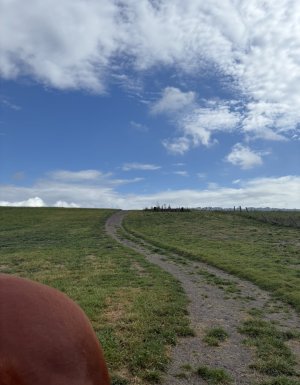

Exactly the behaviour the hooligan showed as a youngster. Stifles for us and apparently very common in younger horses.I dunno guys. I just walked him on this loop and even on this downhill he gets kind of stressy. Nippy, rushes or slows right down. Just doesn’t seem right and to me it seems like pain but I also take the vets point that if he finds it hard cos neuro then that could explain the behavior too. And it’s hard to say it could be pain when he seems very sound. I can kind of “make” him walk sensibly and politely with lots of half halts but I’m not sure that’s the point. And “stabby” as she said going up.
I don’t think this hill should be much of an ask.
I’m a bit tempted to do a pain relief trial with the meds my Colorado vet sent me with. Not as effective as bute and would need to be limited on the time he has it but it could be interesting to see if two days of it or so makes any difference.
View attachment 174347

Are you working on his proprioception in your groundwork? I have a horse that cannot walk in a straight line and used to frequently knock into herself. I don't think there's anything neuro going on (although she is unlevel behind) she's just very uncoordinated. My field is steep and for a while she couldn't trot downhill without either standing on herself or tripping, but if ridden and held together she could. I have spent quite some time working on her body awareness and movement patterns and she now gallops down the hill and no longer regularly knocks herself.
It makes for a much more pleasant ride, especially as there are some pretty steep hills around here. Maybe not as steep as yours, but topped with slippery tarmac and rough stones.
His bodyworker does always say he has tight hamstrings.
Tight there can go with stifles
You might be shocked at the difference large hilly turnout does for him over the next few months. You can do all the in hand hill work you want but it just really can’t compete with hilly turnout that’s got some real acreage to it. Also my guy lived out 24/7 during the summer in a grazing muzzle and was no worse for wear. It made him walk even more so he stayed in even better condition lol I did put sheepskin cover on it. You’re also still really early out from treatment of epm. That can take a while to really get them where they can be confident in their steps again. Vet reports also usually sound worse than the convos with the vet. They are more clinical and try to avoid biasesHere’s the vet report I just got. I did think she had said that she was happy with his cross stepping and she felt it was acceptable but this reads a little different I guess.
Just toured the other barn. Very rustic, great pasture, very direct and straightforward French manager who would also be happy to do some ground work with him. It would be a third of the cost of my current board, certainly no frills. I’m thinking it could be a good half way house between a retirement home but somewhere still where I could do some things with him and see how he goes.
Exam
On examination, Atlas was bright and willing, with behavior consistent with a young, inexperienced horse. At the walk and during flat evaluation, there was mild right-sided stiffness on circles to the right, but no consistent lameness identified.
Neurologic exam revealed appropriate backing and tail pull responses after initial learning behavior. Tight circle work showed mild inconsistency with crossing behind, with occasional delayed or stilted steps that could represent a mild deficit versus training-related difficulty. When evaluated over poles, the horse demonstrated appropriate limb placement and awareness, with only occasional contact of rails. On hill work, abnormalities were more apparent and repeatable, including a short, “stabby” stride when moving uphill and a less coordinated, “floaty” gait with inconsistent foot placement when moving downhill. No clear evidence of foot soreness or primary lameness was identified.
Summary
Mild and somewhat inconsistent neurologic deficits are present, most notably exacerbated during incline and decline work. Examination on flat ground is largely within normal limits for a young horse, but the repeatable abnormalities on hills raise concern for residual neurologic dysfunction. The most likely etiology is residual deficits from prior Equine Protozoal M. Other differentials include cervical vertebral stenotic myelopathy, hindlimb mechanical issues such as stifle or hock dysfunction, or less likely foot pain. Given the timeline of approximately one year since treatment, prognosis for complete neurologic recovery is guarded.
Plan
Recommend continued conservative management with a focus on conditioning and strengthening, particularly with
controlled hill work on mild inclines, followed by reassessment for improvement or persistence of deficits. Additional diagnostics may be pursued depending on intended use and owner goals, including repeat EPM titers with or without CSF analysis, serum vitamin E levels, and cervical radiographs. Safety considerations for riding, especially on steep or uneven terrain, were discussed. A recheck examination is recommended in 2–3 months if the horse remains in work. Referral for a second opinion and advanced neurologic evaluation at UC Davis is available if desired. Long-term
management decisions, including suitability for intended use or alternative placement, should be considered based on progression and safety.

Really appreciate the suggestions and all things I’ll definitely look into to.
I don't think I can hack him to be honest. I am not even really considering riding him right now. He needs a new saddle and I don't want to shell out that kind of expense (it's a total minefield here- I'd be lucky to do it for under $4k) before I have a good idea of how things are progressing.
I also think I need to respect my partners thoughts on this. His immediate reaction was please- just go get yourself something that you will enjoy riding and that you know is safe and don't think about the finances in this, think about being as safe as possible. Of course he will/would respect my decision to ride Atlas but also, he has a valid point. I could technically afford a second horse if I wanted but actually I just don't even want to. I haven't had a ridden horse for 3 years now (of my own) and I have no desire to go out competing, or the time, given it's a 1 hr 30 min round trip just to get to a decent barn that has things I consider essential for a horse.
I know you probably all think that I'm being dramatic with not wanting to ride but truly, I see every misplaced hoof. Every trip. Hills are stressful and hills are part of the course here in Northern California, it's not so simple to just avoid them. There's no such thing as bridleways and hacking really, there's parks to trailer too and then there's the on site hacking that barns have. Even the new barn has a long gradient hill to get anywhere from to hack around the property- he might be fine or he might not. And I'm not interested in just riding around an arena.
I love Atlas and I will always look after him but my heart is just not in this game anymore.


That's a good thing though, as you've made your decision.Really appreciate the suggestions and all things I’ll definitely look into to.
I don't think I can hack him to be honest. I am not even really considering riding him right now. He needs a new saddle and I don't want to shell out that kind of expense (it's a total minefield here- I'd be lucky to do it for under $4k) before I have a good idea of how things are progressing.
I also think I need to respect my partners thoughts on this. His immediate reaction was please- just go get yourself something that you will enjoy riding and that you know is safe and don't think about the finances in this, think about being as safe as possible. Of course he will/would respect my decision to ride Atlas but also, he has a valid point. I could technically afford a second horse if I wanted but actually I just don't even want to. I haven't had a ridden horse for 3 years now (of my own) and I have no desire to go out competing, or the time, given it's a 1 hr 30 min round trip just to get to a decent barn that has things I consider essential for a horse.
I know you probably all think that I'm being dramatic with not wanting to ride but truly, I see every misplaced hoof. Every trip. Hills are stressful and hills are part of the course here in Northern California, it's not so simple to just avoid them. There's no such thing as bridleways and hacking really, there's parks to trailer too and then there's the on site hacking that barns have. Even the new barn has a long gradient hill to get anywhere from to hack around the property- he might be fine or he might not. And I'm not interested in just riding around an arena.
I love Atlas and I will always look after him but my heart is just not in this game anymore.
I took an Ansur saddle to the US when I went there teaching. I was co-training with a working cowboy on English and Western, comparing the differences and similarities. I had been trained to fit them, so took one and all the associated pads in a suitcase! They fitted any horse with the adjustments and everyone could have a try with an English style saddle.Try ridng on an ansur saddle and see what you think, i find them close contact and horses can go very freely in them,they are quite open for the rider, you dont feel fixed or confined
They are expensive new but can be very reasonable second hand, they are almost treeless and adjustable
Thank you. I agree. Ultimately I’ve been on off nursing sick horses for 3 years and I think I need to just prioritize other things right now!That's a good thing though, as you've made your decision.
I went without horses for almost 5 years, when I was setting up home with Mr Red. I had an injury that stopped me and life priorities changed.
A few years down the line I got back into it, bought one, Mr Red backed me and we bought our property and I was then, at a different stage of life, able to commit more than before even.
But then, I wouldn't be surprised if a horse finds you and you do have another.
having horses and riding isn't compulsory LOL.
I took an Ansur saddle to the US when I went there teaching. I was co-training with a working cowboy on English and Western, comparing the differences and similarities. I had been trained to fit them, so took one and all the associated pads in a suitcase! They fitted any horse with the adjustments and everyone could have a try with an English style saddle.
Just enjoy him in any way that gives you pleasure. None of us has seen him so can't judge how he looks and feels. But if you don't enjoy riding him, then there is no point in doing so!


Hi! No he hasn’t. I totally could but it doesn’t really change the outcome. I’m not interested in going down the route of trying to medicate a 4/5 year old with issues like that so early on.Has he had his neck X-Rayed? ECVM can cause clinical signs that are very similar to neurological issues