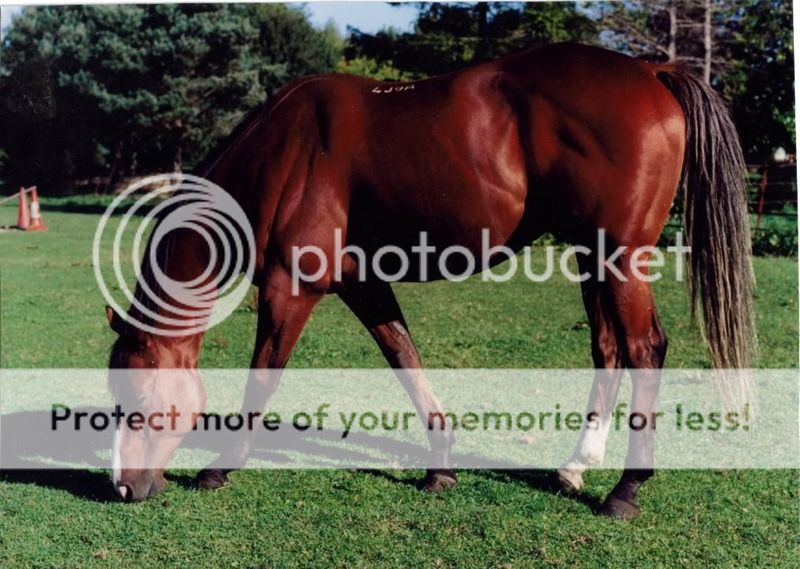
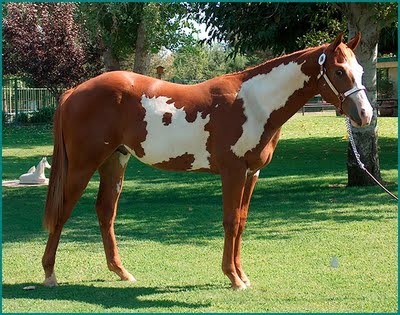
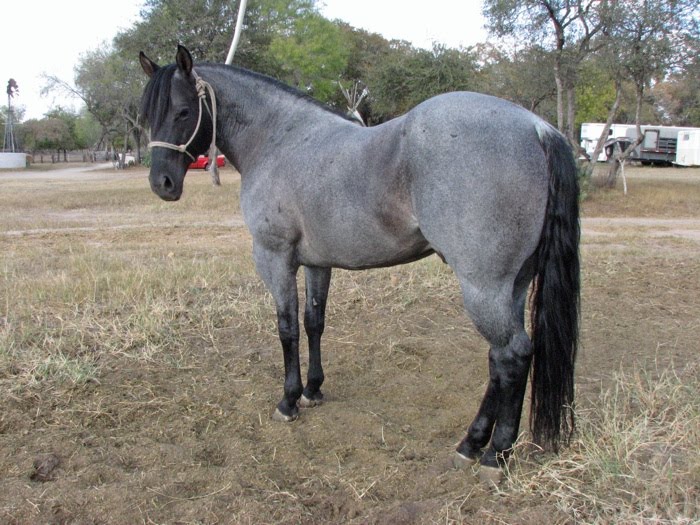
What's a "Blue and White Mare"?

:p

I'd still like to hear the thoughts of those that disagree with me and like the term tri-coloured. :)

Some of the horses in the photos you posted appear to show three different colours. If I were to advertise one I would educate myself on what colour it actually was, so I could put it's correct colour down. Tri colour in my head doesn't really exist (as I've never truly seen one) however it is as simple to some people as counting the number of colours appearing on a horse.

It may sound silly but I honestly think the problem with mislabelling horse colours in the UK comes from passports. I could put my horses down as whatever I please - my grey was down as coloured and one of my chestnuts bay. The information on their passport is based on a person (and not always a clever one) 's opinion. I think to document a horses colour on a passport it should be true and thus tested.
 
The passport system drives me potty... not just the point you mention (which I agree with - someone's who's job it is to fill in official identification documents should know what they are doing) but that one of my horses has two passports as one was lost and instead of paying £70 for a new copy, they (old owner's staff) just got a cheap ID one. You shouldn't be able to do that, but now the central database is gone I could get her yet another with a different PIO if I wished (with the same info - not changing her details). Grrr!
 
Blue and white is fine by me! I like simplicity and not alienating people I am talking to by using too many specific terms. It's probably because most people I know aren't horsey so piebald and skewbald is a bit of a stretch for them, although I do have to correct people who call my Haflinger a palomino :-)
 
I have no problem with adapting what you say to suit who you are talking to, 'ginger' works well when describing my chestnuts to non-horsey people. I do feel that it is odd that the average horse owner is worse at horse colours than the average model horse collector.
 
Whilst on the subject what do you call a buckskin/dun that looks like a bay? My friend has a mare who you would think is a bay but has had a foal who I think is going to turn out palomino, only time will tell, the sire is bay. The mare has a dorsal stripe and slight zebra markings.
 
Ooooh! Thinking of Haffies and the chestnut/palomino debate, that is another massive bug-bear of mine!

There was a girl at my yard who absolutely insisted that her old, nothing-special-yet-better-than-everything (you know the sort) was a palomino. I remember saying he was chestnut (before I realised she thought of him as palomino- didn't make that mistake again, I tell you!) and she flew off the handle saying 'he's palomino, *scoff, scoff, chuckle, chuckle*' (looking at me like I was something she'd just stepped in). She then stated 'well, his passport says he's palomino' and sort of laughed in a 'so there, hah, sticks-tongue-out' kind of way. I was just like 'riiiiight', rolled my eyes to myself and quickly made my exit.

Oh how I would've loved to have made a bet with her, then sent his hairs away to test for cream. Would've been in the money on that one. ;)
 
Whilst on the subject what do you call a buckskin/dun that looks like a bay? My friend has a mare who you would think is a bay but has had a foal who I think is going to turn out palomino, only time will tell, the sire is bay. The mare has a dorsal stripe and slight zebra markings.

If the foal is palomino, then she should carry Cream and therefore be a buckskin with countershading. If I knew that a horse carried cream (on a bay base) then I would call her buckskin.

Other things to consider - Does she have sooty? Is her base colour actually seal brown?
 
Whilst on the subject what do you call a buckskin/dun that looks like a bay? My friend has a mare who you would think is a bay but has had a foal who I think is going to turn out palomino, only time will tell, the sire is bay. The mare has a dorsal stripe and slight zebra markings.

Guessing if the mare looks bay, yet shows primitive markings, she's most probably dun acting on a bay coat, so a 'bay dun'. However, if you think the foal mare be carrying cream, she may in fact be a dunskin- which is a bay horse that carries both dun and one copy of cream. Then again, the foal may be playing tricks on you and the mare may actually only be a bay with countershading.

Do you have pics of both mother and baby?

ETA: Valid points from FC, which I missed. I will leave it to her. I'm off to bed as I'm falling asleep. ;)
 
Haha I try to casually respond to 'is yours the palomino?' with 'flaxen chestnut, yes that's the one' as I think calling it flaxen chestnut makes it a bit more obvious!

I mostly just say orange though :-D
 
The mare is a fairly reddish bay colour, I think you could say her face is a little sooty. I don't have any pics at the mo! The stripe could be countershading yes having looked at pics, you can't really see her stripes at the mo.

The foal came out a lot lighter than a chestnut foal usually would (I just went to do a check and bam, legs sticking out!) she is about a month old now, still looking quite light. Her mane is sort of red at the ends and growing in light.
 
This is a really interesting debate/thread. I must get my boy tested because his passport says dark bay but I have been told over and over he is a black roan, he is certainly a roan and when clipped looks more black then bay...
My yearling has been tested as black. :)
 
Faracat, am I right in thinking that the are a variety of genes that give horses the 'baybald' look that the (lovely) horse you say is a bay frame overo has?

Personally I'd rather use a term in common use that I know to be wrong than a scientific term wrongly. I think its less misleading.

I'm pretty sure that thanks to your threads & the sites you link to I can look at a bay horse with white patches and know its either a bay with splash white or sabino. I can look at another horse and be pretty certain its neither of those things.

I would use tri-coloured for skewbald horses that would have been bay without the white bits. I don't really think they deserve to be called tri-coloured if it is just the mane & tail that is black, but I don't really know what else to call them.

I'll tell you what I'd call the horses you've pictured if my boyfriend or someone asked. Now I know what they are the temptation to make myself out as genuinely knowledgeable might overwhelm me a bit. If I was selling one I'd find out what it was.

Err, some kind of paint horse. The prevalent genes for making coloured horses are different in the US to here.
Tri-coloured
Skewbald. (If pressed I could say it was a flaxen chestnut with something, but I don't really differentiate between chestnuts & flaxen chestnuts in day to day life)
Some kind of sexy flaxen thing.
Skewbald. (Again I can see its base is seal brown. I think I'm using the term base wrong)
Dun & white.
Piebald (I wouldn't call it trio-coloured as it is two shades of the same colour plus white. I feel the same way about the seal brown horse)
Bay with stockings.
I might say skewbald, but might say bay with white bits, prob caused by sabino.
Paint, same as the first horse.
Gray that is fading unevenly.
I'd call this one brindled, because that is what I call this coat pattern on dogs.
Gray & white.

Yes I would call one of those black spots on white, roan-y shouldered appys 'tri-colour' if i couldn't just say appy. Ie if two appys lived in a field together & I wanted one brought in.
 
Last edited:
This is a really interesting debate/thread. I must get my boy tested because his passport says dark bay but I have been told over and over he is a black roan, he is certainly a roan and when clipped looks more black then bay...
My yearling has been tested as black. :)
There is more than one gene that causes 'roaning' or white flecks in the coat. A true roan with the roan gene is easy to spot as there head, legs, mane and tail are left unroaned. This is a true Roan on a black base.

CWFContinentalKing4.jpg


Going from the photo in your sig (a better photo would be great) I suspect that your horse's white flecks are caused by sabino. :)

UGO - Thanks for responding. I find it very interesting that you seem to associate tri-coloured with bay tobiano.

I also find it interesting when you talk about two shades of the same colour not counting. Horses only have two pigments black and chestnut. White is a lack of pigment. The great variation of colours are caused by restricting pigment to certain areas and diluting pigment.

Yes there is more than one pinto gene.

The silver dapple has dark legs, that's the clue that he is black based and not chestnut. As flaxen has no effect on black, the pale mane and tail cannot be caused by flaxen.

Don't confuse black roans or black duns with grey. Greys tend to go grey on their faces very quickly. Both roan and dun leaves the face the base colour (black in this case). :)

If all those horses were in a field and someone told me to get the 'tri-coloured' I would be stumped as they all have three colours. I would have to ask for more information or I'd probably bring the wrong horse in!
 
I am both baffled and intrigued by this (and all the other colour gene)thread. How did you gain all this knowledge FC?

And out of interest, my share horse is "bay roan" on his passport. In the 14 years I've known him he's gone from incredibly dark steel grey though all the shades of grey you could imagine and is now at 18 VERY fleabitten - almost like a negative of a bay roan. Any ideas as to his genetic colour?
He could be purple with green spots for all I care as he's the horse of a lifetime, but it is interesting!
 
I've always enjoyed your imput on colour threads Faracat, thanks for explaining about flaxen. I'll try v hard to remember the legs.

I can see the horse in this link is different to the bay frame overos you've put up. I'd guess he is bay tobino?

http://www.stallionsonline.co.uk/image_from_db.php?id=15684&name=medium

I also very much associate this colour with 'tri-coloured.'

Is it just me or are the more of these around than the were 15 years ago? None of the riding school horses I knew as a child were this colour or grey & white (a term I prefer to blue and white on the grounds I've never seen a horse that was actually blue and white, I've only seen faded looking piebalds)
 
That is really interesting Faracat, he is a clydesdale and they always call them roans so I have just gone with it, its really difficult to get a photo of how flecked his coat actually is.

You can see the flecks quite well here


He seems to get more flecked as he gets older. (owned him since 2 and is now 7.)
 
A - I used to own this anglo arab and wondered why he had a 'grey tail' so researched what caused it (it's a Gulastra Plume, a quirk of sabino and nothing to do with grey) and it went from there.

Seamus.jpg


UGO - the horse in your link is a bay tobiano. :D tobianos tend to have white on the legs and the white over the top of the back or neck.

MT - look at his lovely jagged face and leg markings - a sign of sabino, which is also the cause of the flecks. he doesn't look to have a brown muzzle (although it's partly covered in the photo), so I'd call him a black sabino. :)
 
A - I used to own this anglo arab and wondered why he had a 'grey tail' so researched what caused it (it's a Gulastra Plume, a quirk of sabino and nothing to do with grey) and it went from there.

Seamus.jpg


UGO - the horse in your link is a bay tobiano. :D tobianos tend to have white on the legs and the white over the top of the back or neck.

MT - look at his lovely jagged face and leg markings - a sign of sabino, which is also the cause of the flecks. he doesn't look to have a brown muzzle (although it's partly covered in the photo), so I'd call him a black sabino. :)

No he has a black muzzle! Maybe then all the clydesdales are really sabino and not roans? I really want to get him tested now!!! :D
 
I don't think the average 'tricolour' is a Chimera, that's a whole different kettle of fish.

what is the average triclour then?

tricolour = three distinct colours on the body.

the other options I can think of would be a a grey tobiano with a blood mark or somatic mutations neither of which are average!
 
I think what people are referring to when they say tri-coloured etc, is the phenotype (what it looks like) rather than the genotype (what it is genetically), because you can't be 100% sure unless you have the genetics in front of you, although one can make a very educated guess. So I have no problem with common terms such as blue and white being used for instance. However, I do think the correct colour should be on the passport.
 
UGO - the horse in your link is a bay tobiano. :D tobianos tend to have white on the legs and the white over the top of the back or neck.

Good to know!

Am I right in thinking the reason most cobs are mainly white but some are mainly dark is just to do with how much the genes are expressed, rather than them being different genes? I can only remember meeting one piebald cob with black legs, and only three of his were black. (I used to hack past him thinking how lucky his owner was)
 
Last edited:
what is the average triclour then?

tricolour = three distinct colours on the body.

the other options I can think of would be a a grey tobiano with a blood mark or somatic mutations neither of which are average!

Sorry I worded that badly, what I meant is that what most people would refer to as a tri-colour (for instance bay tobiano) would not be a chimera which contains 2 sets of dna causing the different colours.
 
Last edited:
yup I think that is the distinction, lots more of that option. I think it is a term more suited to dogs than horses. but people will pick up on things to make them sound more interesting ;)/sell horse for more money
 
DG - looks seal brown to me. :)

UGO - yes, you can have minimal expression, maximum expression and everything inbetween. Tobianos don't always have four socks, but I haven't seen one with no socks (maybe someone has a photo of one?). Generally a pinto/coloured without any socks would be more likely to be a frame overo.

This Frame might have a small bit of white on one hind, but you get the idea. Note how the white is on the sides of the neck and body rather than going over the topline like tobiano does.

frame-overo-horse.jpg


MT - I've never seen a true roan Clydesdale. Splashed white and sabino - yes.

A - sorry I missed this.
And out of interest, my share horse is "bay roan" on his passport. In the 14 years I've known him he's gone from incredibly dark steel grey though all the shades of grey you could imagine and is now at 18 VERY fleabitten - almost like a negative of a bay roan. Any ideas as to his genetic colour?
Your description sounds like a grey that was born bay. So many people confuse roan and the early stages of greying out. Greying out around the eyes and on the face is a big clue that a horse is grey, not roan.
 
A true tricolour would if it existed have black and brown patches distinct from each other brown eyebrows and brown down its legs to a white sock or stocking so no horses don't come in tricolour
 
Top