
Yet another delightful rider..... not..... when will this end?

I understand about balance but how do you explain to the horse he needs to lift his feet up in both piaffe and passage if you don’t use extra aids like a whip

Classical dressage is about developing the strength and balance in the horse over many years until the poll is up (genuinely up, not artificially pulled up and in) and the haunches lower so the hocks can support the weight to lighten the forehand. The problem being that this does take a long time and a lot of skill- you aren’t going to have a fully fledged GP horse at 9 with this system.
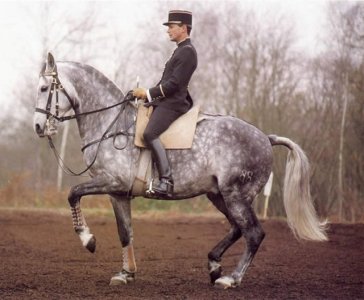
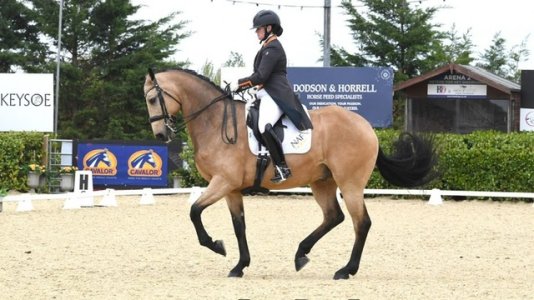
The first picture is correct. The second picture, fairly unbelievably, is taken from a Horse and Hound article titled 'How to teach your horse to piaffe' and is completely incorrect….. the horse is over bent with a compressed neck, the back is hollow, the croup is high, there is no weight being taken behind so the front leg is coming back underneath the body (you will see this a lot more extreme in other examples)
IMG_0580.jpeg

IMG_0581.jpeg
 
It's astonishing what you can see in regular and social media "how to" articles and posts. You can see how the horse at the top (PK and Odin?) is using the ground, using the intrinsic elasticity in soft tissues to achieve the pace, the hind joints clearly compressing, and you can see how the bottom one is using a lot of muscle power and is dropped in the lumbars as well as the more obvious balance and contact/neck issues. The right hip is SO dropped!
 
It's astonishing what you can see in regular and social media "how to" articles and posts. You can see how the horse at the top (PK and Odin?) is using the ground, using the intrinsic elasticity in soft tissues to achieve the pace, the hind joints clearly compressing, and you can see how the bottom one is using a lot of muscle power and is dropped in the lumbars as well as the more obvious balance and contact/neck issues. The right hip is SO dropped!
The rider position too. The top picture shows a gentle, comfortable seat. The second I'm not sure she's even 'seating on her bottom' 😳 as my dad would say. (IMHO obviously)

Thank you @TheMule for the explanation and photos. It's very obvious which horse is happier in its work too.
 
This is a fabulous post showing uphill balance in walk, slightly OT but kinda relevant, all about educating the eye.


I’m asking how? I understand about balance but want to understand how to teach them to lift their feet without the use of artificial aids

It depends on your horse, on your seat on all sorts of things I'm sure but we are not asking them to lift their feet, that's the wrong end of the telescope. We don't ask them to move their feet in walk, we ask them to move forwards and to move in a certain rhythmn by use of our seat, asking them to move their feet is the harmful bit.

But you know how to ride increased collection - we should shape the horse, provide space for them to move into appropriately, rather than learning buttons to press, in the main. So we sit with seatbones able to move upwards and not squirrelling around, we have stability down both sides of our torso, we sit with a neutral pelvis but flexing it as the horse offers a change in balance, a lifted hand offering a forward feel, inner thigh draped to act as a tunnel for the horse to move through, from here we need so much less in terms of active aiding...there would be so many subtleties, but all rooted in simply riding increased collection.
 
I’m asking how? I understand about balance but want to understand how to teach them to lift their feet without the use of artificial aids

As Sbloom said above, a horse lifts its feet when it moves so you don’t have to teach that, what you you is very gradually teach the horse to collect the trot until it gets closer and closer to being on the spot- piaffe is just trotting on the spot, passage is a very expressive collected trot. How do you do that? By having an excellent seat, precise leg aids and a soft hand that knows how to rebalance but without blocking the horse- piaffe should have the same light, giving contact as all the other paces, collection should never come from the hand
 
The rider position too. The top picture shows a gentle, comfortable seat. The second I'm not sure she's even 'seating on her bottom' 😳 as my dad would say. (IMHO obviously)

Thank you @TheMule for the explanation and photos. It's very obvious which horse is happier in its work too.

He's actually sitting on his whole pelvis, 3 point seat, and that is often easier in a standard saddle when the horse lifts in front like this. We have to adapt and flex with the changing balance of horse/saddle, but his entire body gives away that he provides stability for the horse, as a load, as a rider. The GP rider is gripping and unstable.
 
The bounce is there in correct work but it's this ground recoil force, USING the ground and elastic tissues to flow through the whole body rather than picking the legs up and down and bouncing from left to right leg, standing leg relatively unflexed and hip pushing up. The bouncing croup is definitely a thing in most incorrect piaffes.
 
He's actually sitting on his whole pelvis, 3 point seat, and that is often easier in a standard saddle when the horse lifts in front like this. We have to adapt and flex with the changing balance of horse/saddle, but his entire body gives away that he provides stability for the horse, as a load, as a rider. The GP rider is gripping and unstable.
Poss helped by the fact that’s prob not having to nag every stride to keep the horse going?
 
Poss helped by the fact that’s prob not having to nag every stride to keep the horse going?

Absolutely. Like I say if your body, your equitation, can mould the horse, help energy flow in the right way...and that is rooted in stability...then aiding can become invisible. We are SO far from that in most competition dressage.
 
Classical dressage is about developing the strength and balance in the horse over many years until the poll is up (genuinely up, not artificially pulled up and in) and the haunches lower so the hocks can support the weight to lighten the forehand. The problem being that this does take a long time and a lot of skill- you aren’t going to have a fully fledged GP horse at 9 with this system.
The first picture is correct. The second picture, fairly unbelievably, is taken from a Horse and Hound article titled 'How to teach your horse to piaffe' and is completely incorrect….. the horse is over bent with a compressed neck, the back is hollow, the croup is high, there is no weight being taken behind so the front leg is coming back underneath the body (you will see this a lot more extreme in other examples)


View attachment 174918

View attachment 174919
Photos wonderful and horrific in equal measure but I can completely believe that H&H used the second one. It's what's seen in every competition arena.

A lot of people want to get to GP by hook or by crook. They don't appear to have the same ambition to ride beautifully or to make their horse more beautiful.
 
I’m asking how? I understand about balance but want to understand how to teach them to lift their feet without the use of artificial aids

Its a form of extreme collection. Have you never sat on a horse wanting to trot and charge forward? When you sit and hold it back with your seat rather than hands, it drops the weight behind and lightens the front and slows down without losing the energy. That forward energy goes into lifting and lightening. Thats not proper piaffe or how you teach it, but it is a version of the same sort of thing. Energy doesn't dissipate if you contain it, it just goes up instead of forward.
 
In fact a lot of the issues exist because of the effort to generate push from behind but not to train and ride the horse in such a way that the "gearbox" can take that amount of thrust and convert it into push UP in front. The horse instead remains "falling forwards". Then we develop gadgets that further promote that thrust....no wonder we have so many long term soundness issues.
 
Last edited:
This is from a public group on FB but in case the link isn't public I'll cut and paste and add the direct link. I think it's so relevant to this conversation though I realise her interpretation may not vibe with you or agree with your own interpretation. It's always good to question whether it's truly correct, healthy or whether it's just what we're used to seeing:

"This is a must watch. (Not welfare, training-wise).
Here we have a rider, with rather stiff arms, etc but doing a normal flat trot, not yet Basics established, but nothing too wrong. The tail looks good!
PLEASE NO SAD EMOJI. This is not welfare; this is an exceptional video to learn how leg movers are produced, to wow judges.
Then, he decided to add a bit of "Humph" to the trot. What happens when he sits and blocks the long back muscles?
Well, the horse loses its Rhythm, gets tense in the back, the tail goes to the right, showing tension, and the rider says proudly:
"Look, now we have more cadence and expression"!, or something like that.
Well, one can see this flat-but-nice moving horse, going nicely, and who would benefit with less stiff arms and back from the rider and more exercises, patterns to express herself as a true partner, now growing into a leg mover, thanks to tension added by the rider, just like that.
Watch the tail changes and the gait becoming irregular as the "artificial steps" are now born out of a braced back.
This is for educational purposes, be nice to the horse and the rider, and if very generous, be nice to me. I am tired and old now, and receiving aggressive personal messages does not work. Just enjoy focusing on learning and enjoying learning how to see better and understand Dressage a little bit better everyday."


Group link if you'd like to see comments https://www.facebook.com/groups/1284381911680476/permalink/26241417798883542/

The commenter is old school, in her 70s I would predict, trained with, or knew very well, Pat Manning (FBHS, stalwart of BD I gather) who she repeatedly says would be rolling in her grave now.
 
Turns out slow motion is *very* revealing about the quality of the movement

Well thats utterly disgusting and hideous, looks like its broken something

And dressage actively seems to want horses to look like they've broken a leg

How is this any different to the dancing bears and circus animals that were banned?
 
He's actually sitting on his whole pelvis, 3 point seat, and that is often easier in a standard saddle when the horse lifts in front like this. We have to adapt and flex with the changing balance of horse/saddle, but his entire body gives away that he provides stability for the horse, as a load, as a rider. The GP rider is gripping and unstable.
I think my old riding instructure would have said that she was sitting on her fork? Is that right or have I remembered the term wrong? He looks like he's plugged into the horse in the right way.
 
I think my old riding instructure would have said that she was sitting on her fork? Is that right or have I remembered the term wrong? He looks like he's plugged into the horse in the right way.

She is. If the horse had come up in front she wouldn't be, or not so much, so that's tell tale. If a horse really comes up a little more in piaffe (being already up in front in collected trot) the pommel should come up and the only reason a rider should look like they're on their fork (which really they should be able to resist to an extent) is that they've slid back and then have no support in front.

She's also slightly turned to the right which isn't helping with that left leg creeping up but ultimately riders aren't trained as they used to be, and of course a Saumur trained rider (the grey) is always going to be superlative, or should be.

Modern saddles do work against being plugged in, riders mistake being held in by a deep seat and big blocks as sitting deep, but it actually prevents it in so many cases. The right curve UNDER us, not behind and in front of our bodies, are key. She's not being helped by the saddle, but the horse isn't being helped by the training or, likely, the breeding (increased range or motion falls into hypermobility).
 
Last edited:
I’m asking how? I understand about balance but want to understand how to teach them to lift their feet without the use of artificial aids
Short answer is
Sit on your backside, and practice collecting and extending the pace, slowly asking for less forwards movement.
It takes a skilled rider and a mentally and physically strong horse who has been schooled correctly, by a soft and competent rider

No whips involved.
 
Top