Calling Barefoot experts

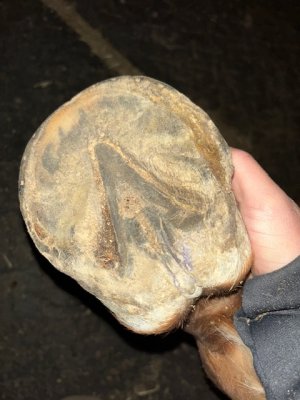
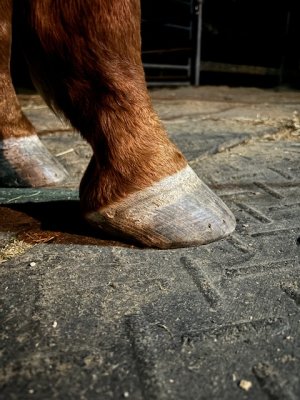
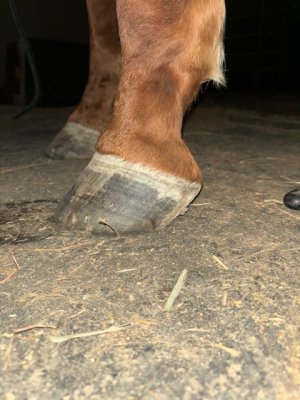
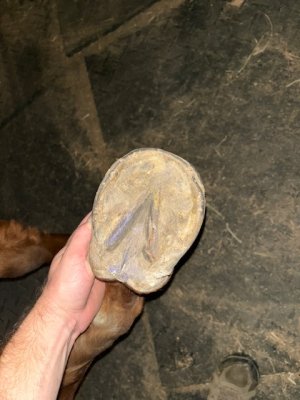
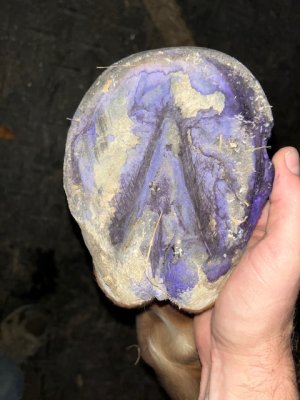
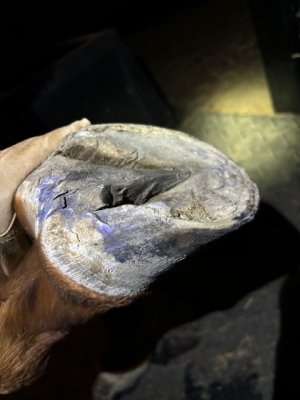
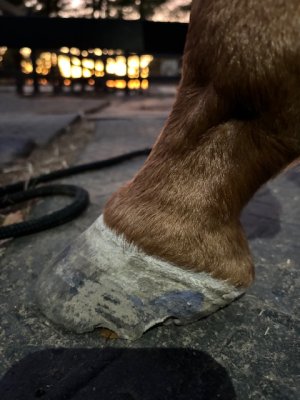
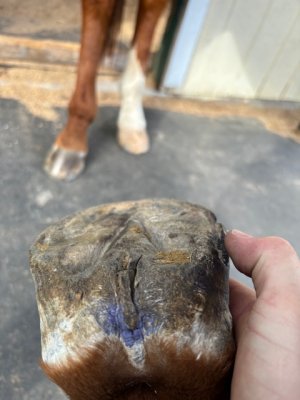
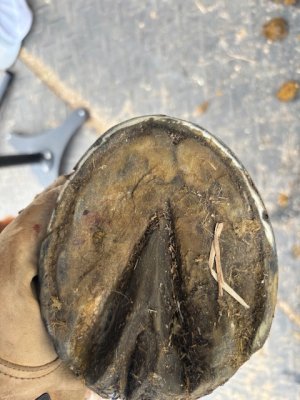
Alright - something I’ve noticed is a little hoof wall separation between the wall and the white line.
Maybe a millimeter deep.
I cleaned it out well tonight, put some durasol in it, and packed it with some hoof clay.
Was that the right move?
I’ve been applying durasol every other day or so.
 

Attachments

  • IMG_4486.jpeg
    IMG_4486.jpeg
    98.8 KB · Views: 79
  • IMG_4483.jpeg
    IMG_4483.jpeg
    117.7 KB · Views: 74
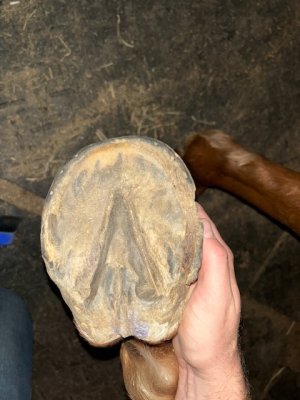
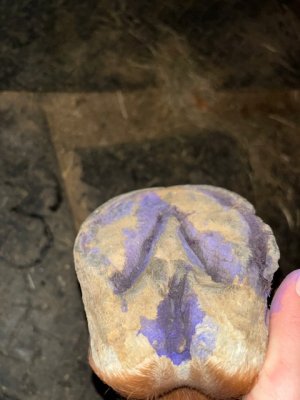
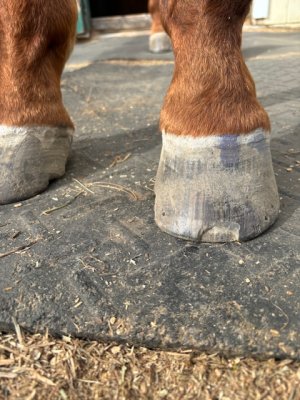
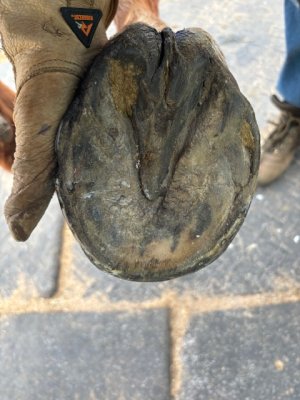
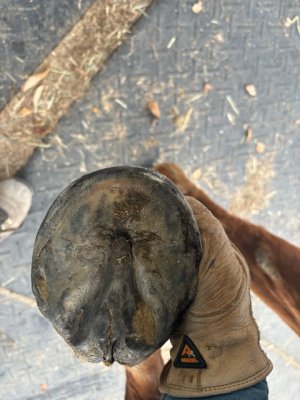
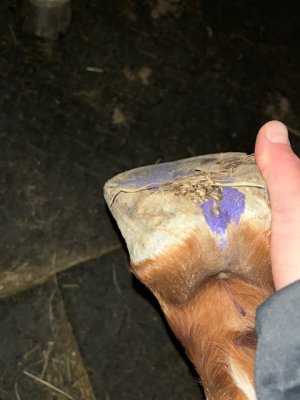
Wow just look at those heels opening up! Are these even the same hooves? The photo on the right appears to show an area that is not being weighted when the horse moves - my old cob has this (club foot improved through trimming) and it's never gone away completely. My trimmer angles the rasp away from the sole and puts a mustang roll on the area, but the sole has remained weak and doesn't build like the rest of the sole. This could be due to conformation and the way your horse moves. One thing to watch out for, is that some newly barefoot horses throw an abscess when the internal structures start to remodel. Owners see the horse very lame, and immediately assume it has to go back into shoes. Not so. Time is your friend here, and Rome wasn't built in a day! Looking good.....
 
Alright - something I’ve noticed is a little hoof wall separation between the wall and the white line.
I'm a little confused. Do you mean the white line, i. e. the lamina, or do you mean the coronary band shown in your picture where you put on the disinfectant?
 
As expected very weak caudal hoof and long toe. As highmileagecob said treat for thrush.

Don't be in too much of a rush, these hooves need to strengthen through gentle comfortable movement and you already know you have injuries within the hoof capsule that needs to heal before they can strengthen, that's why the horse was lame in the first place. If there's ligaments involved they can easily take 3 months or more to heal. When I tore my ligaments my ankle took 6 months to get back to 90% and 4 or 5 years until I no longer had an occasional twinge. Add onto that the need to strengthen the hoof and the fact it takes 9 months minimum to regrow a new reshaped hoof capsule and you can see this is a long term project. Patience will be your friend in this! Hopefully it will be very worthwhile for you both.

Edited to clarify I didn't mean it will take 4 or 5 years before you can ride again, I was just trying to explain how long full healing of some soft tissue can take. I'm now grateful for getting my injury as it has made me reassess my expectations when dealing with animal injuries just how long they sometimes need to 'come right' and how patient I need to be!
No worries!
I meant to respond to this.
His soft tissue injuries consist of thickening of lateral sesamoidian ligament.
He did have significant adhesions in bursa and inflammation around P3.
Also had possible presence of moderate edema in coronary Corium.

Luckily as of now he doesn’t have any damage to his DDFT
 
Looks like the heels and central frog cleft are already widening up, excellent! Tamponade that area to give it a bit of constant pressure and change daily.

Do you trim yourself in between farrier visits?
I don’t - if I see something bending over or something that may look to cause an issue I will rasp it.
I would love to be able to I just don’t know if I have the skill yet. I probably feel comfortable enough to round the walls a little.
 
should I be worried about the separation from the hoof wall? Or is that normal when transitioning to barefoot?
Anything I can do to help it?
 
It's often a sign of thrush, and seems to appear if there have been minor episodes of laminitis. Keep a close eye on things, and try not to let the hoof wall become long enough to act as a lever. Unfortunately it will collect grit and small stones, but again, brush/pick out at least daily. Packing with hoof clay sometimes helps.
 
It's often a sign of thrush, and seems to appear if there have been minor episodes of laminitis. Keep a close eye on things, and try not to let the hoof wall become long enough to act as a lever. Unfortunately it will collect grit and small stones, but again, brush/pick out at least daily. Packing with hoof clay sometimes helps.
Thank you. I’ll keep it clean and add some hoof clay.
Hopefully it will grow out as the foot grows.
I do see some positive changes in his foot which is nice, just need to get that figured out.
 
I would encourage you to do smaller corrections in between farrier visits. Depending on how sharp your rasp is you can start with one or two strokes, then stop, evaluate and maybe do a bit more or only after a few days, if necessary.

Try and keep the wall even with the sole.

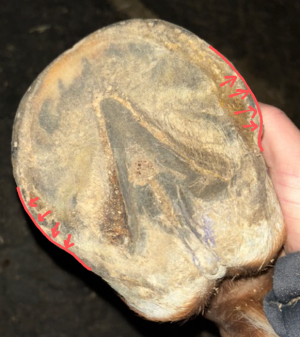
Screenshot_20241105-175500~4.pngHere I would suggest to round the wall and take away the flares. Thrush in the white line will disappear when it can grow down without being stretched anymore.

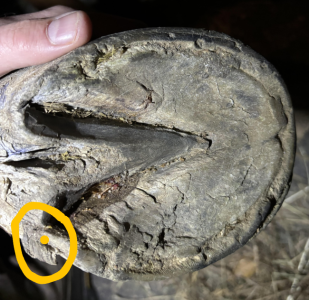
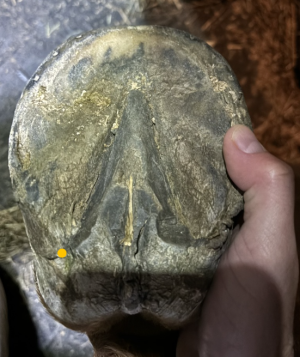
That bit of loose skin or rather the little dent where it comes out of the hoof (yellow marks below) tells you where the actual frog and heel end is as well as the actual height of each heel. You can always find it where the coronary band merges into the frog.

Screenshot_20241105-175748~3.pngScreenshot_20241105-175758~3.png
 
Noticed a little bit of the hoof wall breaking away. Not sure if it’s related to nail holes or not? Only happening on front right (non Navicular foot). The front left seems to be holding up well.
I am going to rasp and round the wall a little bit in a couple days (just waiting on a hoof stand to come in).

I have a pair of boots incoming as well!
 

Attachments

  • IMG_4517.jpeg
    IMG_4517.jpeg
    154.9 KB · Views: 58
  • IMG_4499.jpeg
    IMG_4499.jpeg
    121.7 KB · Views: 40
  • IMG_4520.jpeg
    IMG_4520.jpeg
    106.4 KB · Views: 42
Sent farrier pics and he said “that’s his weak inside wall that he’s had since I started doing him… that’s gonna be tricky”
The front left is looking better though.
 

Attachments

  • IMG_4518.jpeg
    IMG_4518.jpeg
    139.8 KB · Views: 39
  • IMG_4497.jpeg
    IMG_4497.jpeg
    111.4 KB · Views: 46
Not sure why it is going to be tricky. But if you follow the instructions about the part marked red in the previous post it will stop the breaking off. Rasp from the inside out on the red bits not round the entire wall, and rasp down at angle fine side of rasp

Image 4517 the heel is running forward, look at the tubules. If you follow the instructions for the yellow part in the previous post it will help you. I use a loop knife for this. Draw it right back through the groove. If this is the first horse you have trimmed get some gloves. It is a lot less painful especially when you use a knife. :D
 
Noticed a little bit of the hoof wall breaking away. Not sure if it’s related to nail holes or not? Only happening on front right (non Navicular foot). The front left seems to be holding up well.
I am going to rasp and round the wall a little bit in a couple days (just waiting on a hoof stand to come in).

I have a pair of boots incoming as well!
Gosh, that first photo on post 42 really shows how long and drawn forwards the heels have got. It will transform in time.

I wouldn't worry about the broken bit at all. The wall has plenty to give. I would smooth off the rest of the wall, not all to the level of the broken but, but so there isn't a dramatic drop to lever on. That area is very stretched and not tight to the hoof. By removing some of the lever, it will not be constantly pushed apart. I wouldn't go mad with it, just a bit at a time.

I like to do it slowly so the hoof can adjust slowly on the inside, but would rasp a bevel as far back as the nail holes now at the toe too. If the nail holes are there, then outside of it is just dead hoof that he doesn't need and all it is doing is adding leverage to break more off. I wouldn't rasp up the wall, just a 45 degree angle so the toe isn't pointed and the outer edge doesn't touch at the very base.

It is so satisfying to re-shape yourself. As another poster says, just a rasp or two at first, see how it looks, come back next day and see again. I find they re-shape even overnight when walked to their comfort level and lightly tidied.
 
Thank you for all the feedback!
I lightly rasped the hoof wall a little bit and rounded the edges a little.
Front right hoof wall that was chipping and pulling away finally broke off.
Anything I should do to that section? I cleaned it out.

I know with shoes on the wall and shoes take the brunt of the shock. I noticed the wall sits higher than the sole. Ideally should the walls be the same level as the soles or do you want the wall a little higher?
 

Attachments

  • IMG_4536.jpeg
    IMG_4536.jpeg
    118.7 KB · Views: 39
  • IMG_4532.jpeg
    IMG_4532.jpeg
    89.8 KB · Views: 38
  • IMG_4526.jpeg
    IMG_4526.jpeg
    116.2 KB · Views: 46
Noticed a little bit of the hoof wall breaking away. Not sure if it’s related to nail holes or not?
Not necessarily. That can and does happen to hooves that have never been shoed as well when the wall is too long.
Ideally should the walls be the same level as the soles or do you want the wall a little higher?
Same level. Leaving the wall longer means leverage, means a stretched white line, means thrush...
 
View attachment 149890
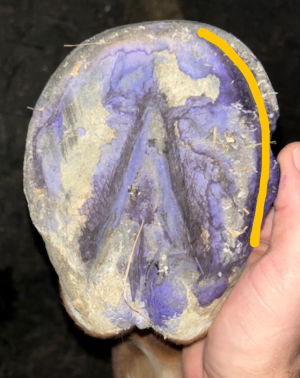
I'd remove everything outside the yellow line and rasp a 45° bevel.

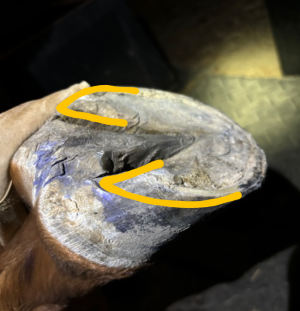
View attachment 149889
The heels are too long as well.
I would do what the first photo shows, but over a few days so you can look/assess and think.

The heels I would leave to come down with walking. I tend to leave heels unless one is much higher than the other. I would then, over a number of days, level them up somewhat.

That second photo really does show what leverage is on the walls!
 
Last edited:
I would want them toes back at some point it will stop the heals running forward but it need to be done gradually or he might be sore on them.

Did the horse have any treatment for the inflammation in the bursa?
 
Thank you!
I will rasp the hoof wall so it is level with the sole and frog.
Is there a reason I’m removing just on the right side of the image and not the middle or left?
Is that a job for the nippers or can I rasp it?

He was treated with a steroid injection in the Bursa and coffin joint in mid September. Then injected with Osphos mid October.
 
Rasping with a good rasp is the way to go unless you are very confident in your ability not to take too much off with the hoof nippers.

I had owned my nippers for two years before I dared to use them, lol, but I do now use them judiciously as and when.

My dymondback coarse rasp is very aggressive as rasps go, but is still much more controllable in use than nippers.
 
Is there a reason I’m removing just on the right side of the image and not the middle or left?
I can only judge what I see on the picture and from what I see on this picture the rest can stay although it wouldn't hurt to round the entire wall a little. If you showed me another picture of that same hoof from a different angle, I might give you a slightly different opinion. That's what you need to learn: Compare the pictures and the feedback from the forum with the real hoof in your hand. Only trim when you're certain about what needs to be done.

Is that a job for the nippers or can I rasp it?
You can use the nipper then smooth the edges with the rasp.
 
The heels I would leave to come down with walking.
I've never seen that happen with such long heels. I'm sure it can happen under perfect conditions that is with the right amount of movement and the right movement pattern on suitable, abrasive ground.

But why shouldn't I remove what I'm sure needs to go? I mean isn't barefoot trimming the attempt to simulate natural abrasion under ideal conditions?
 
Alright so the rasped the hoof wall down enough where it is almost even with the sole.

I was afraid of taking off too much around the hoof.
Both feet are starting to chip now - seems to be around where the nail holes are.
First couple photos are before, second are after.

As a note this is just over the 2 week mark from pulling shoes.
 

Attachments

  • IMG_4547.jpeg
    IMG_4547.jpeg
    136 KB · Views: 41
  • IMG_4545.jpeg
    IMG_4545.jpeg
    144 KB · Views: 38
  • IMG_4544.jpeg
    IMG_4544.jpeg
    169.9 KB · Views: 38
  • IMG_4553.jpeg
    IMG_4553.jpeg
    92.6 KB · Views: 39
  • IMG_4556.jpeg
    IMG_4556.jpeg
    128 KB · Views: 39
  • IMG_4565.jpeg
    IMG_4565.jpeg
    124.5 KB · Views: 37
  • IMG_4562.jpeg
    IMG_4562.jpeg
    133.6 KB · Views: 46
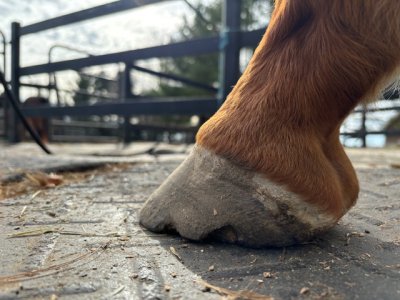
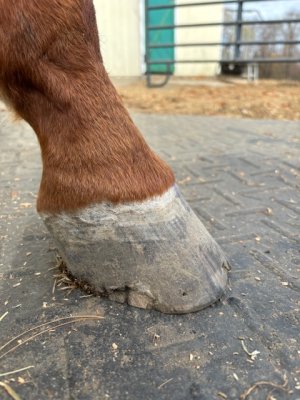
The left front foot looks substantially longer than the right one.
Still lots of thrush going on the clefts. The foot had sprouted so need much more rasped off if you cant walk out on smooth tarmac.
Lots more movement required to wear the feet and get the frog working better. And I would'nt use the same farrier that shod him.
 
Last edited:
I've never seen that happen with such long heels. I'm sure it can happen under perfect conditions that is with the right amount of movement and the right movement pattern on suitable, abrasive ground.

But why shouldn't I remove what I'm sure needs to go? I mean isn't barefoot trimming the attempt to simulate natural abrasion under ideal conditions?
You may, of course, remove whatever you wish from your horses. I was commenting to OP, who is not confident and is dealing with a compromised foot.

I am not a pro but feel the heels on the 5 I have rehabbed of my own changed and improved really quickly with road walking. I start at 100m daily and build it up from there. With OP's horse, the foot is used to shoes, the frog is poor and I would simply allow everything to settle and OP to become confident over time. I believe this is the best way for OP to work with their hoofcare professional and build their knowledge whilst keeping the horse safe.
 
Thank you. The Front left is definitely longer then the front right, and a slightly different angle too. He has always been like that. I did not touch the sole at all. Did the sole need to be trimmed a little bit which would allow me to take more length off of the hoof wall?
I apologize if that is a stupid question, very much new at this. As much as I want a professional to handle it, I would like to be able to manage it so I can keep him at the right length until his hoof care provider comes back (6 week schedule). Also,
If I break any forum rules or etiquette with the endless multiple week posting please let me know!
 
I would draw the rasp across the whole left foot including the sole and heels as they are sooo long.
The right foot I would just bevel around all the edges.
But he needs to move, move, move, walk him out daily as much as he's comfortable.
Is he still lame?
He must be very wonky in his body with so much height difference in the feet.
 
Top