
Close contact/mono flap saddles- riding in for long periods of time?

Monoflaps - won't suit all riders on all horses (build of rider's leg relative to the tree shape needed for the horse and the ribcage shape), reduced flocking and girthing options. Not an issue to be ridden in on longer rides per se, imo.

Close contact foam panels
, reduced area, pretty low tech foam in most of them (and all foams will eventually either harden or collapse, older foam panels should be inspected carefully). Should be used with sheepskin, not just wool, wool lined pads can be nice products but they don't do what sheepskin does. Not recommended for long rides imo and also, imo, most French saddles are designed way more for the rider than the horse.
 
My point is that with saddles, as with most things, for every rule there is an exception. There are plenty of pro yards out there who use these saddles every day, on horses, who work far harder and far longer than any HHO horse, without an issue. Doesn't mean we should all do it, but we shouldn't demonise it.

Sorry, missed this when I posted my reply, to a certain extent I agree with you. If you have a tack room full of saddles so you can switch out easily then they can work just fine, and if you're using the absolute best pads with them, have them checked regularly (and of course bear in mind adjustments are very limited, some can have their tree adjusted, otherwise it's about pads, shims, or a whole new panel) and work your horses really well, you'll be fine.

A fabulous classic dressage trainer uses an XW Wintec 500 dressage on everything that's younger or novice, and changing shape, just pads it up to put it in balance, and nothing has a sore back. It's not a saddle I'd want to put on anything personally (as it's a long way from the way I fit) but for some top trainers and riders a saddle can be terrible but the horse will develop just fine.
 
I don't really understand why monoflap or close contact needs to result in lower bearing surface area?

I've seen friend's monoflap close contact saddles that don't look any smaller an area than the average saddle, but maybe everything looks tiny to a WOW user?
.
 
I don't really understand why monoflap or close contact needs to result in lower bearing surface area?

I've seen friend's monoflap close contact saddles that don't look any smaller an area than the average saddle, but maybe everything looks tiny to a WOW user?
.

Is it definitely foam? What make is it?
 
I have three mono-flap saddles, two flocked and one foam (Equipe Olmpia). Skylla is exclusively ridden in mono-flaps, though if it's wool flocked not foam are they not considered close contact?

We don't use sheepskin as it would alter the fit, just normal saddlepads and if I know I'm going to be doing a lot of sitting trot the vip pad. Neither Topaz or Skylla have any issues with mainly being ridden in them and certainly no sore backs from them, though I get them regularly checked.

I'd say it's more about getting a saddle that fits you both, will result in the best comfort for you and the horse?
 
I’m not sure why the nay sayers about close contact saddles?

My mare’s BC jump saddle was awful, a real asymmetric Friday afternoon job which should never have been allowed out of the workshop, let alone fitted to her by one of the directors :rolleyes:. It never fitted her anyway - too long for her.

Her Equipe CC monoflap jump is much better. Nice even panels, good bearing surface and a wide gullet, which she needs as she has a wide backbone. And it’s not crooked.
 
I have three mono-flap saddles, two flocked and one foam (Equipe Olmpia). Skylla is exclusively ridden in mono-flaps, though if it's wool flocked not foam are they not considered close contact?

We don't use sheepskin as it would alter the fit, just normal saddlepads and if I know I'm going to be doing a lot of sitting trot the vip pad. Neither Topaz or Skylla have any issues with mainly being ridden in them and certainly no sore backs from them, though I get them regularly checked.

I'd say it's more about getting a saddle that fits you both, will result in the best comfort for you and the horse?

Strictly speaking a "close contact saddle" is a foam panel, almost by definition. However you can get at least a semi close contact fit, essential for most wider and flatter backed horses anyway, with flocking. But there is no real convention on this, just like an "event" saddle varying from VSD to XC.

They really are designed to be used with extra shock absorption, so if fitted with a cotton pad sure, you'l change the fit with a thicker pad, but the ideal is to have them fitted to accommodate a sheepskin.

And of course, ultimately the right fit is the most important thing, but if you have choices of fit then it's good to know the pros and cons.

I’m not sure why the nay sayers about close contact saddles?

My mare’s BC jump saddle was awful, a real asymmetric Friday afternoon job which should never have been allowed out of the workshop, let alone fitted to her by one of the directors :rolleyes:. It never fitted her anyway - too long for her.
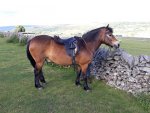
Her Equipe CC monoflap jump is much better. Nice even panels, good bearing surface and a wide gullet, which she needs as she has a wide backbone. And it’s not crooked.

One badly made and badly fitted flocked saddle, and one CC with a decent panel area doesn't disprove the generalisation, I did talk about the foam and the trees above too, and they're the bigger reason I'm not such a fan.
 
I’m not sure why the nay sayers about close contact saddles?

My mare’s BC jump saddle was awful, a real asymmetric Friday afternoon job which should never have been allowed out of the workshop, let alone fitted to her by one of the directors :rolleyes:. It never fitted her anyway - too long for her.

Her Equipe CC monoflap jump is much better. Nice even panels, good bearing surface and a wide gullet, which she needs as she has a wide backbone. And it’s not crooked.
every Ideal saddle I've had or ridden in has been squint, even the ones bought new. I guess i have just been unlucky, but it's a bit worrying.
 
Bench made saddles do have a very small hand made tolerance, they can be functionally straight but have a "handedness" depended on whether the maker is left or right handed. Obviously genuinely wonky is a different issue and needs sorting, and I've seen plenty of "injection moulded tree so they can't be wonky" saddles BE wonky. Very wonky, and yes, when new.

It's a minefield as even fitters can call out a saddle for being crooked and it's found by independent inspectors to be absolutely straight, just the visual issue as mentioned. It causes huge problems, there are jigs that can be used that mean a saddle can't even look "off" but it requires a different method of manufacture and gets away from the bench made "premium".
 
thanks SB that's interesting. i totally lost confidence in the saddlers that supplied my new ones, they just told me the horse was crooked but we never could get the saddle straight despite ridiculously frequent adjustments and tbh you could see how squiffy it was on the rack. I swapped to an equipe and a Wow which sat straight on the horse so... what do you do. Probably not the fault of Ideal, i guess i should have pushed harder to get the saddle sent back or something instead of getting constantly fobbed off by the saddler, interestingly other HHOers recommend the same one so it can't be a universal issue.
 
I don't really understand why monoflap or close contact needs to result in lower bearing surface area
.

Can only speak from handling Devoucoux jump saddles - they just seemed so so light, small and compact (and were fitted for someone tall too) compared to say the Albion K2 (old or new version). Whether it's the shape, or cut of the panels I don't know.

I genuinely got it out the box and went 'is that it?' given the price...
 
I have a Strada St Christopher endurance saddle on my pony which I bought second hand. So, presumably this is a close contact saddle (it has memory foam panels) designed for long hours in the saddle. I found it to be the most comfortable saddle for the rider and also an excellent fit on my pony. So, does this mean that the claim that close contact saddles are not designed for riding long periods of time cannot be used for all close-contact saddles?37A3C14E-5F85-4793-A41B-22E1CFA618D0.jpeg
 
Last edited:
I have a Strada St Christopher endurance saddle on my pony which I bought second hand. So, presumably this is a close contact saddle (it has memory foam panels) designed for long hours in the saddle. I found it to be the most comfortable saddle for the rider and also an excellent fit on my pony. So, does this mean that the claim that close contact saddles are not designed for riding long periods of time cannot be used for all close-contact saddles?

Not really, the true/original close contact saddles are also jumping saddles, though of course there are now dressage versions (perhaps even GP etc) and they do not have memory foam. See The Truth Tack Review I mentioned higher up to see the type of foam they use. Strada also do not have anything like the classic close contact trees in them, completely different shapes. As I said above, there is no single definition of either a close contact fit, or a close contact saddle, but the closest to universal is a certain type of continental jump saddle on a (not memory) foam panel.

I will use an example of tree shape in CC style saddles; the Equipe comes in a XXW (maybe only in some models?) but because of tree shape this width still has a very narrow pommel and a narrow twist. The way that I fit, no XXW horse should be a narrow pommel or twist. They just don't go together, and you can find research done by Latif in 2018 into twist width. Narrow twists aren't just a bad idea on wider horses, but this piece of research shows the narrower the twist the more pressure, on average, under the twist on all shapes of horses.

A narrow pommel means the front of the tree doesn't wrap AROUND the horse, it sits like an old fashioned dolly style clothes peg, usually giving more pommel clearance (height) compared to a wider pommel, presenting a challenge to get the tree points parallel to the ribcage in many cases while keeping the saddle in balance. The same applies to the TG/K&M/Fairfax headplate, a very narrow V shape.

They work great for some horses (and oh that we understood everything about fitting saddles, we really don't, we have LONG way to go, as with all equine professions and sciences), and some fitters will be brilliant at getting good results with them, but if you run into issues, consider all of this. It's like Wintecs, because they have a "kink" in the headplate, tend to cause pressure at the bars, not on every single horse, but it's the most common reason for them not working.

Back onto pommel and twist width one fairly modern approach to saddle fitting, Saddle Fit 4 Life, recommends a wide pommel, and at least slightly wider twist, for all shapes of horses, allowing a narrower horse to have literally an upside down U with a narrow angle at the points, to match the SHOULDER angle, but a very wide head to give space around the wither. So arguable a narrower horse, especially with prominent spinal processes in a higher wither, needs space laterally at the wither and that means a wide head.

There are many different saddle fitting methods, mine is on a medium wide pommel shape, fitting to the ribcage angle with short points, a moderate to wide twist and flatter trees. Because tree shape is such a mystery, for reasons valid and less valid (ie they can't be seen makes it valid, the lack of education/interest/understanding less valid) it's easy to not consider it, because it's not obvious and not easy to understand, but it's a good idea to understand the material of the tree in your saddle, how adjustable it is (and are there any downsides and limitations to the angle change) and the fitting implications of the overall tree shape. New research is coming through all the time, it's worth being up to date on it and asking your fitter, or a brand you're considering, how their trees (and panels) fit the horse.

THEN we get onto saddle fit for the rider :eek::p:cool:
 
Last edited:
Rachel Baylis saddles are basically Semi-flex as far as I know, or at least Dolman/Humphries and Swain made, they have a non-gusseted plain panel but aren't close contact saddles.


What defines close contact, SB? They seem to have very thin foam panels and at least two friends who have them call them close contact, as I did when I had one made 20 years ago. They are full tree , I think semi-flex is part tree?
 
I've posted three times saying there's no single definition, which is why we're having this conversation to such an extent.

The closest is, as I just said, the close contact, usually french, jump saddle. Some Italian saddles would come very close to the same definition. Other saddles it's more debatable, and, as I say, you can achieve a semi close contact fit with the right flocked panel.

I don't think Nick Dolman or anyone else who makes that style of saddle would call them a close contact saddle. The panels really aren't that thin, but I'd also say all those I've seen are flocked. The semi flex is a full tree with a hinge in the middle, as far as I know.
 
Bayliss saddles appear to be made by Barrie Swain so will be a tree like this not quite a hinge, but the centre section is flexible as well as the points, and the points will be more flexible and/or through more of their length than regular flexible points which are generally just a softer last inch or two, leather or possibly plastic (I think, not an expert on that @cremedemonthe might know more).

https://www.bettersaddles.co.uk/shop/semi-flex-saddles
 
I've posted three times saying there's no single definition, which is why we're having this conversation to such an extent.

Apologies I had not seen that, but if it's the case that there no definition, then it puzzles me that you made such a plain statement that Rachel Bayliss saddles are not close contact. It's the view of everyone i know who owns them and I think of Rachel herself, that they are.
.
 
Apologies I had not seen that, but if it's the case that there no definition, then it puzzles me that you made such a plain statement that Rachel Bayliss saddles are not close contact. It's the view of everyone i know who owns them and I think of Rachel herself, that they are.
.

They absolutely do not fit the closest we get to a definition, the close contact continental jump saddle. They are, afaik, exactly the same in tree and panel as Swain semiflex, and I do not consider those to be close contact. The nature of this post gives us an implied working definition, the narrower one of a smaller foam panelled saddle which IS commonly said to not be suitable to ride in for long periods.

If we do use a wider definition, such as to include the Strada endurance saddle shown above, and your semiflex to a certain extent, it stops being useful in the context of this post. You could even include the semi close contact fit I achieve with the designs of saddles I fit, they are designed to fit that way and I would say are closer contact in that regard than any semiflex I've seen.

We are trying to identify the type of saddle that isn't suitable to ride in for long periods, the semiflex is not one of them.

EDITED TO ADD

Finding photos of Bayliss saddles (I had seen one in the flesh but several years ago) they do have a thinner panel than regular semiflexes, but I would still say, and I wish there WAS a firmer definition, that they have a slimline panel for a semi close contact fit, rather than being a close contact saddle. I think the close contact saddle should be the narrower definition, which also actually includes a certain type of flap, the SJ rather than XC style, neat, not super forward cut and small, high blocks. The US perhaps defined them as such, used for H/J and almost always French initially, though other companies got in on the act.

And I had to laugh, up pops a page from the website for the brand I fit for, the designer of which says they're close contact. We see the saddle world from very different perspectives and I would disagree with her use of the term lol.
 
Last edited:
I've posted three times saying there's no single definition, which is why we're having this conversation to such an extent.

The closest is, as I just said, the close contact, usually french, jump saddle. Some Italian saddles would come very close to the same definition. Other saddles it's more debatable, and, as I say, you can achieve a semi close contact fit with the right flocked panel.

I don't think Nick Dolman or anyone else who makes that style of saddle would call them a close contact saddle. The panels really aren't that thin, but I'd also say all those I've seen are flocked. The semi flex is a full tree with a hinge in the middle, as far as I know.

I agree - I do not consider the Ideal Monoflaps close contact nor anything which offers a semi deep seat of a similar ilk (silhouette etc) . They are very different to ride in to a true CC which has a much flatter seat. Years and years ago I worked with Ideal when they were first bringing out the Impala Pro. At the time Ideal were pliance testing everything and No1 best performer was a Butet. The Impala Pro came in 2nd.
 
Hm, interesting. I have the issues sbloom mentioned with Equipe and my horse's withers. My trainer has the issue too (owns a few Equipes) and has asked to borrow my Fairfax for one that needed more room. I don't find the Fairfax to be "very narrow" V shaped, but it's obviously V and not U. I've definitely seen more narrow V shaped saddles.

I feel as though a lot of riders sort of obsess over needing a narrow twist (maybe just in dressage), which is interesting. Do a vast majority really need them? I know that women typically aren't as flat on the inner thigh as men which is often brought up.
 
Hm, interesting. I have the issues sbloom mentioned with Equipe and my horse's withers. My trainer has the issue too (owns a few Equipes) and has asked to borrow my Fairfax for one that needed more room. I don't find the Fairfax to be "very narrow" V shaped, but it's obviously V and not U. I've definitely seen more narrow V shaped saddles.

I feel as though a lot of riders sort of obsess over needing a narrow twist (maybe just in dressage), which is interesting. Do a vast majority really need them? I know that women typically aren't as flat on the inner thigh as men which is often brought up.

I have an albion dr and a equipe dr - the narrower twist of the equipe means my leg position, hip alignment and how I can use the aids is a lot better. I tolerate the Albion but I don't really like it. I joke that it feels like you are sat in a bucket.
 
I have an albion dr and a equipe dr - the narrower twist of the equipe means my leg position, hip alignment and how I can use the aids is a lot better. I tolerate the Albion but I don't really like it. I joke that it feels like you are sat in a bucket.
I feel the same about equipe vs albion. Most albion/ideal and that type of shaped dressage saddle gradually make me more and more uncomfortable, so while i can cope for a short period e.g. riding someone else's horse, for my own the equipe/amerigo shape just feels like "home", my leg hangs where it's supposed to, my hips don't ache and I can actually use my aids correctly instead of it being a vague approximation of what I intended.
 
I feel the same about equipe vs albion. Most albion/ideal and that type of shaped dressage saddle gradually make me more and more uncomfortable, so while i can cope for a short period e.g. riding someone else's horse, for my own the equipe/amerigo shape just feels like "home", my leg hangs where it's supposed to, my hips don't ache and I can actually use my aids correctly instead of it being a vague approximation of what I intended.

I have the same issue with the Fairfax as well both jump and dressage. I would need to try the Harry Meade version but not convinced there will be much difference as still based on the same tree.
 
That's great that Amerigo and Equipe work for some of you. They work for me too, but not my horse so...moot point for me. Sort of curious about Erreplus though.

My Albion Fabrento is the easiest Albion to get along with, for me. I do ok in the Fairfax but it's a bit too much for me. I ordered its replacement from Sommer back in August and I'm still waiting ?

I would love to ride in some of the Italian or French saddles but if they don't work for my horse (and I've tried many out of desperation ?) then it doesn't matter how good they feel to me. I really hate saddles, actually. Even though I need and use them ?

I see some saddles that are so A shaped or tight at the withers that I wonder which horses they actually fit ? there are some that I've seen for sale and really was tempted to ask for photos of the horse it was on.

ETA: Re Fairfax and K&M I tried a K&M dressage (can't recall the model) and it felt like sitting on top of the letter A. Or maybe the narrow side of a 2" x 4' board or something like that. The Fairfax didn't feel this way...but aren't they on the same tree?

I've no idea what kind of twist I actually need. I assume more on the narrow side?
 
That's great that Amerigo and Equipe work for some of you. They work for me too, but not my horse so...moot point for me. Sort of curious about Erreplus though.

My Albion Fabrento is the easiest Albion to get along with, for me. I do ok in the Fairfax but it's a bit too much for me. I ordered its replacement from Sommer back in August and I'm still waiting ?

I would love to ride in some of the Italian or French saddles but if they don't work for my horse (and I've tried many out of desperation ?) then it doesn't matter how good they feel to me. I really hate saddles, actually. Even though I need and use them ?

I see some saddles that are so A shaped or tight at the withers that I wonder which horses they actually fit ? there are some that I've seen for sale and really was tempted to ask for photos of the horse it was on.

ETA: Re Fairfax and K&M I tried a K&M dressage (can't recall the model) and it felt like sitting on top of the letter A. Or maybe the narrow side of a 2" x 4' board or something like that. The Fairfax didn't feel this way...but aren't they on the same tree?

I've no idea what kind of twist I actually need. I assume more on the narrow side?

Maybe try something like an Ideal Roella? Narrow twist on an english tree I think its the closest compromise you will get. I don't know what level you compete at but K&M I find are fine if not competing at a decent level. They are what they are and designed for mass market riders.
 
Maybe try something like an Ideal Roella? Narrow twist on an english tree I think its the closest compromise you will get. I don't know what level you compete at but K&M I find are fine if not competing at a decent level. They are what they are and designed for mass market riders.

Thought about a Roella. I tried the Suzannah and that was too much saddle for me. I did see that Ideal has other (maybe newer) monoflap models now that I'm not familiar with. No Ideal rep here though. Closest one is 6 hours away.

We're at the equivalent of Advanced Medium (in German levels) and my saddle preferences haven't changed too much. I always have to sit in them though. There's been some I like "on paper" then ridden in them and been like "what's going on here" ? I find dressage saddles to be so personal, or I'm just picky.
 
Back to the original question of the thread...I recalled a conversation with a fitter I trust and have used before who mainly deals with trekking saddles now. He believes that a wide or larger surface area when it comes to the panels is best and prefers wool. I've also seen some that are compact, so suit a short back, but wide (obviously wouldn't suit all horses). Another local fitter did say that Western saddles are best for distance riding due to this (surface area thing). Makes some sense I guess.
 
Top