
cob&onion
Well-Known Member
O I meant I love C&O's girly. I'm slightly obsessed with her ears. Although yours is also lovely!
Thank you, yes her "fly protection ears" lol


O I meant I love C&O's girly. I'm slightly obsessed with her ears. Although yours is also lovely!


I'd be very surprised to see a pro fit a loose ring pelham with the cheekpieces attached to the bit rings ..........
If you are worried about the curb action then a leather curb, or shorter shanks could be a solution.


Right thoroughly confused! Is this the bit developed by Paul Belton and Klaus Balkenhol years ago, as a intermediate from snaffle to double? Have to say cannot find ANY info on that ^ and I dont think I dreamed it (but it obviously never took off or disappeared into the abyss for some reason or other) But from memory wasnt that meant to be worn with a double headpiece? Apologies if I'm way off track but I'm out of ideas as to what else a 'Belton bit' is?

..... and if any of you are game to advice Lynn Russell on how this bit should be fitted then goodluck to you

This made me laugh! If any of you had as much knowledge as Lynn or anyone else who makes a living from horses I am sure you realise that EVERYBODY, no matter who they are takes on board advice, whether it is what they think they know or are to be proven wrong.
Nobody knows everything about anything and if they think they do they are a fool.


My guess is some "expert" trainer/producer/YO is peddling this incorrect way of fitting pelhams as the solution to some problem like horse evading the bit.
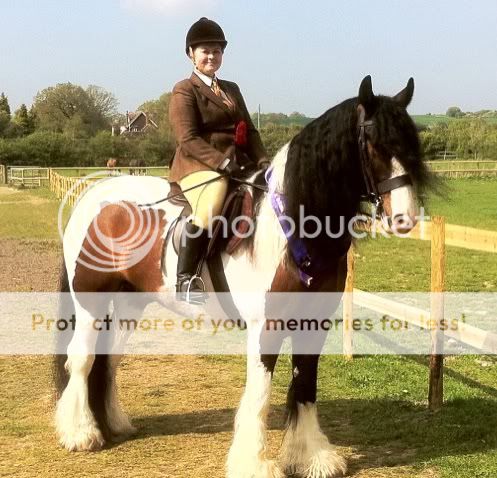
OP, I like your cob, I'd leave her traditional.
The bit works as follows:
The top rein and cheekpiece are attached as Riverdalec has them - to the "snaffle" ring, just like any normal snaffle. As the picture of the bit shows, this is actually a straight bar which fits through the pelham's sides and can rotate independently, thereby remaining completely indepedent from the rest of the mouthpiece and simulating riding in a normal snaffle. The bottom rein is attached to the lower ring on the pelham and the curb chain is attached to the top "redundant" ring. Attaching the curb chain at the required "tightness" for the particular horse allows you to dictate when the pelham shank will stop rotating when the bottom rein is pulled. The key to this design is that, even when you pull on the bottom rein to the point of bringing the curb chain into play, you are still NOT exerting any poll pressure as the shank of the pelham is in NO WAY connected to the main bridlework. The poll pressure remains exactly the same as riding in a bog standard loose ring snaffle type bit.
The bit is fitted correctly.
Okay, adding a more philosophical view point. Who decides what is right or wrong? Ultimately it should be the horse.........

Yes, unless its dangerous. With that bit fitted with the cheekpieces attached to the snaffle rings, there is nothing at all stopping the curb chain from infinite tightness when the bottom rein is pulled, is there?




IMO bits don't come with redundant rings on them for no apparent reason.
.

No, I agree, I don't think there is... no stability at all of top ring.
Riverdalelc could you tell me where I could find this bit please? I have googled Belson bit and had no results.
Which confirms it was the bit I was thinking of. And I still think it should be worn in a double bridle. The whole point of this bit being developed was to create a bit that was somewhere in between a snaffle and a double. Ie a double but without putting two bits in the mouth.
This makes more sense now, I can understand the action, I was going to say in reply to the OP that it looked like her curb rein was way too tight/short, but this would explain the angle.
OP if that is the effect you want, why not just use a loose ring straight bar snaffle with a curb strap?