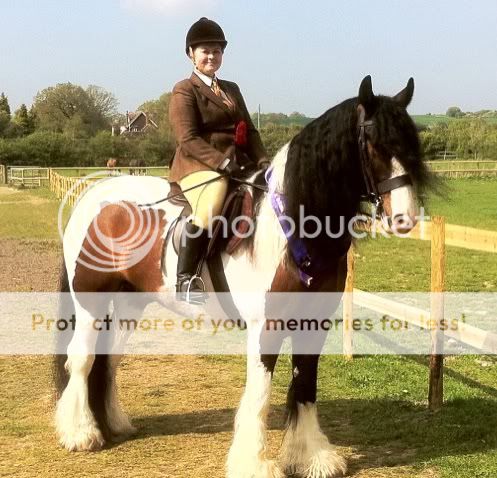
From hairy cob to sport horse and a colored showing question.

Bakedbean, you obviously seem to think you have a knowledge of this type of bit, therefore you should know that a curb chain is fitted so to only come into action when the bit is at a 45degree angle, therefore the way this particular bit is fitted it is not using the same pressure points so unless used in a vicious manner it is using the same action as a snaffle.

I have seen these bits in the county show ring before by pro's and it is fitted correctly.

Think you need to stick your nose into some more books!
 
I'd be very surprised to see a pro fit a loose ring pelham with the cheekpieces attached to the bit rings ..........:confused:
If you are worried about the curb action then a leather curb, or shorter shanks could be a solution.
 
I'd be very surprised to see a pro fit a loose ring pelham with the cheekpieces attached to the bit rings ..........:confused:
If you are worried about the curb action then a leather curb, or shorter shanks could be a solution.

I think it has already been pointed out that it is NOT a loose ring pelham.

As riverdalelc has pointed out, this bit is intended to be fitted this way, hence giving curb action but not poll pressure (which some horses hate). It will give a very similar action to a swales I imagine, but with less risk of the corners of the mouth being pinched.

..... and if any of you are game to advice Lynn Russell on how this bit should be fitted then goodluck to you
 
Right thoroughly confused! Is this the bit developed by Paul Belton and Klaus Balkenhol years ago, as a intermediate from snaffle to double? Have to say cannot find ANY info on that ^ and I dont think I dreamed it (but it obviously never took off or disappeared into the abyss for some reason or other) But from memory wasnt that meant to be worn with a double headpiece? Apologies if I'm way off track but I'm out of ideas as to what else a 'Belton bit' is?
 
Right thoroughly confused! Is this the bit developed by Paul Belton and Klaus Balkenhol years ago, as a intermediate from snaffle to double? Have to say cannot find ANY info on that ^ and I dont think I dreamed it (but it obviously never took off or disappeared into the abyss for some reason or other) But from memory wasnt that meant to be worn with a double headpiece? Apologies if I'm way off track but I'm out of ideas as to what else a 'Belton bit' is?

That was my thought too, not that I know anything about it, it just looks to my eye incorrectly dressed, as no slip head.

ETA absolutely CRACKING horse though!! No wonder you are so often in the money, so to speak :)
 
..... and if any of you are game to advice Lynn Russell on how this bit should be fitted then goodluck to you

This made me laugh! If any of you had as much knowledge as Lynn or anyone else who makes a living from horses I am sure you realise that EVERYBODY, no matter who they are takes on board advice, whether it is what they think they know or are to be proven wrong.
Nobody knows everything about anything and if they think they do they are a fool.
 
This made me laugh! If any of you had as much knowledge as Lynn or anyone else who makes a living from horses I am sure you realise that EVERYBODY, no matter who they are takes on board advice, whether it is what they think they know or are to be proven wrong.
Nobody knows everything about anything and if they think they do they are a fool.

Yes, absolutely... but why has the bit, if it is fitted correctly, got a totally redundant loop at the top (usually for the cheek piece attachment on any other curb bit)?
i've never seen a bit with an unnecessary loop.
i'm totally prepared to accept it if I am wrong but it does look incorrectly fitted to me, based on previous experience.
 
My guess is some "expert" trainer/producer/YO is peddling this incorrect way of fitting pelhams as the solution to some problem like horse evading the bit.

OP, I like your cob, I'd leave her traditional. :)
 
The bit works as follows:

The top rein and cheekpiece are attached as Riverdalec has them - to the "snaffle" ring, just like any normal snaffle. As the picture of the bit shows, this is actually a straight bar which fits through the pelham's sides and can rotate independently, thereby remaining completely indepedent from the rest of the mouthpiece and simulating riding in a normal snaffle. The bottom rein is attached to the lower ring on the pelham and the curb chain is attached to the top "redundant" ring. Attaching the curb chain at the required "tightness" for the particular horse allows you to dictate when the pelham shank will stop rotating when the bottom rein is pulled. The key to this design is that, even when you pull on the bottom rein to the point of bringing the curb chain into play, you are still NOT exerting any poll pressure as the shank of the pelham is in NO WAY connected to the main bridlework. The poll pressure remains exactly the same as riding in a bog standard loose ring snaffle type bit.

The bit is fitted correctly.
 
There should NOT be a sliphead attached, Spaniel, that is the precise point I'm trying to make! If you attach a sliphead which then fits in with the rest of the bridlework, you completely negate the action and intended effect of the bit - to minimise poll pressure as much as possible!
 
Last edited:
My guess is some "expert" trainer/producer/YO is peddling this incorrect way of fitting pelhams as the solution to some problem like horse evading the bit.

OP, I like your cob, I'd leave her traditional. :)


I am not entering the is it right or not as I don't know! but just thought that if the bit was fitted incorrectly - how come this combination are doing so well competitively? surely it would have been picked up by now if it was wrong? particularly with showing when everything is so finely scrutinised..
 
The bit works as follows:

The top rein and cheekpiece are attached as Riverdalec has them - to the "snaffle" ring, just like any normal snaffle. As the picture of the bit shows, this is actually a straight bar which fits through the pelham's sides and can rotate independently, thereby remaining completely indepedent from the rest of the mouthpiece and simulating riding in a normal snaffle. The bottom rein is attached to the lower ring on the pelham and the curb chain is attached to the top "redundant" ring. Attaching the curb chain at the required "tightness" for the particular horse allows you to dictate when the pelham shank will stop rotating when the bottom rein is pulled. The key to this design is that, even when you pull on the bottom rein to the point of bringing the curb chain into play, you are still NOT exerting any poll pressure as the shank of the pelham is in NO WAY connected to the main bridlework. The poll pressure remains exactly the same as riding in a bog standard loose ring snaffle type bit.

The bit is fitted correctly.

I have to say, looking at the construction of that bit, that is exactly the conclusion I have come to as well.

To fit a slip head would negate the lack of poll pressure.

I don't think people are looking carefully enough at how the bit is put together.
 
Okay, adding a more philosophical view point. Who decides what is right or wrong? Ultimately it should be the horse.........

Yes... but some will put up with a lot (not saying this one is, looks very happy). I've seen a pelham put in upside down, and the horse was going okay in it. ditto hanging cheek snaffle. does that make it okay to fit one like that?

alphanumeric - are the curb chain hooks hanging off the topmost link then? i can't really tell from the photographs, i thought the curb chain started from lower.
ah, found a pic of it elsewhere, they do. okay, top ring not redundant after all then, so i'll shut up. ;) ;)
 
Last edited:
Yes, unless its dangerous. With that bit fitted with the cheekpieces attached to the snaffle rings, there is nothing at all stopping the curb chain from infinite tightness when the bottom rein is pulled, is there?
 
As an aside... showing folk get away with all sorts if they're famous enough...

IMO bits don't come with redundant rings on them for no apparent reason. Normally a sliphead would attatch to the snaffle because the checkstrap would be sitting on the top ring.

That it's a double bridle with no sliphead is wrong in itself, but because of the redundant ring on the top, there isn't anywhere to put it!

The bit is supposed to give the look of a double bridle. IE a bridle with two bits. A bridle with one bit is correct as long as it looks like two.

Just as a thought though, owning a cob who hates the poll action of a pelham myself... why don't you just slacken the curb rein a little? Mine is always slightly slacker than the snaffle rein because, like I said, Dorey hates poll action and will bolt with me if she senses it in play.
Means she can show in the correct way (with sliphead etc) and the pelham is fitted right.
 
Her conformation and type is a native. She does not have the feather, bone or width for a traditional, not a hunter type and not a show cob, she is too native/pony like to be compared to them and I would also image not big enough. I would image she is welsh x gypsy cob.

To get her correct for her type, keep the legs natural, tidy and shorten the mane as they do on Welsh Ds, leave the tail natural. Trim the outside of her ears and her jawline.

Tack - plain with a hunter noseband. You can use a pelham or a double.

You need to show in a tweed jacket.

Although my lad is a traditional, you need the same sort of outfit and tack as I use.

Stinky as a 5 year old in a pelham.

HeadShot.jpg


This is April, he is in his double - saddle cloth is far too forward, I had quickly put the saddle on and jumped onboard for this photo.

StinkyqualfiedRIHS.jpg


Turned out correctly as a native, if she moves well, she could be successful as from the photos, she has potential.
 
Riverdalelc could you tell me where I could find this bit please? I have googled Belson bit and had no results.
 
Riverdalelc could you tell me where I could find this bit please? I have googled Belson bit and had no results.

http://www.doebert.com/product_list_albion.php?active_nav=105&lid=2&wpid=105#262

Which confirms it was the bit I was thinking of. And I still think it should be worn in a double bridle. The whole point of this bit being developed was to create a bit that was somewhere in between a snaffle and a double. Ie a double but without putting two bits in the mouth.
 
If it was just a snaffle, MG, it would be a snaffle.

A normal pelham works as a lever, you pull the curb, the bit is the pivot point, so you exert pressure on the poll.

This bit has no pivot point as the snaffle rings are being used for the cheekpieces (a normal showing bridle would put the sliphead on here).

The reason the bit isn't stable is that without something holding those top rings you can pull the curb chain as tight as you like and effectively nutcracker the horses chin. I certainly wouldn't ride in such an unstable bit for the sake of removing poll pressure when a slacker curb chain will suffice.

It's also incorrect to show without a sliphead, which in this case is impossible to fit as putting it on the top rings would bring the lever action back into play.

It's a very bizarre bit if I'm honest. And far more severe than any snaffle OR pelham I've ever seen!
 
Which confirms it was the bit I was thinking of. And I still think it should be worn in a double bridle. The whole point of this bit being developed was to create a bit that was somewhere in between a snaffle and a double. Ie a double but without putting two bits in the mouth.

This makes more sense now, I can understand the action, I was going to say in reply to the OP that it looked like her curb rein was way too tight/short, but this would explain the angle.
OP if that is the effect you want, why not just use a loose ring straight bar snaffle with a curb strap? :confused:
 
This makes more sense now, I can understand the action, I was going to say in reply to the OP that it looked like her curb rein was way too tight/short, but this would explain the angle.
OP if that is the effect you want, why not just use a loose ring straight bar snaffle with a curb strap? :confused:

I'm guessing because a loose ring, straight bar snaffle isn't permitted in the showing classes that the poster uses the Belton bit for? I've read the replies and seem to have come to an uneducated assumption that the bit is for horse that don't actually like the action of a pelham but need one to conform to the entry requirements of the showing class they have entered?

I do agree the bit looks "wrong" on a first glance at the photos but perhaps it's action/usage is more apparent when viewed in the flesh.

I know nothing about bitting and am probably talking complete tosh, but surely a loose headslip (if that ring can even take a headslip) wouldn't exert much poll pressure anyway, as the cheekpiece isn't attached up there, and would only come in to any effect if the curb rein was really yanked on?

I would bet this bit is only used on this horse when they're showing and the poster rides in a snaffle at home.
 
Top