Individual turnout

Is your horse on individual turnout?


  • Total voters
    236
For my contribution, it isn't enough to just compare individual turnout to group turnout. Group turnout, where there is not enough food for all, or not enough space for all, or the wrong mix of horses, or an ever changing mix of horses cannot be good for them for other reasons, and at some point, the benefit of having other horses to socialise, is outweighed by other factors. There has to be a tipping point.
It is like that that other perennial debate "stabled versus non-stabled" where you get the extremes of a horse in an active yard with plenty of exercise and stimulation and perhaps 2 hours of turn out, or a horse standing 23 hours a day in a dark stable and minimal stimulation and next to no exercise, and a horse in a postage stamp of a boring square of grass surrounded by electric fencing, or a bunch of horses knee-deep in mud standing around a haylage feeder, or a happy herd in a large space with plenty of the right sort of grazing and shelter to when they want it.
Just bound to cause endless arguments :rolleyes:
 
The whole notion of risk is interesting here; for some the risk of potential physical injury from interaction with other horses, as would happen naturally, is more significant than the longer term definite physical and psychological risks resulting from individual/separated turnout. I guess you take your choice? Naturally, in settled herds, healthy horses do not beat the c**p out of each other so that scenario suggests a significant level of stress or other driver to that behaviour. That is a bit of a concern isn't it? I have had to introduce horses to a herd at livery, had horses clash with each other etc etc and all of that can be managed to a safe and successful outcome but in some livery and private yards neither the inclination nor the horsemanship exists to achieve that. If people want their horses on individual turn out then so be it; there will be reasons for that but the facts are that this is not the best, even in an imperfect, humanised world, for them. The reliance of facts, science, study is patchy on HHO at best and in this instance distinctly wobbly lol.
What a load of tripe.

Previous to this lad ive alwas had my horses with at least one other, normally in a herd of about 6. Ive managed more introductions than most and most have been successful.

If you think you can turn my lad out with others successfully then be my guest but i’ll take no responsibility for the vet bills or deaths that occur

He is thoroughly miserable in a herd, paranoid and aggressive. Individual turnout next to other horses he is sweet as pie, will groom others over the fence, is wonderfully content and not food aggressive.

So please keep preaching your evangelical holier than thou lament whilst the rest of us live in the real world
 
The whole notion of risk is interesting here; for some the risk of potential physical injury from interaction with other horses, as would happen naturally, is more significant than the longer term definite physical and psychological risks resulting from individual/separated turnout. I guess you take your choice? Naturally, in settled herds, healthy horses do not beat the c**p out of each other so that scenario suggests a significant level of stress or other driver to that behaviour. That is a bit of a concern isn't it? I have had to introduce horses to a herd at livery, had horses clash with each other etc etc and all of that can be managed to a safe and successful outcome but in some livery and private yards neither the inclination nor the horsemanship exists to achieve that. If people want their horses on individual turn out then so be it; there will be reasons for that but the facts are that this is not the best, even in an imperfect, humanised world, for them. The reliance of facts, science, study is patchy on HHO at best and in this instance distinctly wobbly lol.
To be fair there’s nothing objectively factual about your post either it’s just another opinion.
 
What a load of tripe.

Previous to this lad ive alwas had my horses with at least one other, normally in a herd of about 6. Ive managed more introductions than most and most have been successful.

If you think you can turn my lad out with others successfully then be my guest but i’ll take no responsibility for the vet bills or deaths that occur

He is thoroughly miserable in a herd, paranoid and aggressive. Individual turnout next to other horses he is sweet as pie, will groom others over the fence, is wonderfully content and not food aggressive.

So please keep preaching your evangelical holier than thou lament whilst the rest of us live in the real world

That is quite a strong response. I am not aiming to be holier than though or evangelical. Horses are social, herd dependent animals. If your horse is miserable, paranoid and aggressive with others then that horse may have a historic or ongoing issue. It's just not normal for horses to struggle in such an extreme way with other horses though of course individuals clash/don't get on etc. Some horses choose to be more independent but that is their choice. I had no intention to cause offence but the science and study of equines is pretty established in the need for a herd situation.
 
To be fair there’s nothing objectively factual about your post either it’s just another opinion.

What do you mean? It is my opinion that reliance on facts, science and study on HHO is wobbly, true but I think the science around horses needing to be part of a herd is really well established.

ETA: Defra's code of Practice for the welfare of horses, ponies, donkeys and their hybrids (2017) does spell out that horses should not be kept individually. It does identify aggressive animals as potentially needing individual turnout whilst stressing that most horses should have herd turnout with adequate resources. How would you respond, say, to a farmer that did not work to Defra's code of practice for the welfare of other species? Would that feel difficult or cause you to consider any compromise to animal welfare that may be occurring?

If there are so many horses with aggression or inability to live with others that seems like a horse keeping issue worth discussing; either around livery yard standards/arrangements or other things that cause that level of stress/dysfunction.
 
Last edited:
Normal just means what most horses are like. It doesn't mean it's the 'right way' to be. There are exceptions to normal in every population be it it human or horse but doesn't mean there is anything necessarily wrong with that 'not normal' individual. They are just different.
 
Normal just means what most horses are like. It doesn't mean it's the 'right way' to be. There are exceptions to normal in every population be it it human or horse but doesn't mean there is anything necessarily wrong with that individual. They are just different.

Yes, I get that. I still think that it is a welfare requirement to let individuals choose, within our understanding of species appropriate care, accommodation and provision.
 
Mine (a gelding) is out with a mare. I am on a small yard of six and those are the only two not on individual turnout. The other four all have health issues.

Mine would be stressed on his own and has been known to jump out if the mare comes in, although that is getting better all the time as we up the time they are separate.

It takes additional work from both of us as they have very different dietary requirements - he is a stressy TBx with a history of ulcers, she is a chunky IDxcob - but we have found a way to manage them together. They don't love each other, although they can be seen mutual grooming more and more often these days and they often hang out at the water when they are having a break from grazing. One other benefit is that my lad keeps the mare moving which is good for her waistline. However, you do need to keep your wits about you in the field as he will chase her off and she will run through you if you are in the way. We have nailed a routine in the way we feed them and they always give each other the peace to eat. Generally, the mare finishes her feed first and comes for a chat with whoever is poo picking or moving the fence or filling the water until my lad chases her off demanding attention for himself.

My preference is always for herd turnout but it doesn't work for everyone for a number of reasons so I would not judge.
 
There's no option for 'No, in a pair, on livery, because I have two.' Not sure how common that is, though!

this would’ve been me, but they’re separated at the minute for health reasons.

when i only had one and she was turned out in a group of 5 or so, she chose to be by herself and was a right madam at the gate. since being in her pen, she’s shown no interest in her neighbours even when they try to say hello, and her and the baby have been threatening to boot eachother through the fence recently - they’ll whinny to eachother, but if they’re within touching distance it’s squeals/striking all round, and this is after months of being turned out alongside eachother.

the baby was very happy with her bud, but the 3 of them are all on box rest/pen turnout. i think i’m pretty well rounded in my opinion, considering i’ve had 2 “field” injuries, one with a pony alone and one who got booted. the kick injury was far worse though, as opposed to silly antics in the field.

my hopeful aim is to continue as we are for now, and then next summer have all 3 on a track around the perimeter of the field. i have a feeling the baby and her bud will end up together though, whilst i keep stroppy knickers on her own as she seems far happier this way.

i think all horses should be given the opportunity to be out with at least one other, but i see nothing wrong with admitting it didn’t work for whatever reason.
 
But owners who have given very valid reasons for why it is better for their horse to have individual turnout, rather than group turnout, are being shot down.

Wise owners are guided by the horse(s) in front of them, not by lofty diktats from those who seem to be very sure that they know best and wish to impose their will on others.

Have I had a horse that can't be turned out with others? No, but I do know of a few. I also personally know of far too many horses (none thankfully mine) who have had a leg broken and their life ended by a kick in the field.

Most horses, but not all, benefit from being turned out in company.

A horse in a conventionally (not electric) fenced field that can groom and interact with others over a fence is not being kept in solitary confinement. It can still interact with others of its own species. Some horses are so aggressive to others that even that is not possible, so there needs at least to be a decent gap between adjacent paddocks.
 
With respect, no one has been "shot down". It has been acknowledged several times that some horses do not suit herd turnout. However it is not unfair to say that in general, horses are socialable animals and enjoy the company of others.

No one has criticised individuals for choosing what options suit their horses, but as you say we must choose what is best for our horses as individuals and I can hand on heart say that any of mine would be thoroughly miserable on individual turnout and this could be said for the majority of horses. Again, I'm not talking about the exceptions here who are aggressive or don't enjoy mixing with others. I am talking about the average horses who are naturally herd animals.
 
Last edited:
But owners who have given very valid reasons for why it is better for their horse to have individual turnout, rather than group turnout, are being shot down.

Wise owners are guided by the horse(s) in front of them, not by lofty diktats from those who seem to be very sure that they know best and wish to impose their will on others.

Have I had a horse that can't be turned out with others? No, but I do know of a few. I also personally know of far too many horses (none thankfully mine) who have had a leg broken and their life ended by a kick in the field.

Most horses, but not all, benefit from being turned out in company.

A horse in a conventionally (not electric) fenced field that can groom and interact with others over a fence is not being kept in solitary confinement. It can still interact with others of its own species. Some horses are so aggressive to others that even that is not possible, so there needs at least to be a decent gap between adjacent paddocks.

Look, I am not issuing lofty diktats (though it's a catchy phrase!) - just saying what I understand to be true and evidenced. One of the problems with animal ownership and welfare though, is that whole mindset of 'my horse' or 'I know best'; that can lead any of us and the road to hell is paved with good intentions. Our culture of ownership and belief in our decision making is not always in an animal's best interest - we really need to understand animals without that filter in my opinion though I do get what you are saying about individual needs to a degree. Even then though, individually horses need to be understood as social, herd dependent animals.
 
With respect, no one has been "shot down". It has been a knowledged several times that some horses do not suit herd turnout. However it is not unfair to say that in general, horses are socialable animals and enjoy the company of others.

No one has criticised individuals for choosing what options suit their horses, but as you say we must choose what is best for our horses as individuals and I can hand on heart say that any of mine would be thoroughly miserable on individual turnout and this could be said for the majority of horses. Again, I'm not talking about the exceptions here who are aggressive or don't enjoy mixing with others. I am talking about the average horses who are naturally herd animals.

I agree.

The crucial difference is choosing what's best for the horse vs doing what's easier/convient to the owner, and the horse has to lump it. The latter is where there is an issue.

No one has a given right to own any animal so if the only options available compromise horse welfare* then you don't get the animal. Simple if their welfare truly is the no.1 priority.

*also requires a smidge of intelligence and knowledge to even be aware. The amount of people with "fine" horses that really aren't I'd quite staggering.
 
Out of curiosity @conniegirl, do you have any idea about your boy's history / what caused the behaviour he shows? Do you know whether he was ever turned out with others, particularly as a youngster? Has he always resource guarded?

Question also open to anyone else who keeps their horse on individual because they show genuinely dangerous behaviour to other horses.
 
I agree.

The crucial difference is choosing what's best for the horse vs doing what's easier/convient to the owner, and the horse has to lump it. The latter is where there is an issue.

No one has a given right to own any animal so if the only options available compromise horse welfare* then you don't get the animal. Simple if their welfare truly is the no.1 priority.

*also requires a smidge of intelligence and knowledge to even be aware. The amount of people with "fine" horses that really aren't I'd quite staggering.
Nail > head
 
With respect, no one has been "shot down".

No one has criticised individuals for choosing what options suit their horses
Oh but sadly they have on both counts tbf
 

Attachments

  • Screenshot_20230831-170745_Chrome.jpg
    Screenshot_20230831-170745_Chrome.jpg
    112.3 KB · Views: 35
  • Screenshot_20230831-170500_Chrome.jpg
    Screenshot_20230831-170500_Chrome.jpg
    127.3 KB · Views: 35
  • Screenshot_20230831-170640_Chrome.jpg
    Screenshot_20230831-170640_Chrome.jpg
    117.5 KB · Views: 34
  • Screenshot_20230831-170710_Chrome.jpg
    Screenshot_20230831-170710_Chrome.jpg
    68.3 KB · Views: 30
  • Screenshot_20230831-171044_Chrome.jpg
    Screenshot_20230831-171044_Chrome.jpg
    133 KB · Views: 32
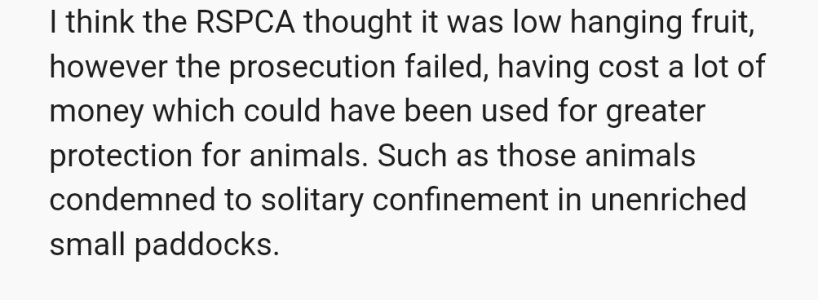
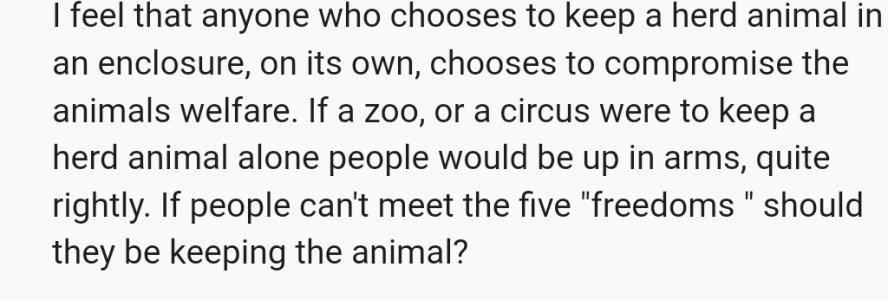
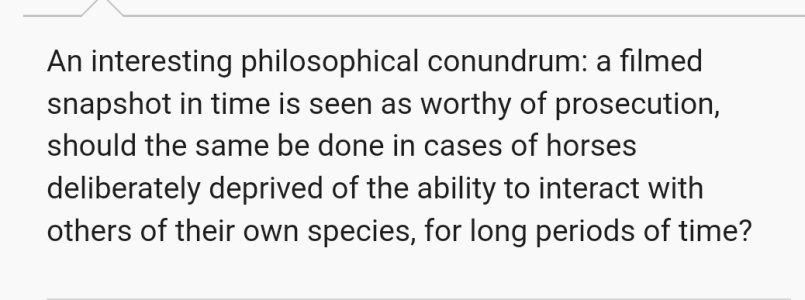
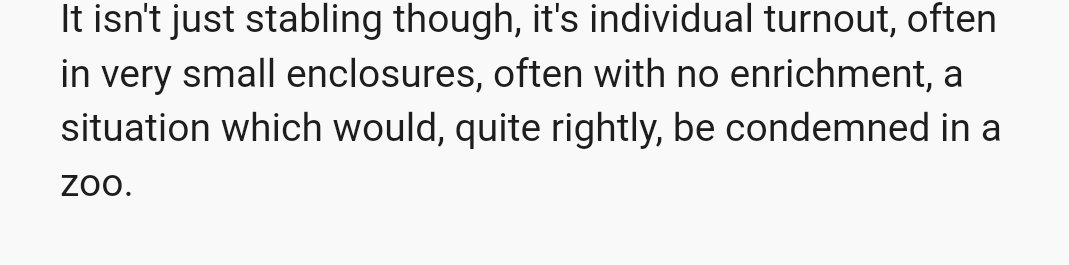
Birker, given the screen shots you've used, do you believe that horses benefit from being kept in singly, in small, unenritched, mono grassed enclosures?
 
The whole notion of risk is interesting here; for some the risk of potential physical injury from interaction with other horses, as would happen naturally, is more significant than the longer term definite physical and psychological risks resulting from individual/separated turnout. I guess you take your choice? Naturally, in settled herds, healthy horses do not beat the c**p out of each other so that scenario suggests a significant level of stress or other driver to that behaviour. That is a bit of a concern isn't it? I have had to introduce horses to a herd at livery, had horses clash with each other etc etc and all of that can be managed to a safe and successful outcome but in some livery and private yards neither the inclination nor the horsemanship exists to achieve that. If people want their horses on individual turn out then so be it; there will be reasons for that but the facts are that this is not the best, even in an imperfect, humanised world, for them. The reliance of facts, science, study is patchy on HHO at best and in this instance distinctly wobbly lol.

Settled groups don’t fight in the same way that occurs when you you introduce new horses.
But there is risk, my horse is a problem in the field and has been kicked several times because he drives the others around and is generally bit of a bully.
He’s the herd leader and frankly not a very good one he’s an idiot .
I do take the risk because it suits me to have them together and he had been on individual before he arrived here and was clearly thrilled when I turned him out with company.
If I owned a livery yard I would not want him out with other peoples horses .
I would love to know how you reckon you can 100 percent safely manage introductions you can‘t you have to take a chance my mare whose leg was broken while turnout was several weeks into us managing introducing her when disaster struck .
 
The whole notion of risk is interesting here; for some the risk of potential physical injury from interaction with other horses, as would happen naturally, is more significant than the longer term definite physical and psychological risks resulting from individual/separated turnout. I guess you take your choice? Naturally, in settled herds, healthy horses do not beat the c**p out of each other so that scenario suggests a significant level of stress or other driver to that behaviour. That is a bit of a concern isn't it? I have had to introduce horses to a herd at livery, had horses clash with each other etc etc and all of that can be managed to a safe and successful outcome but in some livery and private yards neither the inclination nor the horsemanship exists to achieve that. If people want their horses on individual turn out then so be it; there will be reasons for that but the facts are that this is not the best, even in an imperfect, humanised world, for them. The reliance of facts, science, study is patchy on HHO at best and in this instance distinctly wobbly lol.

You define the physical damage from herd turnout as "potential" and physical and mental damage of individual turnout as "definite".

You are, as far as I recollect, the first person who has even said there was physical damage from single turnout, never mind it being "definite". I would like to see you substantiate that claim. And I don't see how you can claim "definite" mental damage of the countless numbers of horses I've met who seem to be totally content with individual turnout. There are no studies that anyone has ever been able to point to in these discussions which prove that.

Naturally in settled herds horses do still kick each other, I don't understand how you can claim that they don't.

For clarity again here, my own horse has company.
.
 
You define the physical damage from herd turnout as "potential" and physical and mental damage of individual turnout as "definite".

You are, as far as I recollect, the first person who has even said there was physical damage from single turnout, never mind it being "definite", and I don't see how you can claim "definite" mental damage of the countless numbers of horses I've met who seem to be totally content with individual turnout.

Naturally in settled herds horses do still kick each other, I don't understand how you can claim that they don't.

For clarity again here, my own horse has company.
.
There is a poster on this thread, sorry can't remember who, who has specifically posted to say that their horse got more injuries on individual turnout than since it has been in a herd.
 
Look, I am not issuing lofty diktats (though it's a catchy phrase!) - just saying what I understand to be true and evidenced


But it isn't evidenced. There is no valid research on this that I am aware of. Please don't point me to some studies testing cortisol levels with a handful of horses rotated through different regimes every few days.
.
 
Settled groups don’t fight in the same way that occurs when you you introduce new horses.
But there is risk, my horse is a problem in the field and has been kicked several times because he drives the others around and is generally bit of a bully.
He’s the herd leader and frankly not a very good one he’s an idiot .
I do take the risk because it suits me to have them together and he had been on individual before he arrived here and was clearly thrilled when I turned him out with company.
If I owned a livery yard I would not want him out with other peoples horses .
I would love to know how you reckon you can 100 percent safely manage introductions you can‘t you have to take a chance my mare whose leg was broken while turnout was several weeks into us managing introducing her when disaster struck .

I don't think I said I could 100 percent safely manage introductions (as in 100% of the time) but I have introduced numerous horses into both unstable livery herds and my own more stable herds. You can't guarantee anything of course but the usual protocol of shoes off, separated by well electrified fence for a period of time and depending on horse's training etc being handled together (separate handlers) and ensuring that all resources are sufficient and available has meant that whilst I have seen some minor injuries, nothing serious has happened. I have seen and had to put up with 'problem' horses too. It is worrying and sometimes has required that horses are not taken out of the field whilst a herd settles but every time I have seen it work. We had a mare that wildly loathed one of our geldings; it took a long time to get them tolerating each other using the simple stuff above. But it worked and they were friendly after a while. And I have had a horse bullied physically which is vile. But that situation was worked out as well. In a group situation owners might need to work together but sometimes they can't or won't. That is a people problem, not a horse one.

We annually bring horses off the hill into a settled herd. A new horse just plonked into a field isn't safe for anyone and likely to convince any horse to be defensive or aggressive. But in lots of places people put new horses into herds regularly. I think it is partially a UK peculiarity that makes it something to worry about; possibly because we are a bit short on land/resources?

I have seen a horse have a broken leg as the result of playing with his friend. I understand the fear of injury.
 
But it isn't evidenced. There is no valid research on this that I am aware of. Please don't point me to some studies testing cortisol levels with a handful of horses rotated through different regimes every few days.
.

What evidence would work for you? What do you think is 'valid'?
 
Birker, given the screen shots you've used, do you believe that horses benefit from being kept in singly, in small, unenritched, mono grassed enclosures?
It depends how small a paddock you are talking about. I've never heard the term mono grass before, sorry.

But if I'm honest I did resent the link between individual turnout being a form of abuse.

I've never abused any of my animals, I love them dearly and always have. And there is a very distinct difference between tapping a horse on the nose which I have already freely admitted I did with Lari as I was getting repeatedly bitten, to hitting a horse over the head, punching it on the face or kicking it in the chest.

Seeing my horse with his leg nearly hanging off and being handed back his rug weeks later with bits of flesh on the inside it is a sight I will never ever forget.
 
And there is a very distinct difference between tapping a horse on the nose which I have already freely admitted I did with Lari as I was getting repeatedly bitten, to hitting a horse over the head, punching it on the face or kicking it in the chest.
How distinct is this distinct difference? How do you define a 'hit' versus a 'tap' - is it the force, the hand position, or just the emotion of the handler and whether they want to do the horse damage? If the difference is defined through the force exerted, then you'd really have to consider relative force based on the sensitivity of the area. And the nose, full of whiskers which are sensitive enough to recognise even the slightest changes in the breeze, is pretty sensitive.
 
But it isn't evidenced. There is no valid research on this that I am aware of. Please don't point me to some studies testing cortisol levels with a handful of horses rotated through different regimes every few days.
.

Are you aware of the phenomenon of social buffering? Have you read this paper that explains a range of things well: https://pubmed.ncbi.nlm.nih.gov/37450226/

It clarifies: 'For horses, social isolation is a particularly strong stressor that
negatively affects their behavioural and physiological reactivity (Kay and Hall 2009; Żelazna and
Jezierski 2018)'

Also: Attenuation of fear through social transmission in groups of same and differently aged horses
Authors: Maria Vilain Rørvang a b, Janne Winther Christensen - From Applied Animal Behaviour Science Journal Volume 209, 2018. https://www.sciencedirect.com/science/article/abs/pii/S0168159118301059

I expect you may want something more specific but as with the evidence around the benefits of removing shoes from horses that were lame, there may not be money available for such specific work. I am not sure why it would be that contentious to assert that a naturally herd dependent animal has its welfare needs more likely to be met in that setting but there you go...There is research and evidence if you look.
 
Last edited:
You may resent whatever you choose to resent, however the five freedoms for protected animals does include the ability to display normal behaviours. Normal behaviours for any herd animal includes the ability to socialise with others of the same species. I do think that part of the problem comes from unstable herds on livery yards, horses coming and going from the group is far from ideal and not the norm for social groups of horses.
 
You define the physical damage from herd turnout as "potential" and physical and mental damage of individual turnout as "definite".

You are, as far as I recollect, the first person who has even said there was physical damage from single turnout, never mind it being "definite". I would like to see you substantiate that claim. And I don't see how you can claim "definite" mental damage of the countless numbers of horses I've met who seem to be totally content with individual turnout. There are no studies that anyone has ever been able to point to in these discussions which prove that.

Naturally in settled herds horses do still kick each other, I don't understand how you can claim that they don't.

For clarity again here, my own horse has company.
.

Um, I haven't said that horses in settled herds don't kick each other. They may well do. The psychological damage to a horse kept alone is evidenced - you could find that. Social buffering is a phenonmenon that most horse owners are absolutely aware of even that particular term is slightly unfamiliar. The physical damage is done through the impact of stress, poor quality of rest/sleep, the lack of satisfactory mutual grooming etc which helps horses to relax. I am not sure why that isn't clear to anyone who understands the importance of stress on the physical body. I am sure that you do know about that. Demanding specific pieces of research which will conform to a particular set of (unstated) parameters is just silly and unhelpful I think!
 
Out of curiosity @conniegirl, do you have any idea about your boy's history / what caused the behaviour he shows? Do you know whether he was ever turned out with others, particularly as a youngster? Has he always resource guarded?

Question also open to anyone else who keeps their horse on individual because they show genuinely dangerous behaviour to other horses.
Ive no idea what caused it. He was a colt until 3 but he ran with a bachelor herd at that point.
He has then been in various good homes as a top level childs show pony (qualifying HOYS multiple times, winning at RIHS) whilst being home produced.

To the best of my knowledge he has never been abused, miss-treated or starved.
As i said over a fence, a stable wall, or inhand he is sweet as pie, will groom, kiss and graze next to a horse no problem.

Ridden he is completely horse neutral ive had several riders use his bum as a brake (happens occasionally when you are in classes with 8 yr old kids) and ive put him between a class of children on first ridden ponies and a loose section A stallion who had already flattened several people and horses. he just stood there, puffed up a bit and that shocked the stallion enough that i could grab it.
I happily let him loose in that situation as i knew that the worst he would do whilst tacked up would be to mug a bystander for polos and i needed both hands for the stallion.

He happily grazed the other side of an electric fence with that Haffy mare for months before and after we tried turning them out together. it was the last time i tried to turn him out with anything.

What ever stopped him being willing to live in the same space as another may have involved a white section A though as it is those that he is the worst with.
 
Top