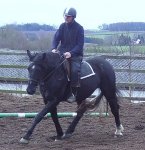
My horse went for me yesterday, and he really meant it - Thoughts?!

I don't think that everything you do with a horse has to have a point, sometimes you can do things because it interests you and it's enjoyable - it isn't for everyone, but then nothing is.
This clearly isn't the thing for him/us, and mistakes were made - they will not be repeated. I think this was just herd play/behaviour and food based, as has been discussed up thread. I think I initially overthought other possible causes, and missed the obvious - if you hear hoofbeats don't look for Zebras and all that.
I will look into the possibility of ulcers, the vet is coming out soon to re-start his vaccs so I will speak to him then.
 
I don't think everything you do with a horse should have a point - quite the opposite - but you probably want to avoid unintentionally encouraging really bad things in your training. I also wouldn't say that "this isn't the thing for this horse" - I would probably say it's an issue of execution rather than throwing the baby out with the bath water. There are things you can usefully teach a horse in these sorts of conditions - just not those which encourage playful or dominant behaviours, and you need to be massively more aware of the signals your horse is giving off.
 
I don't think everything you do with a horse should have a point - quite the opposite - but you probably want to avoid unintentionally encouraging really bad things in your training. I also wouldn't say that "this isn't the thing for this horse" - I would probably say it's an issue of execution rather than throwing the baby out with the bath water. There are things you can usefully teach a horse in these sorts of conditions - just not those which encourage playful or dominant behaviours, and you need to be massively more aware of the signals your horse is giving off.

I meant more that this isn't the thing for him and I to do together. I have no doubt that fantastic results could be acheived with a professional or someone who knows more about this sort of training than I, as he is an intelligent and enthusiastic horse - but I don't have those skills, and I can't afford to have the level of education I would need in it currently to avoid something like this happening again. Yes I can read up on more body language/behaviours, but I don't think you learn the proper timing and real subtleties unless you are learning in person.

I am sure that should I cease trot work, and put a headcollar on, it likely wouldn't happen again, but I am not willing to take that risk. Firm and consistent handling has proved most helpful for us, so I'll just continue this. I will still get out the pro I have contacted however, just to assess him and provide some thought re: anything that would benefit him day to day - it can't hurt.
 
Like a couple of other people have mentioned I had a horse that had been trained in some liberty work (not by me) and the trotting loose beside someone would often illicit some behaviour that was a step or two away from a bite to the side. I guess the horse had just enough inhibitions to prevent it actually making contact.

I've also found trotting my current horse in hand can result in a head swing & attempt to nip for the first stride. I've corrected this by immediately making him turn some circles so he gets a consequence for the unwanted behaviour and that has stopped it.

Like others, I wonder if it is particularly the trotting alongside that is the trigger for the biting behaviour. Maybe you could get some help with the clicker training if that's a route you want to go down. I know the timing is critical so an experienced trainer could help with that. I'm sure some in hand (as opposed to liberty) training would also help.
 
I watched your original video and thought it was setting the horse up to demand food and if he didn't get it quickly enough to let you know the consequences. If this is the same horse he didn't look as if he was understanding the exercise simply he stopped when you did and expected food.

I can see what you were doing and have done it often enough. I don't use food though. I use a schooling whip to guide the horse with a headcollar and rope to start with and then nothing on the head with just the whip and then ultimately my arm extended without the whip to guide the horse. Finally it follows my body language. Doing it at a trot is no different than a walk.

Doing it without food the horse is listening to you. There is no reward except perhaps a stroke. This makes it a lot less dangerous. He doesn't expect anything to eat. I am his herd leader, he is the follower, we both know our place. To me food would cloud the issue. It would then become a contest (as it would with another horse) as to who was getting the treat quickly enough.

I don't think there is anything wrong with your horse. He is simply exhibiting horse behaviour. He doesn't expect you to overthink it as he hasn't. He has just reacted as a horse would do.

I don't understand the point of doing it with a clicker and treats when it works perfectly well without.
 
To me the video looked like the horse was pushing you out of his space like he would do to one he considered inferior and then getting rewarded for it. I agree that you've accidentally set him up to demand food and you don't want to find out the hard way what he'd do if he deemed his reward didn't come quick enough. I think this has been a lucky warning that things could have gone a lot worse and I think you've been very sensible trying to understand why and avoid it getting worse.
 
I did a couple of sessions of clicker training with J and over the period of 2 weeks he started to really try to bite me (my coat) when leading in or if he was in his stable. I don't mean nips I mean with intent bites. I stopped doing the clicker training and any sweets he gets, he gets from his feed bucket and he has stopped trying to bite.
 
I think it is a great idea to call in a pro.

I do a lot of "loose" ground work with my PRE, and most of the time he has a halter on. Rule number 1 from day 1 was that he only gets food when he looks away. He cannot be rude, he cannot be pushy. He learned this right quick and has not forgotten. Occasionally when I reach in my pocket for something he will look away so hard that people wonder what he's doing LOL but I think this has helped him never be nippy in respect to food.

Now, one time when we were meandering around in the forest, I was leading him and he nipped at my shoulder (did not make contact - just an "air nip") as he would do to another horse - he is quite dominant to other horses in the field and often moves them around to assert himself. I made it the "scariest" 2 seconds of his life (quick smack, loud noise, backed him up), then dropped it. He never tried it again. You have to show them in the moment what isn't ok. With my horse it just takes one dramatic event, then its over. No gentle poke in the nose, light smack, soft spoken "no" - otherwise you'll find yourself repeating yourself. With him I am loud and clear.

The problem is when you have a difficult horse that fights back. Then it is dangerous. Then it is time for a professional. You really have to be on your toes and prompt. As well as having a real knack and keen sense of body language of both horse and human.

If I had a horse come at me violently, or make skin contact, you can bet I wouldn't hesitate to lead that horse with a whip (such as a dressage whip of sorts) and carry one during our groundwork sessions. I may not need it, but if I do, it is there. I think I also luck out with my horse because he is intelligent and sensitive. So if I mean business, he gets it.

There is no need to be mean, you must be firm but fair. This is a very large animal in comparison to us. Awareness and proper dicipline is key.

Explaning the timing, body language, and correct queues and rewards is difficult. If you find a person that is really experienced and skilled to help you, that really is best. I also find that some people just have more of a knack for it than others for whatever reason.
 
I watched your original video and thought it was setting the horse up to demand food and if he didn't get it quickly enough to let you know the consequences. If this is the same horse he didn't look as if he was understanding the exercise simply he stopped when you did and expected food.

I can see what you were doing and have done it often enough. I don't use food though. I use a schooling whip to guide the horse with a headcollar and rope to start with and then nothing on the head with just the whip and then ultimately my arm extended without the whip to guide the horse. Finally it follows my body language. Doing it at a trot is no different than a walk.

Doing it without food the horse is listening to you. There is no reward except perhaps a stroke. This makes it a lot less dangerous. He doesn't expect anything to eat. I am his herd leader, he is the follower, we both know our place. To me food would cloud the issue. It would then become a contest (as it would with another horse) as to who was getting the treat quickly enough.

I don't think there is anything wrong with your horse. He is simply exhibiting horse behaviour. He doesn't expect you to overthink it as he hasn't. He has just reacted as a horse would do.

I don't understand the point of doing it with a clicker and treats when it works perfectly well without.
Well said!
 
Liberty work should not be playing imo but training the horse to respond to voice commands which it has already learnt while on a lead rope.

Absolutely right!! I do a lot befoe I even put a young horse on the lunge/long reins. Hell, handling a very young foal gets the first lessons - and done with some persistence until what WE call good behaviour. The easiest horse we EVER backed was a stallion who took 3 WEEKS to 'accept' hand pressue in the saddle area while led to the field (with a tea towel around the neck.) The vast majority of young foals (150 odd over the years) accepted it in 3 days or less - you can guess the stable name he 'earned' when he bucked ALL the way in and all the way out for 3 weeks!! But the actual getting on, being led forward and doing EVERYTHING (including canter) on the lunge took one 20 minute session. And yes, the lads had done the ground work and it was a bit of a joke to see how he would respond. The answer: perfectly good - not a foot out of line. Once a horse learns good behaviour (as opposed to natural 'fight or flight' instinct) the rest is easy (or at least achievable safely.) This pic was taken on about his 3rd time ridden.

Buck - at 4.jpg
 
Absolutely right!! I do a lot befoe I even put a young horse on the lunge/long reins. Hell, handling a very young foal gets the first lessons - and done with some persistence until what WE call good behaviour. The easiest horse we EVER backed was a stallion who took 3 WEEKS to 'accept' hand pressue in the saddle area while led to the field (with a tea towel around the neck.) The vast majority of young foals (150 odd over the years) accepted it in 3 days or less - you can guess the stable name he 'earned' when he bucked ALL the way in and all the way out for 3 weeks!! But the actual getting on, being led forward and doing EVERYTHING (including canter) on the lunge took one 20 minute session. And yes, the lads had done the ground work and it was a bit of a joke to see how he would respond. The answer: perfectly good - not a foot out of line. Once a horse learns good behaviour (as opposed to natural 'fight or flight' instinct) the rest is easy (or at least achievable safely.) This pic was taken on about his 3rd time ridden.

View attachment 40752
What a lovely photo. Amazing to think it was just the 3rd time ridden.
 
What a lovely photo. Amazing to think it was just the 3rd time ridden.


lol, he was almost as good in the last 5 minutes of his 1st day! The reason doing it in one da was joke was because - at Grading - I got a lecture from the Chief Inspector that I should have him gelded because his poor temperament meant he HAD to be gelded! My reply (I was getting a bit shitty by then, knowing he'd been put down to Class 2 BECAUSE she thought that:) "You've known him for 30 minutes (in a strange place, surrounded by stllions he didn't know!) I've known him for more than 3 years, so I'll be the judge of that!" And 6 out of 7 pure-red daughters have already been Graded Class 1.
 
Robin tried to “play” with me once in the field. I was pushing a wheel barrow and he tried the jog, snake neck and nip move. I know he was playing and the same move on his field buddy would have resulted in a great game. But he was growled at and told to bugger off. I am quite happy for him to mooch about while I poo pick but I am not his play toy. I expect clicker training would have the same result as yours.
 
OP, I don't know you personally, but what I've often observed with people trying out clicker training and/or working at liberty (not necessarily always the same thing), they do just that - try. It frequently means that they've seen a couple of videos or watched others doing what seems like "fun" with their horses, and then try to repeat that with their own horses - unfortunately, without realizing the science beneath it and the steps that should be taken to do this safely. Considering this, a good idea is to consult a pro and to learn to do this type of activities properly, setting your horse and yourself up for success. :)

I, too, use clickertraining to train my huge 13yo warmblood (who sometimes works as a trick/stunt horse in ads and movies) and my exuberant WB 2yo, and the basic rules of no biting, accepting treats calmly (not demanding them, not invading my space uninvited, etc.) and calming down on cue are the first ones that are taught - only after these are installed properly, can one think of doing something more "active"/"fun". ;) Best of luck!
 
Reading through this thread has made me think that i must be totally old fashioned and out of touch with modern horse training.

What has happened to simply halter training a foal ? what has happened to showing a young horse how to stand in his own space and remain there, to lead politely and be mannerly. What has happened to bringing this basic training into adult life and making the horse a useful, safe and pleasant horse. Basic training that will stay with the horse all of its life. Training that will keep it and us safe ?

For me a horse at liberty, is a horse that is turned out, able to do as he pleases in his own space, and for most horses liberty is for many many more hours than the hours they spend with us and working or simply being handled. In my uneducated view, I feel that we should keep training simple, fair, disciplined and with consistency so the horse always knows what is expected. There is nothing acceptable, funny or pleasant about a biting, mouthy and over bold gelding who is more than capable of doing plenty of damage to you.
 
Reading through this thread has made me think that i must be totally old fashioned and out of touch with modern horse training.

What has happened to simply halter training a foal ? what has happened to showing a young horse how to stand in his own space and remain there, to lead politely and be mannerly. What has happened to bringing this basic training into adult life and making the horse a useful, safe and pleasant horse. Basic training that will stay with the horse all of its life. Training that will keep it and us safe ?
Don't worry, some us still do that. I've never had a problem with any that I've bred, they are naturally nice, but that training in manners starts as soon as they are born. I've taken on one savage horse and brought him around, but he wasn't for the faint hearted, and would have flattened anybody who tried groundwork like that on the video.
 
I have seen so many accidents happen while clicker training and know very little about it so would never attempt it. Back in my naive, youthful days I once tried liberty with treat reward training with an Arab mare. I ended up with a cranky horse who chased me around the paddock looking for treats, took months to fix. I have never fed a horse from my hand since.
 
Reading through this thread has made me think that i must be totally old fashioned and out of touch with modern horse training.

What has happened to simply halter training a foal ? what has happened to showing a young horse how to stand in his own space and remain there, to lead politely and be mannerly. What has happened to bringing this basic training into adult life and making the horse a useful, safe and pleasant horse. Basic training that will stay with the horse all of its life. Training that will keep it and us safe ?

For me a horse at liberty, is a horse that is turned out, able to do as he pleases in his own space, and for most horses liberty is for many many more hours than the hours they spend with us and working or simply being handled. In my uneducated view, I feel that we should keep training simple, fair, disciplined and with consistency so the horse always knows what is expected. There is nothing acceptable, funny or pleasant about a biting, mouthy and over bold gelding who is more than capable of doing plenty of damage to you.
Why can’t you do both? My horse is very pleasant to be around and handle, extremely polite day to day, doesn’t mug me for treats, is a nice, happy person with good ridden and ground manners (I’m not saying perfect, he can be a hyper little wotsit). But we also work at liberty. Liberty work is no different to lunging or in hand work, you just take the rope away. What it does do is highlight your weaknesses as a trainer, where are you relying on that rope to achieve something, is it possible to get that same thing, lift/bend/flexion/whatever without it. You get to see how it uses it’s body and it’s mind without a physical restriction in place. I find it fascinating. It doesn’t mean just buggering about with the horse charging all over the shop. You are still aiming for simple, fair, consistent and disciplined. But yes, sometimes you work through moments or confusion whilst you try to understand how to replace some of the missing lines of communication from taking the line away. As long as you remain fair and consistent these are just passing moments. I do refer to it as play rather than work, I also refer to my ridden sessions as play rather than work. But because to me it feels more joyful to do so. I work because I have to, I play because I want to, it’s just words that I carry over to my horse life. I still do all the ‘normal’ horse training stuff too.

Edit to add: ignore my post, realised in the context of the OPs horse it isn’t really relevant what my horse and I do, they are very different animals and I certainly wouldn’t jump straight into doing with him what I do with mine.
 
Why can’t you do both? My horse is very pleasant to be around and handle, extremely polite day to day, doesn’t mug me for treats, is a nice, happy person with good ridden and ground manners (I’m not saying perfect, he can be a hyper little wotsit). But we also work at liberty. Liberty work is no different to lunging or in hand work, you just take the rope away. What it does do is highlight your weaknesses as a trainer, where are you relying on that rope to achieve something, is it possible to get that same thing, lift/bend/flexion/whatever without it. You get to see how it uses it’s body and it’s mind without a physical restriction in place. I find it fascinating. It doesn’t mean just buggering about with the horse charging all over the shop. You are still aiming for simple, fair, consistent and disciplined. But yes, sometimes you work through moments or confusion whilst you try to understand how to replace some of the missing lines of communication from taking the line away. As long as you remain fair and consistent these are just passing moments. I do refer to it as play rather than work, I also refer to my ridden sessions as play rather than work. But because to me it feels more joyful to do so. I work because I have to, I play because I want to, it’s just words that I carry over to my horse life. I still do all the ‘normal’ horse training stuff too.

Edit to add: ignore my post, realised in the context of the OPs horse it isn’t really relevant what my horse and I do, they are very different animals and I certainly wouldn’t jump straight into doing with him what I do with mine.


Just to support what BBP says, there is no reason why a horse can't learn by 'traditional' methods (which I find means something different to different people) and clicker training where appropriate. Our 2 youngsters have been trained traditionally from the beginning. We first turned to clicker training because one of the youngsters who had been fine about her feet developed a problem after having a vet sedate her and dig out an abscess. She became very wary about picking up her front feet in particular. Clicker training helped her to relax about it all again.

Since then we have used it with both of them for different things. The cob wasn't keen on having cold cream rubbed into a sore on her hind leg but clicker training got her over it. Yes it would have been possible to sort it out without the clicks but it would still have had to be broken down into small steps and the click speeded things up, which at the time was quite important.
We started teaching movements loose from the ground in the field that they already knew, turns on the forehand/quarters, head down etc simply to give them something to think about on days when they hadn't done any other 'work' except come to call for their feed. We worked with both of them at the same time, which helped to teach them both to concentrate on their own handler and not worry about what the other horse & handler were doing.

I am happy to admit that I used to think that it was a nonsense and do still think that anyone who buys a clicker must have money to burn - what's wrong with a tongue click? Then we saw a demo for a very small group of riders by an extremely well known, highly thought of dog trainer, which showed how successful it can be done properly. It doesn't matter what species the animal is, the principles are the same. I have watched zookeepers at Chester use it with elephants and dolphin trainers have used it for years. In both those cases food is certainly involved, we don't use anything special, just Agrobs haycobs, which is what they are fed on regularly. they certainly don't get over excited about it.
 
I obviously appreciate all opinions on this thread and thank anyone who has taken the time to post, however I am unsure why clicker training and consistent handling seem to be mutually exclusive in a lot of people's minds?

I have owned the horse for 3 weeks (yes, I shared him for a few months before that but he was handled as his owner requested and not just by me of course), his manners won't materialise over night and we have made huge improvements in a lot of areas already just through being firm and consistent daily. I feel it is appearing as though I am incapable of handling the horse and enforcing boundaries through normal methods, just because I tried something alternative to have a bit of fun and made a mistake and it went wrong.
 
Last edited:
I obviously appreciate all opinions on this thread and thank anyone who has taken the time to post, however I am unsure why clicker training and consistent handling seem to be mutually exclusive in a lot of people's minds?

I have owned the horse for 3 weeks (yes, I shared him for a few months before that but he was handled as his owner requested and not just by me of course), his manners won't materialise over night and we have made huge improvements in a lot of areas already just through being firm and consistent daily. I feel as though it is being made out that I am incapable of handling the horse and enforcing boundaries through normal methods, just because I tried something alternative to have a bit of fun and made a mistake and it went wrong.


You will soon pull it back, I'm sure, there is no reason to stop all clicker training but for now, I would recommend doing it on a rope and only doing close up small movements, such as picking up feet, when you point to one, so that your horse understands that you are still directing operations and he is not allowed to treat you like a horse.
 
You will soon pull it back, I'm sure, there is no reason to stop all clicker training but for now, I would recommend doing it on a rope and only doing close up small movements, such as picking up feet, when you point to one, so that your horse understands that you are still directing operations and he is not allowed to treat you like a horse.

Thank you but to be honest, I have no real desire to continue doing it in the immediate future, I don't want to set up either of us for failure and any fun aspect has been thoroughly sucked out of it by this thread :p If I find myself in a position in the future to learn the tools I need to try it again, perhaps I may try it, but I don't at the moment.

I just feel as though I have been made out to be a bit of a numpty in some posts, for doing a method they don't see the point in and having some human error involved - and it isn't a particularly nice feeling; yes he is a new horse to me, but I have been handling horses for 15+ years, and have been around them for 20+ (not long compared to some I know). I don't think I would be upset right now if I never heard the word clicker again :D
 
I obviously appreciate all opinions on this thread and thank anyone who has taken the time to post, however I am unsure why clicker training and consistent handling seem to be mutually exclusive in a lot of people's minds?

I have owned the horse for 3 weeks (yes, I shared him for a few months before that but he was handled as his owner requested and not just by me of course), his manners won't materialise over night and we have made huge improvements in a lot of areas already just through being firm and consistent daily. I feel as though it is being made out that I am incapable of handling the horse and enforcing boundaries through normal methods, just because I tried something alternative to have a bit of fun and made a mistake and it went wrong.

We're always learning lass. With horses it's never ending. Take the good advice, dust yourself down, and crack on safely.
 
Not a numpty at all, you tried something, it didn't work for you and your horse, that's all
We have all tried methods and discounted them over the years I'm sure
I am a clicker fan, use it with my horse in his own field at liberty, it works for us but if other people don't like the idea that's fine
At the moment I am teaching him to go round a barrel, no reason, just playing and having a bit of fun, I love watching his body language and facial expression as he works out what to do to 'press the button' to release the treat.
He understands the rules, doesn't mug me, just clear thinking process
I'm sure as you build up your bond with your new horse you will find ways that work for both of you
 
Reading through this thread has made me think that i must be totally old fashioned and out of touch with modern horse training.

What has happened to simply halter training a foal ? what has happened to showing a young horse how to stand in his own space and remain there, to lead politely and be mannerly. What has happened to bringing this basic training into adult life and making the horse a useful, safe and pleasant horse. Basic training that will stay with the horse all of its life. Training that will keep it and us safe ?

For me a horse at liberty, is a horse that is turned out, able to do as he pleases in his own space, and for most horses liberty is for many many more hours than the hours they spend with us and working or simply being handled. In my uneducated view, I feel that we should keep training simple, fair, disciplined and with consistency so the horse always knows what is expected. There is nothing acceptable, funny or pleasant about a biting, mouthy and over bold gelding who is more than capable of doing plenty of damage to you.

I heartily agree with you. Though I don't think this is modern horse training, circuses have done this sort of thing for years. I watched Jean Francois Pignon while waiting for the sj at Olympia. All very nice but he does have a whip;-) I'm afraid that the sort of horsemanship that gives me goosebumps is provided by Scott Brash!
 
Thank you but to be honest, I have no real desire to continue doing it in the immediate future, I don't want to set up either of us for failure and any fun aspect has been thoroughly sucked out of it by this thread :p If I find myself in a position in the future to learn the tools I need to try it again, perhaps I may try it, but I don't at the moment.

I just feel as though I have been made out to be a bit of a numpty in some posts, for doing a method they don't see the point in and having some human error involved - and it isn't a particularly nice feeling; yes he is a new horse to me, but I have been handling horses for 15+ years, and have been around them for 20+ (not long compared to some I know). I don't think I would be upset right now if I never heard the word clicker again :D


I'm sorry you feel like that, I would hope that we are all learning all the time. IMO, the time that we stop learning about horses is the time to retire from them.
 
Thank you but to be honest, I have no real desire to continue doing it in the immediate future, I don't want to set up either of us for failure and any fun aspect has been thoroughly sucked out of it by this thread :p If I find myself in a position in the future to learn the tools I need to try it again, perhaps I may try it, but I don't at the moment.

I just feel as though I have been made out to be a bit of a numpty in some posts, for doing a method they don't see the point in and having some human error involved - and it isn't a particularly nice feeling; yes he is a new horse to me, but I have been handling horses for 15+ years, and have been around them for 20+ (not long compared to some I know). I don't think I would be upset right now if I never heard the word clicker again :D

People have been very harsh and I've been uncomfortable reading some of the replies. Its obvious that quite a lot of people have no idea how clicker training or in fact liberty training works. They decide its not for them and dismiss it as nonsense.

I think you probably did make a mistake, but only in that you werent reading him perhaps as well as you needed to. I dont see any reason why you cant carry on. Since you posted I've picked it up with mine again and am really enjoying it. I wouldnt let a thread on a forum stop you doing something you enjoy.
 
Top