Mylo & Myka

When I sent one of youngsters away to be backed I stayed and watched them work with him and then with another horse . The other horse belonged to a friend of mine.
My lad at the time was super easy . Took everything in his stride , my friends horse was a whole different ball game . My lad was walk / trot /cantering under saddle and hacking out within 4 weeks . My friends horse was still being leant over .

So what I’m saying is , you could be doing all the right things , but horses learn at their own pace . That’s why backing horses is an art . It’s about knowing how quickly or slowly to take it, and that only comes with experience.
It’s good you have Joe on call to help , but have you anyone else who could come and work with you on a more regular basis ?
 
She’s had the saddle on about 12 times. Everything has been done stepwise: saddle on/off no movement. Saddle on movement with no stirrups. Progressing to walk/trot with stirrups up, then down. There was some minor jumping around when she first trotted with the saddle on which was weeks ago. Since then she has seemed completely unconcerned by it.

Re trigger stacking that makes sense but worries me because I think this goes back to my skills (or lack thereoff) in reading her. I really wasn’t sure how she’d react to another horse but she just seemed totally fine. Listening to me. Calm controlled responses. But she probably wasn’t.

Unless something totally random happened just as she moved which I didn’t notice.

Oh well it’s a steep learning curve for sure!
It's definitely a steep learning curve. I find it is with every animal I take on (horses or dogs), what you've learned with one can be taken forward to the next animal, but because they're all individuals, you still have to adjust what you've already learned to suit them and to better read them. Your skills at reading her will only get better, you're committed to doing this right and have great help on board, so it will turn out fine despite any set backs.
 
Helpful call from Joe. He thinks the most likely explanation is that when I was tacking up, she was intently focused on the other horse and not really paying any attention to what I was doing. So when she then moved, the saddle took her by surprise and she jumped forward. Then the saddle started 'chasing' her and so it escalated. That makes sense as looking back she was staring at the other horse when stood at the gate being tacked up.

With young horses he makes a point of being quite 'noisy' with the saddle every time he tacks up, so there is no chance they don't know they have it on.

Lesson learned. He was also quite reassuring - you can't anticipate everything, and every horse you train takes you by surprise from time to time, and teaches you something new to take forward to the next horse.
Joe sounds like a very sensible person so it's great that you have him to help you. Looking forward to reading more about how it all goes. (reading avidly as I'm hopping for a home bred foal to make an appearance this spring and it is supposed to be my next competition horse, so happy to be able to look at what others have done before me)
 
Helpful call from Joe. He thinks the most likely explanation is that when I was tacking up, she was intently focused on the other horse and not really paying any attention to what I was doing. So when she then moved, the saddle took her by surprise and she jumped forward. Then the saddle started 'chasing' her and so it escalated. That makes sense as looking back she was staring at the other horse when stood at the gate being tacked up.

With young horses he makes a point of being quite 'noisy' with the saddle every time he tacks up, so there is no chance they don't know they have it on.

Lesson learned. He was also quite reassuring - you can't anticipate everything, and every horse you train takes you by surprise from time to time, and teaches you something new to take forward to the next horse.
Makes total sense. We're all guilty of being too quiet around young/nervous ponies. When I tell people Ben is nervous they automatically start walking round him carefully- it's very odd thing when we interpret ' don't startle the horse' as creep around quietly but it's how our brain seems to work.
 
Makes total sense. We're all guilty of being too quiet around young/nervous ponies. When I tell people Ben is nervous they automatically start walking round him carefully- it's very odd thing when we interpret ' don't startle the horse' as creep around quietly but it's how our brain seems to work.
This has reminded me of a funny story . A lady I know has a nervous dog which barks at everyone/everything . Lady dressed in glow coat saw a bunch of riders in the distance . Didn’t want to frighten the horses wih barking dog . Or let the dog get frightened when she saw the horses So hid behind a hedge. As horses got closer she jumped up and down behind the hedge waving her arms . Just to let people know she was there 🤣🤣
 
Helpful call from Joe. He thinks the most likely explanation is that when I was tacking up, she was intently focused on the other horse and not really paying any attention to what I was doing. So when she then moved, the saddle took her by surprise and she jumped forward. Then the saddle started 'chasing' her and so it escalated. That makes sense as looking back she was staring at the other horse when stood at the gate being tacked up.

With young horses he makes a point of being quite 'noisy' with the saddle every time he tacks up, so there is no chance they don't know they have it on.

Lesson learned. He was also quite reassuring - you can't anticipate everything, and every horse you train takes you by surprise from time to time, and teaches you something new to take forward to the next horse.

Seems like a pretty reasonable explanation. I always give the saddle a good whack a couple of times before I get on so Miles knows it's there!
 
Seems like a pretty reasonable explanation. I always give the saddle a good whack a couple of times before I get on so Miles knows it's there!
I still do that!

The Appy was a very interesting project to start (10 years ago now) because she already had a tonne of bad experiences - I never knew what she would be OK with and what would trigger her. It was someone I trusted telling me to stop faffing which helped me realise tiptoeing gently isn't always the answer.
 
So long as she’s fine next time…it’s just one of those things.

I will say though that although she’s clearly sharp, there are mitigating factors - it’s winter, turnout is limited by cold/daylight/frozen ground meaning nowhere to play even if not by the yard. 3 year olds need to play - or they just get endlessly wound up. They are also not old enough for work to replace play like an older horse can. I’ve just turned my ‘backed and going well’ 3yo away again because she couldn’t play properly on the yard and it was driving her nuts. The big field she is now back in with her youngstock friends told the tale this morning of how MUCH they had played and run around last night. She was bright and cheery this morning. We’ll restart ridden work in March/April!
 
Well it's been an interesting week!

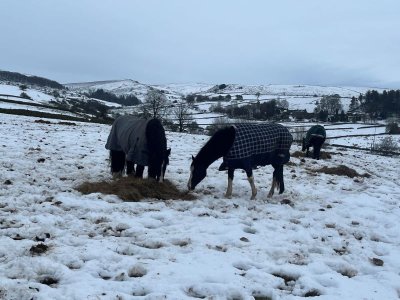
After that session the snow came in and I was not able to get to the yard. Also the YO was not able to turn out because there was an ice-rink between her stable and her field. The road to the farm was blocked almost a week! I first got up Sat evening finally and she was climbing the walls. So Sunday morning I turned her into the arena. Her usual field was too rutted and on too much of a slope to risk going out in there.

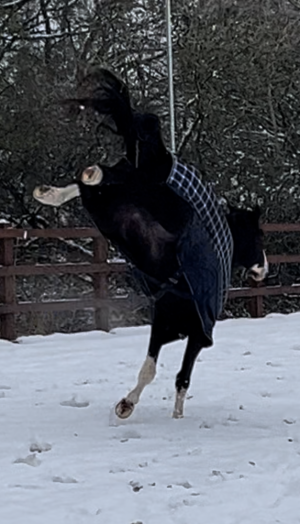
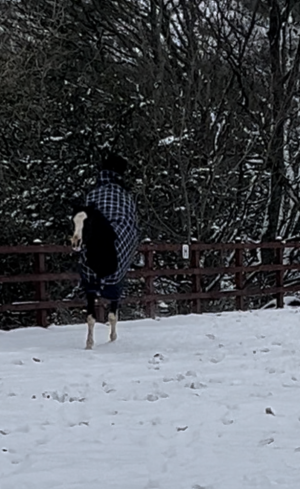
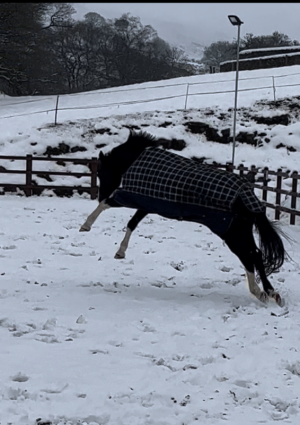
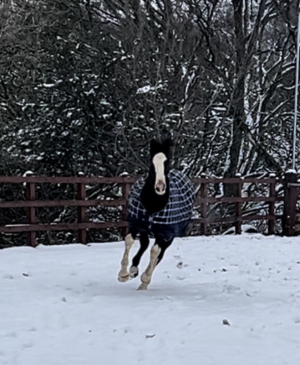
I am not sure how much snow she has seen before because she was doing a huge amount of pawing and snorting at first. She then exploded and that went on a while......

When she finally stopped running and bucking, she was drenched in sweat under her rug which I then took off as she was just sopping. I think anxiety was as much a driver of her behaviour as pent up energy. It was odd - her behaviour looked playful - leaps and bucks, not just blindly lapping the arena, but she was very reluctant for me to go near her, to be touched, to be re-haltered. Nostrils flared, ribs braced. She acted like she was an unhandled feral! She slowly calmed down then rolled all over the arena - 5 -6 times. Gradually she approached me and sniffed me all over and let me pet her, and I could re-halter. But I had to treat her as if she was barely handled or she'd jump away or flinch. Once the head collar was back on she was almost dry and she let me re-rug her - but again slooooooooowly.

Before snow-mageddon she had been out every day and in at night but I have decided she's better off out 24/7. So after she was calm enough to re-rug and re-halter, I turned her into the huge 24/7/365 field with 4 other horses and ad lib hay in multiple piles. Watched for a while and she seemed very chill. The other horses were mildly interested but much more interested in the hay!

Went up today wondering what she might be like as her behaviour yesterday was just so odd. But thankfully today she seemed totally back to normal. Warm dry and toasty under the rug. More importantly happy for me to feel her under her rug! When yesterday I could hardly touch her. I haltered her, petted her all over which she was fine with, then led her away from the other horses, and she followed willingly. Then released and left her. I'll let her decompress for a couple of days before trying to work her properly. I'll just go say hi, then catch and release a couple more times first.

Horses in winter, eh.

IMG_9307.PNGIMG_9311.PNGIMG_9305.PNGIMG_9303.PNGIMG_9324.jpg
 
My 3 year old acted like he was feral one day last week when we were trying to do some calm and easy ground work in the arena. The next day he found his halo again, so 🤷🏼‍♀️

Mine isn't a spooky horse by nature, but during the winter at times, he has a character transplant.


Being out 24/7 should help!
 
Being out 24/7 should help!
I wish I'd done that from the start - I was just keeping her in the routine she was used to. I do worry that its very bleak up there when it's windy, wet and cold but all the 'out' horses seem fine. And definitely better than spending the best part of a week stuck in.
 
I was wondering how you where getting on during last weeks cold spell. Weve been in much the same position, the older ones rising 3, rising 4 and older) where stabled 24/7 for a nearly a week due to the yard being icy and the fields being solid. But they did get a walk around the arena for 30 mins each per day. which i think may just have helped keep a lid on things. I expected handstands when i turned them out, but nope they all where just delighted to see a bit of grass.

you cant beat 24/7 turnout for the young ones can you. Ive now switched back to in during the day and out at night, and all seem relaxed with that.

One good thing though, there is a saying if they can buck they can jump. If thats right Myka clearly has scope based on those photos !
 
My 3 year old acted like he was feral one day last week when we were trying to do some calm and easy ground work in the arena. The next day he found his halo again, so 🤷🏼‍♀️

Mine isn't a spooky horse by nature, but during the winter at times, he has a character transplant.


Being out 24/7 should help!
My 10yo reverted to being a bit feral this week 😅 it's a good learning point when I was teaching D to stand to be mounted it was tempting to do just get on when she was distracted but I had visions of her being taken by surprise and me ending up on the floor 😅
 
Least she's athletic eh! My 3.5 year old is also out 24/7 and it's a real PITA as he's an hour away from where I'm living, but I couldn't get what I wanted for him (24/7 turnout in a herd) closer so it is what it is for now.
 
Least she's athletic eh! My 3.5 year old is also out 24/7 and it's a real PITA as he's an hour away from where I'm living, but I couldn't get what I wanted for him (24/7 turnout in a herd) closer so it is what it is for now.

Is that full livery or LOTS of driving? Or both. Felix is an hour away. Mylo 2 hours. Both are living out and I don’t get to see them much. But do get sent very regular pics.
 
Is that full livery or LOTS of driving? Or both. Felix is an hour away. Mylo 2 hours. Both are living out and I don’t get to see them much. But do get sent very regular pics.
Oh it's full livery! I am travelling way too much to do that drive on DIY. He's just out in a pasture. I would love to have him closer but I don't want the pressure of limited turn out meaning I have to "do" something with him every day to keep him stimulated. So although he's a long way away, I only go 3/4 times a week.
 
3 year olds are weird. Hermosa went through a stage at 3 where I was regularly threatening to sell her (though some weird hormones surrounding weaning the BOGOF foal probably weren't helping).

She moved to a yard with day turnout /overnight stabling in winter when she was about 4.5, but by that point, she was very ready to be doing training things every day, so it was fine. As a scatty 3 year old, it was much better for her to be in a herd 24/7 and me doing a few wee things circa three times per week.
 
When I started working her again after a couple of days turn out, it became clear just how much the saddle episode frightened her. She has been an anxious, spooky mess as soon as she was back at the 'scene of the crime' - ie the arena where she fell victim to an attacking saddle! I have been so disheartened about how spooky, freaked out and suspcisious she has been. But finally after taking things back about 10 steps, I feel she has relaxed again and we can finally begin to get somehwere again. Joe tomorrow. Can't wait.

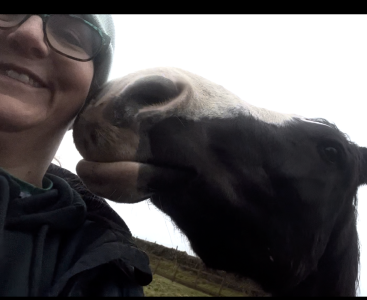
She seems to have forgiven me....

IMG_9375.PNG
 
Longer post....

Someone cancelled their 9am so I grabbed it for Myka, thinking a lesson at 9, some soak time, then another at 1 would be perfect.

There were 2 really useful elements to the first lesson. 1 is Joe could see how anxious she was, so was able to help her work through it. But in doing so he also identified that when she's scared she falls in towards the human with her shoulder. This is not something any horse does natually - they move AWAY from the 'danger' not towards it. But it's something they can easily learn if the human responds to being crowded by stepping back. So it's a learned and shaped behaviour to get the danger to back off, as opposed to a natural reaction to fear. And it's not wanted for 2 reasons: 1 it's not great for a horse to decide that the best response is to get you to back off, as opposed to figuring out the answer. And b) it's unsafe if a horse's reaction to perceived threat is to jump towards the human, instead of away.

It was very subtle. I know better than to let a horse barge or block me, but I missed the shoulder dropping in, the slight crowding, even sometimes just the weight shift towards me. So he ironed that out for me, and I need to be more aware in future. The rule of thumb is if I ever feel the urge to step back, I need to drive her off me instead.

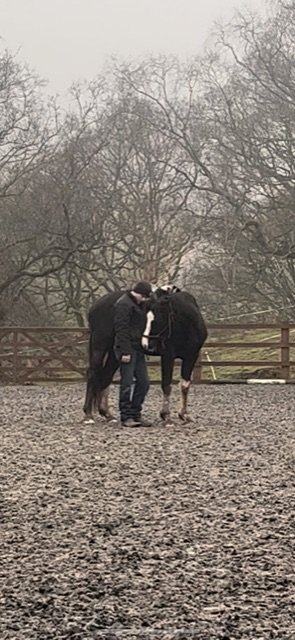
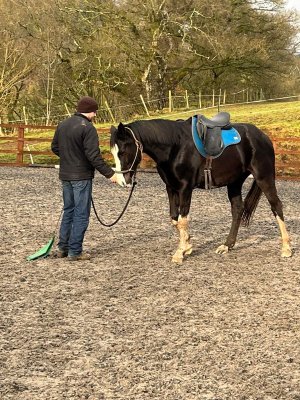
In terms of working through worry, he just let her move. In any direction she chose apart from towards him. He stayed with her, neutral body language, holding the flag/pad/ropes/saddle/whatever in place as she kept her feet moving until she figured out nothing bad was happenening. Rinse and repeat till she was totally relaxed. Then move on. It took an hour to get the saddle on as he never moved from one step till she was totally fine with the step before. And the biggest difference is that his version of totally relaxed was different from mine. For me, if she stood still and did not brace, snort, raise a head or flinch then that was a tick. For him he wants true relaxing not just tolerating. So lowered head, soft breath, sigh, floppy lip, resting leg type level of relaxation. And then she was put away till lesson 2.

During lesson 2 we got to where we had been at the end of lesson 1 in half an hour. Ie to where she was tacked up and relaxed. We then did some ground work at low paces to help her adjust to it. Over time upped the pace so she was trotting by the end. And still chilled. But though she ended feeling good, she was tense at the beginning of the lesson and he suspects will be again. Next time maybe it will take 15 minutes. Then 10. Then 5 etc. But the bottom line is my homework is just to focus on working through any residual uncertainty. She should not brace AT ALL as I approach, run hands over her, tack her up. A brace on the ground is ususlly a buck if you are on board, and we want to set her up dor success.

This feature from Ross Jacobs that popped up on my feed was timely. Joe is a master at 'changing the inside of a horse'.

It's the post titled Horsemanship as a discipline.


Myka Joe small.jpg
 
She seems back to normal. Yay! So progressing her groundwork a little. She’s getting pretty good at lateral steps but is now anticipating so I’m mixing it up - 2 steps across, 2 steps back, 2 steps across the other way. But it was so windy my phone kept falling off the fence! So you can’t see her better work but this gives you the idea….

 
Interesting write-up, AE, thank you for sharing.

And the biggest difference is that his version of totally relaxed was different from mine. For me, if she stood still and did not brace, snort, raise a head or flinch then that was a tick. For him he wants true relaxing not just tolerating.
As you've mentioned this issue before, I'm wondering if you might like Rachaël Draaisma's Language Signs and Calming Signals of Horses - it's a good guide to subtler signs of tension.

In terms of working through worry, he just let her move. In any direction she chose apart from towards him.
You've reminded me of this excerpt from Mark Rashid' Whole Heart, Whole Horse.

When an individual is traumatised in any way, energy from the trauma is stored in the body. Animals in the wild are very good at expending the energy of a trauma, often by doing little more than running or standing and shaking. There are stages that the body goes through during the trauma. The first stage, the doctor explained, is that the body prepares to either fight of flee by releasing certain chemicals and making physiological changes. In the second stage, the body does what it needs to do-either runs away or fights. The third stage is the experience of the trauma, followed by the fourth stage, when the body decelerates and resets.

Having gone through these stages, animals in the wild can move on with their lives very quickly with little or no emotional ill effects from the trauma itself. Conversely, he pointed out, humans who are traumatised seldom expend the energy, so it is stored in the body.
You've obviously got the professional background to recognise whether this is actually scientifically valid, but it's interesting how easy it is for us to get the habit of trying to restrain that movement, because we think we're helping them cope by not letting them gallop around or whatever, even though, by doing so, we might be making an experience more 'traumatic'.
 
You've reminded me of this excerpt from Mark Rashid' Whole Heart, Whole Horse.


You've obviously got the professional background to recognise whether this is actually scientifically valid, but it's interesting how easy it is for us to get the habit of trying to restrain that movement, because we think we're helping them cope by not letting them gallop around or whatever, even though, by doing so, we might be making an experience more 'traumatic'.

This stuck with me too when I first read it. I have that book lying around somewhere. I think Mark is making a very valid point that has been reflected in how I train horses, but I also think he paints in broad strokes, because reaction to trauma (for people and horses) is so individual.

When Hermosa was a baby, she was quite scared of flappy things, like rugs, saddle pads, etc. I tried various things but the way I eventually fixed it was by having her loose in a hardstanding pen that was big enough for her to feel like she could move away from the thing, but not so big that she could bog off and end up miles away. I then threw saddle pads at her. Flapped them around. Put them on her back, pushed them off, etc. She worked out on her own, whilst able to move freely away from them, that it wasn't actually scary. She is also a horse who doesn't hold onto trauma. Is that her background or just her? Like today, I was riding in the outdoor, and she spooked, one of those jumpy forward leaps. I looked behind me to see a sofa bouncing across the carpark (it was maybe a bit windy). I admittedly leapt off her back because I was not sure where the sofa was going to go. When the sofa stopped, still in the carpark and not in the arena itself, I figured, we should probably not end there, then I got back on and we walked and trotted a few more circles. All fine, so I quit before any more furniture could get a mind of its own. Even though she'd had an understandable fright, she was totally calm and over it like a minute later.

Now Fin holds onto trauma more than any horse I have ever met. Had he come across a lively sofa taking itself for a walk, I'd be spending the next week cajoling him into re-entering the damn outdoor. And as per Mark's theory (as I understand it), he should be able to regulate himself because he was wild for eight years. But he's terrible at it, especially when he has to look to humans for guidance and not other horses. He's far more reliable when hacking in company. So maybe that's the missing piece -- not being around humans as a youngster and being reliant on the herd to regulate himself, rather than humans or his own internal systems. But that's where we go back to the individual thing, as I know of plenty of ex-ferals who don't have that issue, and plenty of domestic horses who do.
 
Glad she’s doing well again.

I find this so fascinating because I do everything very differently - but I can completely see that both methods essentially do the same thing. I walk mine pre backing - out and about to see a different field on the yard and then the real world. First with just bridle then with a bareback pad and eventually a saddle. We walk miles and miles, day after day where they learn to move over away from cars, round me to do gates, to wait to go through gaps, trust me in scary moments (dogs, traffic, puddles) and in the process, the lines of communication, leadership and trust open up. I can look at what you and Joe are doing and see that it does the same things, just in a smaller space. More accessible wherever you are as it were.
 
I have lost confidence in progressing backing Myka since saddle-gate. I am just going to let Joe do all those firsts - leaning over etc - when he has her from April.

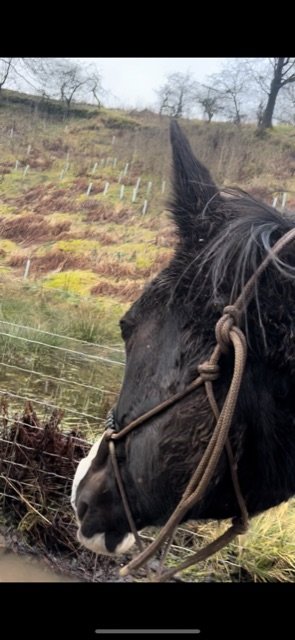
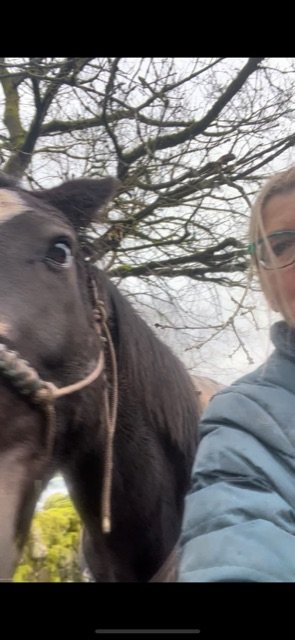
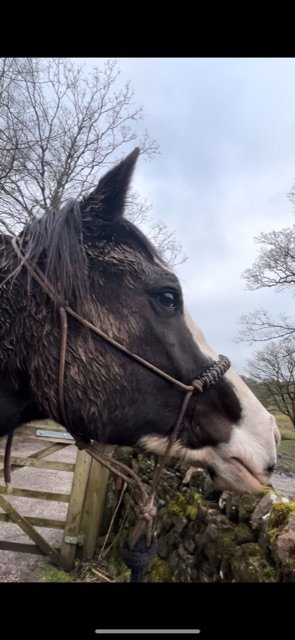
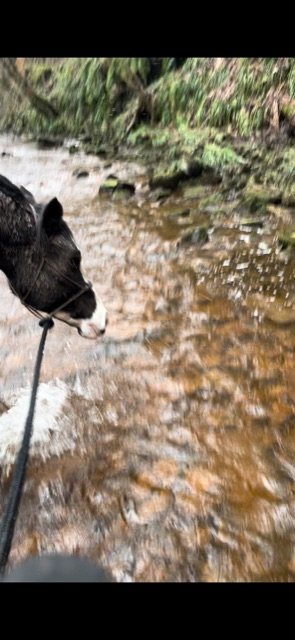
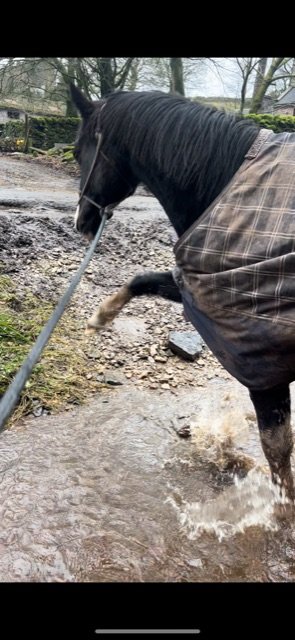
So I am now just sharpening up the flat work and taking her for in-hand walks around roads and tracks. We went further today then ever before and she was good as gold. Relaxed and happy. And seems happy with being out 24/7, though is just a total mud monster all the time. She does love a good roll in the muddiest places. :rolleyes:
 
I have lost confidence in progressing backing Myka since saddle-gate. I am just going to let Joe do all those firsts - leaning over etc - when he has her from April.

So I am now just sharpening up the flat work and taking her for in-hand walks around roads and tracks. We went further today then ever before and she was good as gold. Relaxed and happy. And seems happy with being out 24/7, though is just a total mud monster all the time. She does love a good roll in the muddiest places. :rolleyes:
You will reap the benefit of those walks for the rest of her life, in confidence and trust in you, and in her attitude to work.
 
Top