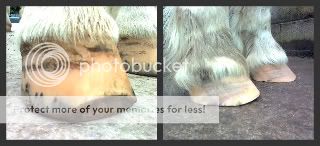
ok really stupid question r.e shoes vs barefoot

Excuse me - but I'd like to see where I've insulted over anybody shoeing???

Shoeing long term/incorrect shoeing does damage feet, and feet often are healthier without shoes, I don't even think any farrier would dispute that and most recommend a break from shoes at some point. The fact remains that the type of grazing that many horses are on does have a negative impact on the horse so yes, grass intake may need controlling to keep a horse healthier.
I still don't see how those statements mean that it is insulting to suggest removing shoes or restricting grazing.

Because your implication (again) is that those of us that shoe are somehow failing our horses and damaging them. That is insulting.
 
Can most horses go barefoot?

Probably not. Many people are not in a position to provide what their particular horse needs to go barefoot. For example, some horses could not hack out on stones at the weekend if they did not also get consistent levels of work during the week.

Just to add a little bit to this - my hacking is very stoney (granite) forestry tracks, and I have one horse who is very happy on grass, roads etc but who doesn't like the stones. He wears boots to hack, so he can be barefoot the rest of the time. He probably only does 2 or 3 hours hacking per week, so it would be madness to feel that I had to shoe to manage that. He schools well (and won a dressage test today!) with his bare feet.

I would argue that shoes do cause damage to feet, and I find it odd that people don't instinctively see that. I can see that there are occasions where shoeing is a neccessary evil, but I can't see why it is done routinely rather than for short periods of time for specific situations. The argument that some horses are shod for most of their lives with no apparant damage is a bit like arguing that some people can smoke 20 a day and live until the age of 90, so there can't be much wrong with smoking.

I will now leap back behind my parapet.
 
Changes, what is the core issue that you object to in all of this? Because I don't believe anyone has criticsed you personally, or even made sweeping statements about paddock paradise etc. is it that people have beliefs which don't agree with your own?

I don't care what people believe as long as they are not harming their horses. My worry is the inexperienced persuaded by the forceful attitude of the barefoot evangelists to try and go barefoot, and keep their horse lame rather than stand up and say it's not working and their horse is sore. Because there are a lot of those.

I don't like how some Paddock Paradise systems force the horse to walk a long way for water, for example. I've had this disagreement elsewhere. The horse should always have direct easy access to water.
That applies especially with a sore horse whose shoes have just been removed. That is bordering on a welfare issue for me.
Don't get me wrong, I'm not accusing anyone on here of doing that, but it happens and it's wrong.

If you had seen the poor horse I referred to earlier you would have wept ........ all that pain because she couldn't bear to admit she was wrong and the horse desperately needed shoes........

The trouble is, there seems to be no middle ground from the barefoot side. For me, if you have a horse that is sound without shoes, then brilliant. There's no beef from me for that. Yet the barefoot people, as some are doing on this thread, continue to go on about how shoes damage horses.

The horse has been domesticated, and if shoes are neccessary for him to be comfortable, then surely that is better than being sore?

It's all a bit Emperor's New Clothes for me, I'm afraid.
 
Our rehab took about 4 weeks to become fully sound, and was competing again within the same season. I didn't chart it. He was jumping Grade 'C' and Nov BHTA as it was then. The cost was nowhere near what you suggest.

Where did you find the stats for that, please? I'd like very much to see them. As I would the veterinary proof for liver damage causing sweet itch that supposedly materialised on this thread.

I'm glad that you now admit that not every horse can go barefoot, because that's not what you said earlier on the thread. Thank you for clarifying what you meant.


Your rehab was unlikely to have had anything more than a minor strain of the DDFT or collateral ligament if he came sound that quickly. Research on cadavers and MRI of live horses has shown that most cases of "navicular syndrome" are actually a strain of the DDFT and most of the rest are collateral ligament damage. Radiographs of the navicular bone bear little correlation with the lameness of the horse, so even if yours had lesions on the navicular, current thinking would suggest that it is far more likely that he was lame because of a soft tissue injury.

The cost today would be at least as much as I have said. Most insurance excesses are around £150, one vet callout is £70 without any treatment, higher in the southeast, one set of heart bars on the front only are £80. Trips to vets for stuff like radiographs/lameness workups where the diesel cannot be recovered on insurance would, for me, cost £25. Add it up!

Do your own research on the liver stuff Changes. A poster somewhere on this thread quoted a veterinary source but I'm b*ggererd if I'm going to spend the time looking it up again for you when you have already seen it once.

Can anyone else help me on the 20% recovery rate stats? It was quoted on here at some point but I don't know where to start looking for it. I'll try googling it.

I have ALWAYS said that not every horse can go barefoot. WHERE do you get that from? Quite honestly, it's beginning to make you seem more than a wee bit dense. It is so frustrating discussing things with you because you will keep on repeating things I have never said. If you research my previous posts you will find a lengthy one advising people just what horses are NOT suitable for barefoot. I wrote it about a year ago.
 
Last edited:
I don't care what people believe as long as they are not harming their horses.

Fantastic, we all agree then :D:D:D

My worry is the inexperienced persuaded by the forceful attitude of the barefoot evangelists to try and go barefoot, and keep their horse lame rather than stand up and say it's not working and their horse is sore. Because there are a lot of those.

Yawn! Zzzzzzzzz it's like a broken record in here

I don't like how some Paddock Paradise systems force the horse to walk a long way for water, for example. I've had this disagreement elsewhere. The horse should always have direct easy access to water.
That applies especially with a sore horse whose shoes have just been removed. That is bordering on a welfare issue for me.
Don't get me wrong, I'm not accusing anyone on here of doing that, but it happens and it's wrong.

Are you infact a troll? I'm begnning to think you actually have a herd of mustangs on your estate and you're just bored

The trouble is, there seems to be no middle ground from the barefoot side. For me, if you have a horse that is sound without shoes, then brilliant. There's no beef from me for that. Yet the barefoot people, as some are doing on this thread, continue to go on about how shoes damage horses.

Plenty of middle ground, background and foreground - if this isn't BEEF then I'd hate to see what is

The horse has been domesticated, and if shoes are neccessary for him to be comfortable, then surely that is better than being sore?

Well, yes domesticated but hardly doing the work of a primary form of transport these days are they - or is it still horse and cart where you live?

It's all a bit Emperor's New Clothes for me, I'm afraid.

You're a bit Groundhog Day to me I'm afraid

:).
 
I don't care what people believe as long as they are not harming their horses. My worry is the inexperienced persuaded by the forceful attitude of the barefoot evangelists to try and go barefoot, and keep their horse lame rather than stand up and say it's not working and their horse is sore. Because there are a lot of those.

I don't like how some Paddock Paradise systems force the horse to walk a long way for water, for example. I've had this disagreement elsewhere. The horse should always have direct easy access to water.
That applies especially with a sore horse whose shoes have just been removed. That is bordering on a welfare issue for me.
Don't get me wrong, I'm not accusing anyone on here of doing that, but it happens and it's wrong.

If you had seen the poor horse I referred to earlier you would have wept ........ all that pain because she couldn't bear to admit she was wrong and the horse desperately needed shoes........
A horse shouldn't be made to walk for essentials when sore I agree, but it does depend to some extent on how sore. I mean do you think lame horses shouldn't be turned out as well? For horses with laminitis and thin soles etc. there are protocols to keep them comfortable, doing as you describe is not the fault of the system it's the responsibility of the owner surely. :confused:


The horse has been domesticated, and if shoes are neccessary for him to be comfortable, then surely that is better than being sore?

It's all a bit Emperor's New Clothes for me, I'm afraid.
I don't believe that horses genetic engineering by humans has changed a horses basic physiology or anatomy yet. Just because an animal is domesticated it doesn't mean it's needs change. I believe we are trying to fit horses into the lives we want for them. I believe it's time we looked more closely at what their needs truly are and make efforts to provide something more appropriate.
I include myself in this as well btw.

There is tremendous pressure on horseowners to conform all the time, the biggest thing barefoot has done for me is make me ask why rather than just do what everyone else might be doing or not doing.
If you have researched and come to your own conclusions and are happy with your decisions then that's great. What more can we all do. The fact that some of us don't agree is imo a positive as it keeps us all thinking.

Can't help on the stats cptrayes I'm afraid.
 
Your rehab was unlikely to have had anything more than a minor strain of the DDFT or collateral ligament if he came sound that quickly. Research on cadavers and MRI of live horses has shown that most cases of "navicular syndrome" are actually a strain of the DDFT and most of the rest are collateral ligament damage. Radiographs of the navicular bone bear little correlation with the lameness of the horse, so even if yours had lesions on the navicular, current thinking would suggest that it is far more likely that he was lame because of a soft tissue injury.

The cost today would be at least as much as I have said. Most insurance excesses are around £150, one vet callout is £70 without any treatment, higher in the southeast, one set of heart bars on the front only are £80. Trips to vets for stuff like radiographs/lameness workups where the diesel cannot be recovered on insurance would, for me, cost £25. Add it up!

Do your own research on the liver stuff Changes. A poster somewhere on this thread quoted a veterinary source but I'm b*ggererd if I'm going to spend the time looking it up again for you when you have already seen it once.

Can anyone else help me on the 20% recovery rate stats? It was quoted on here at some point but I don't know where to start looking for it. I'll try googling it.

I have ALWAYS said that not every horse can go barefoot. WHERE do you get that from? Quite honestly, it's beginning to make you seem more than a wee bit dense. It is so frustrating discussing things with you because you will keep on repeating things I have never said. If you research my previous posts you will find a lengthy one advising people just what horses are NOT suitable for barefoot. I wrote it about a year ago.

I accept what you say about your horses, because I have not seen them, yet you can seemingly diagnose exactly what was wrong with a horse I used to have?
I am fully aware of the changes in thinking over the years regarding navicular. Hence why it's no longer the death sentence it used to be, and why correctly done remedial shoeing works.

You are also not the only person on the thread, there are others saying every horse can go barefoot, I am responding to those. As I don't hang on your every word, I haven't seen your post of a year ago. However, I did agree with you on here earlier when you said you didn't believe every horse could go barefoot. So I'm not sure why you are calling me dense for agreeing with you?

If you claim these statistics, then it's up to you to prove them. Same as the liver damage causing sweet itch. Otherwise how can anything you say be taken with more than a pinch of salt?

Tallyho - you're not worth the keyboard time ........

I guess whatever I say is going to be twisted. I just hope this thread has made people think a bit more before they put their horses through attempting barefoot.
 
I accept what you say about your horses, because I have not seen them, yet you can seemingly diagnose exactly what was wrong with a horse I used to have?
I am fully aware of the changes in thinking over the years regarding navicular. Hence why it's no longer the death sentence it used to be, and why correctly done remedial shoeing works.

You are also not the only person on the thread, there are others saying every horse can go barefoot, I am responding to those. As I don't hang on your every word, I haven't seen your post of a year ago. However, I did agree with you on here earlier when you said you didn't believe every horse could go barefoot. So I'm not sure why you are calling me dense for agreeing with you?

I.

I am diagnosing nothing, I am suggesting what is most statistically likely.

You have been replying directly to quotes of what I have written, repeatedly stating that I have said that all horses can go barefoot. Suddenly, now that I can point you to a thread a year old proving that I don't say any such thing, you say you are not addressing me.

Good, at least you got the message at last.
 
As changes says, I hope the take home message is to do your homework thoroughly before any great change in lifestyle for your horse :grin:

Ps the shoes damage your horses feet thing is well known by farriers, trimmers and laypeople alike, I think. Certainly the farriery texts recommend giving a horse a break from shoes where possible, to recover. Thats obviously for a horse with no problems to keep it that way. Hickmans farriery says that no improvement may be made to the hoof with (normal) shoes, but damage is easily caused and that is where the skill on farriery lies; first, do no harm.
 
Because your implication (again) is that those of us that shoe are somehow failing our horses and damaging them. That is insulting.

I have never said that anyone who shoes is failing their horse or damaging them - quite the contrary, and have recommended shoeing!!???
 
http://onlinelibrary.wiley.com/doi/10.1111/j.2042-3306.2010.00081.x/abstract

This is the most recent study I think. Without a login I can only see the abstract but I'm told that the detailed article breaks down to 78% of horses with ddft injuries and 83% of horses with collateral ligament didn't return to the previous level of work. Which I assume is where the 20% is coming from.
Would love to see the whole thing if someone has a login to download the PDF.
 
Marvellous, thanks Criso. I'd like to see the whole thing too - anyone got a login to it?

And Rockley currently has about an 80% success rate with horses who have already failed with the conventional treatments. In a properly controlled study being overseen by a Professor at Leahurst, so not just anecdotal.

And people don't think that is a miracle worth getting evangelistic about. Well I do!
 
Criso, if you pm me your email addy I will see if I can get it when im on my laptop. Should be able to.
 
@ cptrayes - I just read some of your old blog.
On that premise I really don't have any faith in your hypothesising so there is no point in continuing any discourse on here.
 
Nothing whatsoever has changed about your faith in me from reading my blog.

You had no faith in anything I wrote anyway Changes, irrespective of how well founded it is. I note that you aren't commenting on the research we found for you on cure rates for conventional treatment for horses with navicular syndrome, or the fact that there is veterinary support for liver malfunction being one cause of sweet itch.

The horse you were probably reading about is sound, not on drugs, in full work and happy to be alive when he was 24 hours from being put to sleep by a desperate owner who could not bear to see him in pain any longer. He has been sound since twelve weeks after he arrived with me after two years of lameness and pain. I don't know what your problem is with that, and frankly neither he nor I could not care less.

What I do agree with you wholeheartedly on is that there is no point in you continuing your discourse with any of us who know how to cure a navicular horse or hunt or event barefoot horses because you simply don't have anything constructive to add to the discussion.
 
Last edited:
Nothing whatsoever has changed about your faith in me from reading my blog.

You had no faith in anything I wrote anyway Changes, irrespective of how well founded it is. I note that you aren't commenting on the research we found for you on cure rates for conventional treatment for horses with navicular syndrome, or the fact that there is veterinary support for liver malfunction being one cause of sweet itch.

The horse you were probably reading about is sound, not on drugs, in full work and happy to be alive when he was 24 hours from being put to sleep by a desperate owner who could not bear to see him in pain any longer. He has been sound since twelve weeks after he arrived with me after two years of lameness and pain. I don't know what your problem is with that, and frankly neither he nor I could not care less.

What I do agree with you wholeheartedly on is that there is no point in you continuing your discourse with any of us who know how to cure a navicular horse or hunt or event barefoot horses because you simply don't have anything constructive to add to the discussion.

Again, more assumptions and reading my mind now. You're wrong, btw. :rolleyes:

It wasn't that horse on your blog that made me want to stop reading asap. I couldn't bear to get that far. It was another horse (amongst other stuff).

Liver damage causing sweet itch - to clarify - there is still no vet proof about that put out there.

Recuperation figures - there is the linked article (which I can't access in total) about returning horses from Navicular, but in the initial summary doesn't look as if it will back you up about the success rates.
To relate them with your rehab figures you MUST compare like with like.

This is synopsis from the start of the article - the figures differ from yours.

Results: Frequent abnormal structures included the navicular bone, the deep digital flexor tendon, the navicular bursa and the distal interphalangeal joint. Thirty-four of 56 horses (60.7%) failed to return to previous level of exercise due to persistent or recurrent lameness or owners' decision to decrease the horse's athletic level; however, 11 horses (32.3%) were being used for light riding. Prognosis for horses with concurrent deep digital flexor tendon, navicular bone and navicular bursa lesions was worse than horses with individual lesions. Deep digital flexor tendinopathy was strongly associated with persistent or recurrent lameness.
In effect, 23 horses out 56 returned to work of some level. That's more than 20%.
One person's definition of return to full work varies from another, so unless the two studies are scientifically stood side by side, comparison is impossible.

I have every right to post, and whilst you might not think it constructive, because I am questioning your statements, you don't own the topic.

Finally, and I do mean it this time, I can't discuss with you, because you use notions as truth, sidestep and put words into my mouth.

No doubt you will try and come back with some other theory presented as fact, which is essentially what made me doubt you to start with.

I'll leave you with the last word on this. I expect you won't be able to resist ;)
 
I'm afraid Changes that you don't necessarily need vet proof to prove anything!
My youngster was permanently tripping badly last year and I had a series of tests, nerve blocks, xrays, bone scans to find out why she was having this problem.
In the snow I took her shoes off and have been riding her barefoot ever since. She's never tripped once!!
The vets at The Royal Veterinary Clinic were gobsmacked that she suddenly stopped tripping but of course they still think they are right and still want me to have further tests. Why?
I could of course put shoes back on to prove the point but why should I? I know what stopped her from tripping and it's about time that vets realised that sometimes the diagnosis is very simple!!
 
You keep promising us that you will stop writing, Changes, and you keep on letting us down :(

No-one has stopped you trying to post, that is just your latest unfounded accusation.

Do, please, tell me what is on my blog that you find so distasteful, otherwise I have no option but to guess, do I?

Are you unable to bear the fact that I tie a horse down in a lorry when I travel him to prevent him damaging himself? For using draw reins to teach a baby not to buck and smack his neck into my face on a canter strike off? For having a blind horse put down? That I do not think it is unacceptable to wallop a badly behaved horse?

Do enlighten me.

If anyone else wants to see what Changes is so upset about that she cannot bear to read it, the address is smartiesdiary.blogspot.com

Changes, a discussion is where one person makes a point and the other person counters it, often adding other elements to further the discussion. It is not just "one person asks a question and the other answers it". You say you cannot have a discussion with me because I "sidestep", when I do no such thing. I do not step away from anything which I previously wrote (unless I was wrong when I say so freely), I do not change direction (unless I am wrong when I say so freely) I simply add to the previous argument to show you why I think you are wrong. That IS discussion.

You're right of course, I can never resist the last word, but I'd be happy to have the answer to my question as to what you find so upsetting on my blog that you cannot bear to read how I managed to save a horse 24 hours from being put to sleep with a barefoot rehab. It's a shame you didn't get that far, you might actually have learnt something.
 
Last edited:
Got the detailed study and makes interesting reading Only had a quick look so what jumps out is.

This was carried out using phone calls and questionnaires to owners. Criteria was working at the same level as previously as it was felt this was less open to interpreation.

This was a study on foot pain and with MRI's leading to better diagnosis these can be split into different types which greatly influences the outcome.
There is a table that breaks down the type of injuries and recovery rate which I am wary of posting as it stands as in case of copyright issues.

However summary

The figures I quoted before are correct though the percentage for collateral ligament injury is for moderate to severe with 16.6% making a full recovery, mild enlargement has 0% successful outcome making the average for all level collateral ligament injuries lower. If you average them it comes to 11%

DDFT injuries have a 21.8% return to previous level of work especially when combined with other problems and this study also refers to a Sue Dyson study from 2005 in which combined ddft and navicular bone lesions had a success rate of 5%.

Navicular bone issues fare better with successful outcomes between 20% and 42% depending on the exact nature and location.

Mild Navicular bursa and Digital tendon flexor sheath injuries fare best with success rates of 50%.


Couple of quotes


"One of the limitations of the study was the lack of a control
group. Although our study provides useful prognostic information
for horses with foot pain treated with corrective shoeing, rest and
rehabilitation and intrasynovial anti-inflammatory drugs it is
impossible to draw conclusions regarding any effect of this
recommended protocol without examining a group of horses with
similar spectrum and severity of lesions with no treatment."

So we have no idea if chucking them out in a field and forgetting about them for a year would have had the same outcome.

"In conclusion, this study demonstrates that horses with foot
lesions managed with corrective shoeing, rest and rehabilitation,
and intrasynovial anti-inflammatory medication have a guarded
prognosis for long-term soundness. There is no apparent
association between clinical parameters and outcome; however, the
presence of a deep digital flexor tendinopathy influences long-term
prognosis for soundness."
 
I'm afraid Changes that you don't necessarily need vet proof to prove anything!
My youngster was permanently tripping badly last year and I had a series of tests, nerve blocks, xrays, bone scans to find out why she was having this problem.
In the snow I took her shoes off and have been riding her barefoot ever since. She's never tripped once!!
The vets at The Royal Veterinary Clinic were gobsmacked that she suddenly stopped tripping but of course they still think they are right and still want me to have further tests. Why?
I could of course put shoes back on to prove the point but why should I? I know what stopped her from tripping and it's about time that vets realised that sometimes the diagnosis is very simple!!
Great story and so so familiar to me on Forums like this. Well done for listening to your horse, it certainly seems tests are totally unnecessary as the 'problem' has resolved. :)
 
I'm afraid Changes that you don't necessarily need vet proof to prove anything!
My youngster was permanently tripping badly last year and I had a series of tests, nerve blocks, xrays, bone scans to find out why she was having this problem.
In the snow I took her shoes off and have been riding her barefoot ever since. She's never tripped once!!
The vets at The Royal Veterinary Clinic were gobsmacked that she suddenly stopped tripping but of course they still think they are right and still want me to have further tests. Why?
I could of course put shoes back on to prove the point but why should I? I know what stopped her from tripping and it's about time that vets realised that sometimes the diagnosis is very simple!!

Mitchyden if you check out any barefoot forum or barefoot blog you will find that immediate or almost immediate cessation of tripping is very, very widely reported.

I also laugh at people always wanting scientific evidence. There is no statistically valid scientific evidence for remedial shoeing , or for many treatments used by vets. Take isoxuprine, used on Changes' horse, for example - we were told by Alsiola who posts on this forum and is a vet that the clinical evidence for the success of isoxuprine is very, very weak. I know a homeopathic vet. NO homeopathic treatment can be scientifically proven.

Then there is aspirin. Since the earliest records, willow bark has been chewed as pain relief. That's because it is high in salicylic acid. What's salicylic acid? Aspirin! People do not need scientific evidence to know when something works. Anecdotal evidence is not invalid simply because it is anecdotal. The anecdotal evidence of willow bark chewers has saved many a person from pain over the centuries.
 
Last edited:
Got the detailed study and makes interesting reading Only had a quick look so what jumps out is.

This was carried out using phone calls and questionnaires to owners. Criteria was working at the same level as previously as it was felt this was less open to interpreation.

..........

So we have no idea if chucking them out in a field and forgetting about them for a year would have had the same outcome.

Thanks Criso that's great.

One of the Rockley rehabs was included in this study or another done in the same way, and her comments on it on the UKNHCP forum were interesting. She was asked to rate her own horse's soundness on a scale of 1 to 5. There was no objective veterinary assessment at all, they just took her word for it. How this would skew results I am not sure, but I suspect most people like to believe that their horses are sounder than they are. Given that most of the study (possibly all except her) were shod, this would make the result even worse.

Secondly, we need to be sure we are comparing like with like. The Rockley rehabs, my own, and most of the others that I know of return to full work, hunting and jumping. I rarely hear of a shod rehab doing better than "he is is full work but I am careful what I do with him on hard ground". That, for me, is NOT a return to full work.

For me, your last sentence says it all. I think it's worth repeating:

"we have NO IDEA if chucking them out in a field and forgetting about them for a year would have had the same outcome."

There was a study done comparing recovery rates under different treatments. All the horses had their shoes taken off in order for them all to be judged on a level playing field. All the horses improved to some extent. No-one connected with the study made the connection that the only thing all those horses had in common was that they had no shoes on.
 
Last edited:
Very true about how you can misinterpret. When frankie first went lame and was being remedially shod I starting taking pictures which I hoped which show improvements. Farrier and vet raved about how much his feet were improving.
Forgot about these until he went barefoot and his feet were being tracked as part of the research project at rockley when I dug them out. They clearly showed feet getting worse and worse, heels underrunning and contracting despite the best attempts of my farrier.

I look at the study and think with damage to the ddft, dsil and collateral ligament in both feet, statistically I shouldn't be able to ride him never mind the jumping I've been doing.
 
Very true about how you can misinterpret. When frankie first went lame and was being remedially shod I starting taking pictures which I hoped which show improvements. Farrier and vet raved about how much his feet were improving.
Forgot about these until he went barefoot and his feet were being tracked as part of the research project at rockley when I dug them out. They clearly showed feet getting worse and worse, heels underrunning and contracting despite the best attempts of my farrier.

I look at the study and think with damage to the ddft, dsil and collateral ligament in both feet, statistically I shouldn't be able to ride him never mind the jumping I've been doing.

I never took any 'remedial' shoeing photos the three years he was remedially shod but started taking 'barefoot remedial' photos. I do remember that his hoof just got worse and worse and in the end was told either an op to cut the tendon or resection would be the only thing to do. He'd be on boxrest for 9 months minimum. Lucky I came across Pete Ramey who is also a farrier and some of his farrier friends...

I've shown this before but this is just after vet pulled shoes and 7 months into barefoot. The whole time in recovery period/transition he lived out 24/7 with no form of grass limitations, just him and his mates in about 4 acres in a hilly paddock through all that frozen weather we had. I have kept a log of sole & side plane views after each trim but this is just for a comparison. Note the white line seperation (vet called it seedy toe) and the "box foot" (contracted heels). I started riding him again in January with no boots or anything. It's the same horse, just his feathers had grown a bit over winter.

photo0114-1-1.jpg
 
Last edited:
Actually that would be my piece of advice for anyone with concerns about hoof health, take pictures. I do it every time the farrier visits. Worried about whether putting shoes on will have an effect, compare 6 or 12 months down the line. Trying remedial treatment do the same. And don't just take front and side but take pictures of the bottom of the foot so you can see the frog and heels. I have the experience of everyone thinking something is working because that's what they expect/hope will happen but the photographs telling a different story.
 
Apologies if this has already been thrashed out elsewhere but this thread is SOOOO long i think I might be dead before I get through it all. I've only recently started paying attention to the whole barefoot debate and at the moment, I like what I'm hearing. Regarding the problem of not being able to stud up for competition - surely you really only need to stud behind and most foot related lameness problems are in front. Why not just put back shoes on?
 
Hi Alltheprettyhorses, welcome. Hope you enjoy H&H as much as I do.

Why not just put back shoes on? Well, that is a logical observation and I can see where you are coming from, but ime unshod horses don't need studs and they are better at balancing anyway and have better proprioception which helps in comp. In my village, it's about 40:60 shod:unshod (barefoot) horses and my neighbour on Monday came 2nd in regional ODE in the rain when lots of shod competitors called it a day after first few fences. The winner was shod and had studs all round. Not bad though for no shoes at all eh?
 
Apologies if this has already been thrashed out elsewhere but this thread is SOOOO long i think I might be dead before I get through it all. I've only recently started paying attention to the whole barefoot debate and at the moment, I like what I'm hearing. Regarding the problem of not being able to stud up for competition - surely you really only need to stud behind and most foot related lameness problems are in front. Why not just put back shoes on?

I think I'd be concerned about anything that tipped a horse more onto his forehand. A set of shoes plus a bit of foot growth on a big horse would make his back legs about half an inch longer than they should be and that could be just enough to tip more weight onto the front ones.

I also found that they were completely unnecessary. I did Henbury after a night of rain once, and the competitors coming off the course were warning each other about how slippery it was. Mine, who had often slipped in shoes with studs, (I have a bad one on video on a perfect showjumping arena at Chatsworth) did not slip once.
 
Last edited:
Top