Oldenburg Stallion Licensing 2018- Thoughts? What has happened to Dressage breeding?

Yes; it's causing quite a bit of debate amongst the aficionados at present. Worrying if you love the traditional horse.

The Iberian baroque style horses will be no longer if the latest champions are anything to go by.
Mabey they can start breeding both types and differentiate between the two types in the studbook. Like the traditional Irish horse in the Irish sport horse studbook.
 
Mabey they can start breeding both types and differentiate between the two types in the studbook. Like the traditional Irish horse in the Irish sport horse studbook.

I think they had the opportunity to a few years ago, then they changed the grading criteria for all. So to the breeders of the traditional type, it does look as if the studbook are favouring the selection of warmblood types. Some studs are saying that actually, to compete, the horse needs to change. I disagree. The sport needs to stop favouring one type of horse only.

Maybe there should be a gov'ing body for dressage, sj and xc for the standard monotype rollkurred to death horses.... and one seperate one for normal horses. It would solve all the problems and people can go to whichever competitions they like best.
 
I think they had the opportunity to a few years ago, then they changed the grading criteria for all. So to the breeders of the traditional type, it does look as if the studbook are favouring the selection of warmblood types. Some studs are saying that actually, to compete, the horse needs to change. I disagree. The sport needs to stop favouring one type of horse only.

.

If they want to breeds 'Iberian warmbloods' then why don't they? And leave the Baroque type alone.

Humans breed everything they get their hands on to excess in pursuit of prizes or kudos, they just don't seem to know how to stop 😕😞😢.
 
Really interesting and informative thread.

I have limited knowledge on dressage breeding but currently riding a very nice young Oldenburg, and the owner also has several Iberians one of which I might get a chance to ride next year. I find the comparisons fascinating.
 
Cortez, a yard near me is full of very highly bred 'proper' Lusos ....... But they are all 17 hands or more when I thought baroque horses 'should' be smaller. Any views on the breeding for size?

I enquired about Friesians once from a good Dutch dealer. They told me that they weren't meant to be big horses either, and that breeding them bigger had resulted in weak horses that didn't stand up to work. I wanted 17 hands at the time, so I gave them a miss.
 
granat was a very coarse looking horse, sitting ability was his forte and he was ridden by a lady rider.


i don`t that iberian horses are NOT good at extensions, i find they extend very well, true extension come from collection from release of built up power, the whole horse, front end, rear end, back and neck, its the quality of the extension surely?

16. 2. hh is big enough for any horse, i would not be looking to breed anything over that

if they are trained in tight side reins, rollkured, then ridden forwards too fast forwards in the initial training, or any combination, could this be a factor in the lack of sit, the development of the ability is lost in the training like precious and elusive quality, once gone never to return

i must say if i was looking to buy i would look at english bred horses, having lived on mainland europe and seen the lack of poo picking and various other management practices yuk, that could have long term health consequences, would put me off.
 
Yes, Baroque horses "should" be smaller. If you talk to the old breeders in Spain (well, the ones that aren't obsessed with Dressage-world domination at the moment...) they will tell you that a good horse shouldn't be much over 15.3h: I like them 15.1 - 2. Your Friesian comment is apt as they have effectively ruined a wonderful old breed by breeding the sportier, tall, "modern" type. I hear the "modern" word a lot in Spain and Portugal now too. My hope is that there is enough Spanish horse tradition and traditional riding things (like paseos, romerias, fiestas, etc.) to keep the horse as it should be.

Tristar, much as I love my Iberians, I can tell you that they do not have the same kind of elastic extension that the WB does, and this will always depress their ability to get top marks in dressage competition.
 
My Christmas treatis to go to Olympia and watch the GP dressage, a lot of my pleasure comes from watching horses with different body shapes/types completing the same movement. Some years its really inspiring that a horse that is not the 'typical' dressage shape does all the moves, sometimes its sad that a horse that can do all the moves does them with no expression, it appears to have become mechanical.

I have been following dressage since the 70's when most people who rode had no idea about it and explaining that these exaggerated movements had started with basic training of any horse. A bit like cat walk fashion being the ultimate expression of what we end up wearing in the shops, the construction elements are the same, but with extra twiddly bits.
Dressage had become more accessible and understandable by everyone, and you can have a non standard horse and work through the levels.The introduction of the what I call the 'wavy legged horse' at the top levels, for me does detracts from the whole purpose of the sport, yes breed for ability but to try and breed horses that essentially will have no other purpose than producing exaggerated extensions? I also don't the roached back appearance of the exaggerated of the very up hill horses, in which they are not training the horse to move the weight back, even when stood they look sloped like GSD.
I wish I still had the book that inspired me as a teenager, most of the horses were compact, short necked power houses, and we have developed a large framed fluid horse, only seeming to go over the toward Tennessee walking horse territory
 
Last edited:
I rode my last FEI level dressage competition, and bred my last dressage foal, in the 1990's, glad to walk away (collected walk, naturally....) from a sport that was already leaving it's purist roots very far behind.

The drilled, mechanical way of going, the obviously stressed horses, the judging that rewarded things that are clearly against the stated principles of what used to be the "art" of dressage, all makes me feel sad and a little sick at what we are doing, both to the horses themselves and the long tradition of dressing horses in the art of horsemanship. I still see it, in Spain, in Portugal, in Vienna and in individual trainers who largely pursue the principles away from the competition arena.
 
My Christmas treatis to go to Olympia and watch the GP dressage, a lot of my pleasure comes from watching horses with different body shapes/types completing the same movement. Some years its really inspiring that a horse that is not the 'typical' dressage shape does all the moves, sometimes its sad that a horse that can do all the moves does them with no expression, it appears to have become mechanical.

I do the same, I actually find the GP more interesting than the freestyle as so enlightening seeing different strengths & weaknesses.
This also brought to mind something about Valegro after reading earlier comments. Seeing him in the flesh at Olympia in the GP made me realise that although there were more extravagant moving horses in the class, it was the absolute ease at which he went through the test that really put him a class above.
 
iberians do not need to do the `same kind of extensions as warmbloods`they do their own kind of extensions which are closer to the classical ideal and should be recognized as correct and marked accordingly as already written in the standards set by the fei.

yes written, not an opinion , but defined in writing. dressage is defined by the fei, the standard is classical and should be adhered to.
 
iberians do not need to do the `same kind of extensions as warmbloods`they do their own kind of extensions which are closer to the classical ideal and should be recognized as correct and marked accordingly as already written in the standards set by the fei.

yes written, not an opinion , but defined in writing. dressage is defined by the fei, the standard is classical and should be adhered to.

Should be, but isn't. IMO the whole sport needs to be re-evaluated, or broken in two: Modern in one arena, and Classical (god, how I hate that word!) in another. The word "dressage" means training, not breeding leg-flinging examples. It is like apples and oranges, if you have wildly different ways of performing the same movements it is impossible to compare and mark in any rational way.

Depending upon how you define "Classical", there is not actually any extension as such, nor tempi changes, and what is currently required at GP level is barely beyond the "campaign" school.
 
Last edited:
What finally made me unable to watch international GP competitions was that (until Valegro) the winning horses were always the ones that looked the most artificial and strained; the "best" riders were the most domineering; the winners usually had the worst highly collected movements......probably just me, but I'd prefer to allow a few fluffs and mistakes and reward the horses that were still able to enjoy what they were doing and show some grace and art.
 
I have to say there is something very special in watching something that looks like it could piaffe all day (correctly) and go straight into a long rein halt or walk.

If you look up Fuego on youtube and watch his freestyles they are amazing. In one he goes from extended canter to piaffe, show me a modern warmblood that could do that!
 
iberians do not need to do the `same kind of extensions as warmbloods`they do their own kind of extensions which are closer to the classical ideal and should be recognized as correct and marked accordingly as already written in the standards set by the fei.

yes written, not an opinion , but defined in writing. dressage is defined by the fei, the standard is classical and should be adhered to.

Exactly! This is why it's so frustrating that so many judges do not seem to have read the rulebook or seen enough "iberians" (or normal horses for that matter) to be able to discern a movement for it's own true merit. Non-Wb's seem to be marked down for not moving like a wb...
 
Cortez, a yard near me is full of very highly bred 'proper' Lusos ....... But they are all 17 hands or more when I thought baroque horses 'should' be smaller. Any views on the breeding for size?

I enquired about Friesians once from a good Dutch dealer. They told me that they weren't meant to be big horses either, and that breeding them bigger had resulted in weak horses that didn't stand up to work. I wanted 17 hands at the time, so I gave them a miss.
I'm a bit puzzled by the popularity of Friesans in dressage. The couple that I've seen find a balanced canter very difficult. I know someone who spent two years of blood, sweat and tears teaching hers to canter. The are lovely together now but it took a lot of hard work.
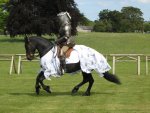
I also saw one at a dressage demonstration doing novice level work. It looked like it took so much more effort to ride than the others. (The other horses were tbs, sport horses and a cob). The cob was quite heavily built but it looked a lot lighter on its feet than the Friesan.
 
Last edited:
I'm a bit puzzled by the popularity of Friesans in dressage. The couple that I've seen find a balanced canter very difficult. I know someone who spent two years of blood, sweat and tears teaching hers to canter. The are lovely together now but it took a lot of hard work.

Ha ha! I know, I had a lovely little Friesian cross mare, very Baroque, and she looked lovely in canter, but I was working harder than she was!Fern in armour.jpg
 
That's it. They look lovely but you have to work for it!
Most dreams do take a lot of hard work to achieve :)

If it’s your dream to ride a beautiful black (or white) horse with flowing mane, in those books and films, be prepared as they say :D
 
Most dreams do take a lot of hard work to achieve :)

If it’s your dream to ride a beautiful black (or white) horse with flowing mane, in those books and films, be prepared as they say :D
True, and the flowing manes are beautiful. The friesens are stunning to look at. Their trot is very fancy too ☺️
 
Exactly! This is why it's so frustrating that so many judges do not seem to have read the rulebook or seen enough "iberians" (or normal horses for that matter) to be able to discern a movement for it's own true merit. Non-Wb's seem to be marked down for not moving like a wb...

speaking from my own experiences of riding a couple of PB WBs with fairly ordinary paces, iberians, arabs and natives.. i would say that on the whole i don't believe I've been marked down.. However I think that there have been extra marks *available* to those with the more scopey paces or those with more natural suspension. I can only think of a couple of occasions over nearly 15 years of affiliated competition where I've really felt that the judge was unfairly penalising us.

Once with a judge that is generally a low marker for anyone who doesn't appear to be riding a 20k horse (I avoid him now, don't need the kick in the teeth), and most recently in our first inter1, where cob did the most extended Extended Trot she could muster, to be told it was "not enough for extended" :rolleyes:

Having sat in on some judge training they've basically said so much, that a correct but not extraordinary version of a movement or paces would score well, but the same thing performed with the same correctness but with more cadence, more scope, more reach, more whatever, would score additional marks. Although that immediately puts those of us on "other" horses at a bit of a disadvantage immediately, I sort of can't argue with that? if it's better, it should score more highly. I personally just have to hope that the spectacular WBs have a brain fart and won't cooperate, or the rider makes a mistake, or something!! o_O
 
i think its time for separate wb classes so they can throw themselves around in peace, and classes judged exclusively by true classical judges or trainers with its own tests with marks for natural outlines and straightness development with marks for tactful and considerate riding in young horse classes starting at 5 years old, with marks for riding without spurs and good use of the riders legs in bringing horses to respond to sensitive aids, including intelligent use of the riders seat in relation to the horses back and development of early collection, including a couple of halt to trot during the test to keep the horse supple and kindly forward, and penalize forced outlines, rushing onto the forehand and all hard driving aids and all forms of tension and stiffness, and good marks for enthusiasm and showing pleasure and happy outlook towards work not merely `obedient` but the seeds of partnership not dominance, and top marks for the rider most in touch with the horse they are riding
 
What would the reason be for international gp horses not sitting. Surely they are being trained to do it.

That is the basis for a million conversations, lots of books, lots of debate. It's not just breeding that has changed, so has training. Read up Gerd Heuschmann (sp?), Erik Herbermann, Anja Beran, Klaus Schoneich, Marije de Jong for thoughts on modern versus correct in hand work and ridden training.

Witness the bouncing croups in the piaffe, that is what they seem to be trained to do, not to progressively lower, collect and strengthen from backing to Grand Prix. Flash trumps all.
 
Top