Scales of training and the less than perfect horse

soloequestrian

Well-Known Member
Joined
14 January 2009
Messages
3,117
Visit site
I had an interesting conversation the other day and would like other views.
I've always had less than perfect horses in terms of conformation or behaviour. I like dressage, but have struggled with the order of the introduction of movements at different levels: specifically with the lengthened movements which are introduced well before lateral movements, which I've always done a lot of. Discussion on this with a friend was along the lines of perhaps for horses that are conformationally and behaviourally well suited to dressage (i.e. uphill and unspoiled), lengthening is actually relatively easy compared to performing lateral movements well. Perhaps the dressage levels are written with those types of horses in mind and they are never going to suit the animals that are conformationally less desirable? The levels do follow the scales of training, but I feel as though if I had followed the pattern of introduction of lateral work with any of my horses, I would just never have got there - I've often used it to help get the weight back a bit which then should help with lengthening.
Any thoughts?
 
Depends what you mean by lengthening... depends what scales of training - there seems to be so many versions.

And even so, some horses have a natural aptitude to some things than others. So the scales have never made that much sense to me - e.g. if you have a "bendy" horse you need to work on straightness. A "giraffe" needs to work on contact and lengthening the frame and rhythm. Horses for courses.

In the military such scales and rigid frameworks were probably necessary to train many horses in a short space of time. We're not training for war anymore so why keep on using this system? The "art" of horsemanship doesn't seem to follow the pyramid scales... when training horses for kings and noblemen, horses were ultra-refined following certain "masters" whom all had differing views e.g. Baucher/gueriniere/podhajsky etc...

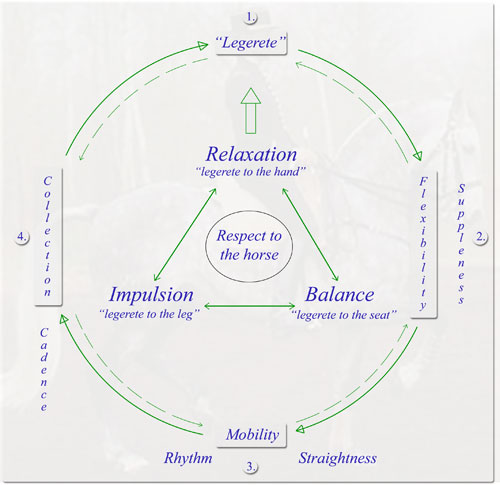
I prefer this one...
Legerete.jpg


It's flexible enough to suit any type of horse and it's not exclusive of each type of movement and you can go back and refine as many times as needed.
 
As above the scales of training are a guide, a point of reference rather than anything set in stone, training is about making the best job out of what you have, that includes accounting for the rider, if a horse can do lateral work correctly it will need to be rhythmic, relaxed, have some connection and understanding of what you are asking, have enough impulsion or at least enough to allow the lateral work to help generate more and be straight enough to be asked to move laterally although again lateral work can assist with straightness.

You do not have to take each "stage" as an entity, they are the foundations on which every horse should be worked so they become stronger, more able to cope with whatever work you want them to do, it helps a SJ to work in a basically correct way even if they never set foot in a dressage arena.

Dressage tests are now based on the scales and for most "normal" horses a few strides of "showing some lengthening" should be more than possible very early on in their training although they may learn some lateral movements first most will not be truly engaged enough to perform them well in competition before they can show lengthening, I have had many different types to educate and have rarely found an issue getting enough lengthening from them to get a reasonable mark in a test but it would take far longer to get a decent shoulder in established to get halfway down a long side in a test environment.

Competing in dressage at the lower levels is as much about presenting a good test, having a relaxed obedient horse and showing it to it's best, develop their strengths and keep working on their weaknesses as no horse is perfect, it is a case of bringing out the best in them and using the competitions as a guide with the aim to come out pleased whatever the result.
 
I agree, SE. I have a cob who is doing smashing shoulder in and half pass in canter, lovely shoulder in on trot, and credible half pass, yet he struggles to string two lengthened strides together before he falls into his forehand and runs. He's not the first horse I've had who got lateral work cracked long before he learnt to lengthen.

I really like Tallyho's model. I think that maybe comes from Philippe Karl, I recognise the 'legerete'?
 
Yes it is ycbm and I explored it and other classical about 15 years ago.... left it and went back to "conventional" - getting stuck in the same places - and I've come full circle as I think its the only one that makes any sense, to the horse.
 
I find a lot of horses nowadays have the lateral work and 'bendy bits' well in hand but can't produce a decent walk.

I'm riding two like that at the moment. Both have been professionally started too, but sent away for a few months to be professionally started, not brought up by a professional.

I wonder whether it's an issue of patience when they are started? Starting a horse for dressage takes an awfully long time and perhaps the amateur competition market demands ready-made things far too soon.

Obviously conformation and type will affect aptitude, but moving on to the showy things before the basics are established seems to be very common.

ETA, not suggesting that people with horses that do this aren't schooling properly, more that we get them with this sort of history and have to work against it, so in reality we have to work through the training scales backwards.
 
Last edited:
I like that model. The annoying thing for me is my horse CAN do all of those things, but he either gets lazy and can't be bothered or he gets distracted and forgets what he is doing. I need a new brain for my horse.
 
I like that model. The annoying thing for me is my horse CAN do all of those things, but he either gets lazy and can't be bothered or he gets distracted and forgets what he is doing. I need a new brain for my horse.

hehe :) yes I feel your pain. All horses can do dressage but it's how you put it together for them.

My last horse was very talented and picked everything up easily and because he was naturally forward and "up" in himself he found laterals easy. I was spoiled.

My mare is not at all forward neither in the brain nor the body! Plus she is as bendy as hell and can twist her neck like a corkscrew.... be patient though - it's taken us 2 years to even get any decent walk/trot out of her but hopefully the foundation is now there so..... another 2 years and we may even get to a walk & trot test :D:D
 
hehe :) yes I feel your pain. All horses can do dressage but it's how you put it together for them.

My last horse was very talented and picked everything up easily and because he was naturally forward and "up" in himself he found laterals easy. I was spoiled.

My mare is not at all forward neither in the brain nor the body! Plus she is as bendy as hell and can twist her neck like a corkscrew.... be patient though - it's taken us 2 years to even get any decent walk/trot out of her but hopefully the foundation is now there so..... another 2 years and we may even get to a walk & trot test :D:D

Lol mine sounds like a combination of your last horse and current one. He will get there, hopefully, he just prefers jumping and works far better doing that. Annoying, I bought a horse for dressage and it wants to jump. :P
 
I find a lot of horses nowadays have the lateral work and 'bendy bits' well in hand but can't produce a decent walk.

I'm riding two like that at the moment. Both have been professionally started too, but sent away for a few months to be professionally started, not brought up by a professional.

I wonder whether it's an issue of patience when they are started? Starting a horse for dressage takes an awfully long time and perhaps the amateur competition market demands ready-made things far too soon.

Obviously conformation and type will affect aptitude, but moving on to the showy things before the basics are established seems to be very common.

ETA, not suggesting that people with horses that do this aren't schooling properly, more that we get them with this sort of history and have to work against it, so in reality we have to work through the training scales backwards.

I don't think this is a problem with introducing the bendy bits too soon, more a problem of not working on the straight bits enough.

I agree with you on horses being produced for sale learning 'tricks', and falling apart when a buyer gets the horse home or out to a competition.
 
All interesting. I've always had horses that have come to me with ridden issues of one sort or another - not necessarily problem horses but definitely started or ridden in a less than ideal way. It would be interesting to know who writes the lower level dressage tests - there are some moves in there that don't seem very fair e.g. the one where you have to canter across the short diagonal, give and retake the reins on the centre line and then counter canter for the rest of the long side (60m arena, can't remember which test). I just avoid that one now - it's too horrible!
 
horses all learn differently and sometimes a basic you think has been learned properly will disappear and they will go through all sorts of can do. cant do. dont understand. oh its easy stages as they learn and its up to us to fine the best way for each individual horse to learn what we want them to do. one thing that made me laugh recently was this blog entry http://www.chronofhorse.com/article/how-make-grand-prix-horse and if anyone is interested another from the same writer about a test she was riding :D http://www.chronofhorse.com/article/johnny-goes-to-the-show-2
 
i find with the greener ones that i do end up doing the lengthening moves before the lateral ones. I just prefer getting the weight back first before doing anything else. It's much easier to build up strength behind doing bits of lengthening moves when hacking up hills etc. I just find that way the horse finds the lateral moves easier when introduced, as they have the power behind and are off the forehand more.

I agree with ycbm, the model of bringing young horses on nowadays does more damage than good. And a lot of the time it ruins the natural 'forward' straightness that most have. You get on them and everything just feels backwards, sideways and over fiddled with, instead of flowing forward happily.
 
I see use the scales as a guide to how things happen you show the horse how to develop rhythm and that helps the horse develop suppleness and begin to understand how to give itself up to be worked and be relaxed in it's work because of that the horse starts to develop contact and connection and so on .
How you get there depends on the horse and the system you are trained in.
 
Hmmm, I know what you mean, but I don't think you're talking about scales of training - more the types of movement that are included or excluded from each level of BD test. I do agree, I think lengthening and basic lateral should be introduced at the same level, because successful trainers often use one to develop the other, but which one depends on the horse and rider strengths/build/preferences.

Similarly, elementary tests often don't seem to come together for high marks until you're scoring well at medium. But it is very difficult to write low level dressage tests, and the line has to be drawn somewhere so...
 
I actually don't know anyone who would apply the scales of training in the order they are usually written, perfectly conformed/bred horse or not. For me, you can't have rhythm without some degree of impulsion, you can't have suppleness without an eye on the straightness, you can't have any of those without contact, etc etc etc.

Each horse is different and the rider's job is to think about which elements to tackle first, in which order, in which combination... and how. No horse has read the rule book.

This morning I have ridden 2 very different green horses which needed to sort out a contact/straightness issue before they could go forward or be supple, and therefore before they could maintain a rhythm. On both, a good time was spent riding outside leg to inside hand... another rule broken, lol.

I think it's a nonsense to think that there are rigid rules, when horses don't come out of the factory made to a certain spec :)

As for the order of stuff taught, I start lateral work very very early, just simple yielding and shoulder-fore or counter shoulder-fore as an aid to develop straightness. It doesn't have to be a test standard movement to deliver benefits in the general way of going. For many horses, learning to canter shoulder-fore is what rescues a running pace or a loss of balance onto the forehand. I think it's helpful to teach the horse that in order to save its balance it needs to become more upright into the outside hand and step underneath itself, then it's easy to teach them to lengthen without falling onto their heads :)

I do think the newer tests are going the right way FWIW with a greater emphasis on basic training, good transitions and testing elements where there is nowhere to hide - the canter to G+ R to counter canter is a good test of the horse's balance, self carriage and connection to the rider's seat... it's short sighted to think that you can progress to more advanced work until that kind of thing is easy :) yet IMO it's a fair test at novice level
 
Far too many people are rushing the early education is my thought. We were at a busy unaff show on Friday, lots of nice ordinary horses competing prelim and novice tests. So many of them were badly ridden, rushed along out of balance and on their heads. When I trained with a now retired trainer, years ago you were not allowed out of walk until the walk was correct, leg yield in both directions and change of pace within the pace was established. I can vividly remember her saying that until I could ride each corner of the horse and feel what was happening I would be going no further.

I also think that lateral work is useful very early on, after all what you are actually doing is asking the horse to let you move the shoulders and allow himself to be in front of the leg, straight and balanced. In my view if you can't achieve that I don't think the horse should be hacking on the roads as you are not in control of him and cannot get him to move away from your leg out of potential danger.

On the subject of tests, there is an intro test that has a change the rein through 2 10m half circles in trot through X. That movement is impossible for most young horses and I don't think it is seen again until novice level.
 
with the newly broken horse going forward is the key, not rushing, not running or speeding, going forward to the leg in an open space or on a soft grass surface in a natural form, then put the leg on positively and at the same time lengthen the reins as the horse surges forward into lengthened strides, they need to lengthen the whole body and neck, when the horse can do this you can move on to other things.

the principle is that the horse has know how to lengthen before it starts work with any degree of collection or shortening of the frame, lengthening comes first in my experience.

a lot of horses slow down when starting lateral work.

that 2 half circles things is daft.
 
with the newly broken horse going forward is the key, not rushing, not running or speeding, going forward to the leg in an open space or on a soft grass surface in a natural form, then put the leg on positively and at the same time lengthen the reins as the horse surges forward into lengthened strides, they need to lengthen the whole body and neck, when the horse can do this you can move on to other things.

the principle is that the horse has know how to lengthen before it starts work with any degree of collection or shortening of the frame, lengthening comes first in my experience.

a lot of horses slow down when starting lateral work.

that 2 half circles things is daft.

Wholly agree.... and embedding the correct "bend" which I think can be interpreted in many ways but to me it's the right curvature of the whole spine not just the neck. Also the right "flex" in the poll too not stiff but yielding and taking contact - which I can't ever understand how it's possible with tight nosebands and flashes (another story I know!).
 
with the newly broken horse going forward is the key, not rushing, not running or speeding, going forward to the leg in an open space or on a soft grass surface in a natural form, then put the leg on positively and at the same time lengthen the reins as the horse surges forward into lengthened strides, they need to lengthen the whole body and neck, when the horse can do this you can move on to other things.

the principle is that the horse has know how to lengthen before it starts work with any degree of collection or shortening of the frame, lengthening comes first in my experience.

This doesn't work with cobs (or any other horses) which are naturally built onto the forehand. They just tip and run, unless you believe in holding them up with the reins, and often not then either.

The only way to get my cob to understand that I'm not entering him for Appleby Fair is to put him in shoulder in or leg yield before lengthening. So to lengthen, he had first to understand how to shoulder in or leg yield.

In thought the conventional wisdom was that lengthening comes from collection, not the other way round? Confused now if we're actually all talking about the same thing!


I also agree with whoever it was who said you can't safely hack a young horse out until it responds to lateral aids.
 
This doesn't work with cobs (or any other horses) which are naturally built onto the forehand. They just tip and run, unless you believe in holding them up with the reins, and often not then either.

The only way to get my cob to understand that I'm not entering him for Appleby Fair is to put him in shoulder in or leg yield before lengthening. So to lengthen, he had first to understand how to shoulder in or leg yield.

In thought the conventional wisdom was that lengthening comes from collection, not the other way round? Confused now if we're actually all talking about the same thing!


I also agree with whoever it was who said you can't safely hack a young horse out until it responds to lateral aids.

Twas me that said that.

and the result when it all goes wrong with a huge unbalanced carthorse. Not pretty, this was last year and he has improved greatly, now able to sit a little more and wait.

DSCF3639_zpsd0zvy49z.jpg
 
I strongly believe that being able to do a shoulder in led yield thingy is vital to safe hacking on the roads .
What do you do when horses spook if you can't ?this something that's always bothered me .
 
I strongly believe that being able to do a shoulder in led yield thingy is vital to safe hacking on the roads .
What do you do when horses spook if you can't ?this something that's always bothered me .

I went buying for myself a few years ago, good money types, I tried 7 on one day and not of them had any sideways or half halt. All were advertised as schooled polite and safe horses.
 
Lengthening comes from collection, not the other way around. No horse can properly drive from the hind leg until it has balance over said hind leg; anything else is just running on the front end. Lateral work is a great lesson in being able to ride all four corners of the horse, something I'd rather be able to do before I hurtle it on in a lengthening-y facsimile.
 
Twas me that said that.

and the result when it all goes wrong with a huge unbalanced carthorse. Not pretty, this was last year and he has improved greatly, now able to sit a little more and wait.

DSCF3639_zpsd0zvy49z.jpg


Exactly, only thankfully mine's a good hand smaller than
yours!
 
I think sometimes judges at dressage tests don't help. Tests ask for "some" medium strides to be shown, but judges seem to expect the whole change of rein to be done in medium and mark you down if it's not sustained along the whole distance. That results in a lot of forced movement with the horse either running or on the forehand, rather than just a few strides of correct movement.
 
I think sometimes judges at dressage tests don't help. Tests ask for "some" medium strides to be shown, but judges seem to expect the whole change of rein to be done in medium and mark you down if it's not sustained along the whole distance. That results in a lot of forced movement with the horse either running or on the forehand, rather than just a few strides of correct movement.

We had an example of that very recently. Huge mature nicely schooled horse built like a boat so everything is an effort. Change the rein in novice test and show 'some' steps. So rider (Ted's rider) sets the corner up, ensures he is straight before asking for some steps. Horse responds very nicely in balance no loss of tempo and showed clear change of pace, before being asked back to working trot before quarter marker.

It scored a 5 not enough steps, the test was 20 x 40 horse is 17.2. What do they want, motorbike it around the corner and fire it across diagonal into a heap the other side ?
 
I think sometimes judges at dressage tests don't help. Tests ask for "some" medium strides to be shown, but judges seem to expect the whole change of rein to be done in medium and mark you down if it's not sustained along the whole distance. That results in a lot of forced movement with the horse either running or on the forehand, rather than just a few strides of correct movement.

This is an old bugbear of mine, as well. It should be possible to do a nice transition into four good medium strides and out again and get the same mark as a horse doing the whole distance, because the test does not call for the whole distance in medium.
 
This is an old bugbear of mine, as well. It should be possible to do a nice transition into four good medium strides and out again and get the same mark as a horse doing the whole distance, because the test does not call for the whole distance in medium.

not sure I agree with getting the same mark, a fair mark - yes, but the same mark as a horse that has sufficient balance to show more steps? 4 steps is really not a lot, it's not the test's fault that a big horse needs more time to get ready than one which is very established. As with everything in dressage, the horse that is able to show more of the same, or a better version will score more highly.

I come up against it (quite rightly) at every show - I'm riding a 14.2 welsh D, who can't possibly show the cadence that is not prescribed in the test but produced by many WBs... if we both do the same kind of test but they do it with better paces then they will score probably half a mark or more extra on each movement.
 
As always, dressage is about "how" you do it rather than "if" you do it. And cadence is one of the things that you are marked on.
 
Top