Tension in Dressage

no it sounds like you will improve each test with some mileage on him. And the comments sound like he has great potential. the tension is a hard one. I have one young one in who gets tense, and i usually spend the first 6 tests doing tiny shows and just riding them so they have fun going around a ring, with no pressure on them. I just write off the marks because the long term goal of getting them happy in the ring is more important.
 
But you are missing out on basic blocks of training with that line of thinking, you cannot ride a tense horse into a contact unless you have built up the strength behind and the suppleness through the back. You cannot ride a tense horse into a contact, because you have tension being held in the body. You don't ride any horse into a contacrt, you ride the hind end correctly and the front sorts itself out.

Funny, that’s what the judge suggested needed to happen on a couple of the movements he was marked down for tension.
 
no it sounds like you will improve each test with some mileage on him. And the comments sound like he has great potential. the tension is a hard one. I have one young one in who gets tense, and i usually spend the first 6 tests doing tiny shows and just riding them so they have fun going around a ring, with no pressure on them. I just write off the marks because the long term goal of getting them happy in the ring is more important.

Thank you, that’s what I’m trying to do to be honest. He had a first test in which he was hopelessly over excited and didn’t behave, the second time he was much improved and very obedient but still showed some tension...but we are at the stage where he thinks going to a comp is terribly exciting and the comments about him were very positive and indicated potential.

Never had tension come up with other horses, and was slightly baffled at the scoring of horses not going particularly well...but as you say I have a lot to take from this and feeling hopeful for the future.
 
Watching tense horses is horrible .
The aim of dressage is harmony and without harmony there’s nothing .
As the rider of an impressively tense but very talented horse I did my years at the coalface of tension .
I never got her cracked in the arena she would work well at home and at clinic but she knew what a horse trail was and that was that .
But boy did I learn from her I learned exactly what not to do how to forget learning how to ride tests and learn how to train I never had a tense horse I could not settle since .
Your horse is who he is enjoy him and seek to train him to be the best he can .
I know all about the frustration of seeing a dope on rope being squeezed and half carried round get a better mark but you just have to rise above it .


Ah yes, I did omit the "tense because we are a a one day event" reason!!! Omitted because OP is at an unaffiliated prelim, but a silly omission anyway as I have had 2 horses who would be tense at an event.

One would buck, the other be rather like OP's horse sounds. The bucking one would tend to score better as between the bucking she would take the contact and swing. That did sometimes seem the wrong way round, as the horse who actually did all the movements where they should be scored lower than the one bucking (same events albeit different sections) but I have to admit that the tense one (who became OH's horse) did not move correctly because of that tension in all movements rather than the mare who just wrote off a few movements each test.

I also learned from OH's horse, hence my answers on this thread about going back to the basics at home, and I too have had better results since.
 
ten tension is a tough one. I had a nightmare for years with one horse, he was just very 'thinky' and never looks fully relaxed in the ring.
 
ten tension is a tough one. I had a nightmare for years with one horse, he was just very 'thinky' and never looks fully relaxed in the ring.

I think he just enjoys himself a bit too much at the moment. Everything is exciting to him. I can’t knock him though as he was so much improved from the first and did everything I asked this time instead of refusing to walk and other interesting freestyle moves.
 
thats brilliant he imprived so much by the second time, he will be probably be totally chilled after a few. I suppose its all so new to them.
 
OP, the late Bisto was a tense horse. he loved to work, was forward thinking and responsive. He was clever and athletic, had lovely paces but I struggled to keep him relaxed. I did some online dressage with him and we were slated, always beaten by ploddy cobs which were behind the leg and a bit on the forehand. TBH I was a bit pissed off too but going back to the scales of training the judging was correct. However, we did improve by working on getting him properly round and properly on the aids, it wasn't a quick job though. good luck with your horse, he sounds a lot of fun. I've learned loads from this forum, there are some very knowleable people who take the time to reply. I feel very lucky to have access to good help and advice and all for free! Have a lovely Christmas!
 
OP- have you done any writing for judges? It’s a fabulous way to gain a deeper understanding of what they are looking for. Also, don’t forget, all judges are different. You may well have found that a different judge would have marked your horse higher than those lazier, on the forehand types, but obviously that judge on that day felt that your horse was showing tension and it was impacting on the quality and accuracy of the test.

Sounds like you have a lovely horse who is going to do well, so don’t get too worried about it. I’ve had tests that have felt good and the marks haven’t reflected it, but equally I’ve had tests that felt pretty dreadful to me but gained me some of my highest marks. It’s a funny world!
 
I have 2 pure bred Arabs and they can often be tense for no apparent reason, one thing I have found one of my horses is really clever and since we have been doing more advanced stuff he has become more settled, it's almost like if you really make him think and use his brain more he relaxes, you might be better off starting some more difficult schooling to get him thinking, I tend to use lateral work as a diversion quite a bit if mine are being silly.
 
Being short of a rib tension really glares at you when it’s in an Arab .
OP just keep going out and doing tests always do two at each competition.work the horse as normal in the warm up then back off in the arena so it’s a bit of rest in there .
 
Interesting thread (and question). I have an, um, unusual horse, in part because of the muscular issues that he has. And when he's having an off day competing he can either be beach donkey lazy and thoroughly behind my leg, or like a charging rhino, who takes any straight line up or across the arena as an invitation to canter and is horribly tense through his top line whenever we are not circling or cantering.

Scores wise, whichever off day version it is generally ends up in about the same ballpark between 58 and 60%. The bad and worse scores are in different places, but overall we end up with the same. So I would say, from my experience, judges don't have a preference, it just ends up being a numbers game as to the things you're penalised more or less for.
 
I opened this this morning thinking it was going to be about Olympia as the dressage was yesterday, and often times at that level I do see tension being rewarded more than it should be, for reasons completely beyond my comprehension (in my very very non professional and irrelevant opinion!).

I went to a Tristan Tucker TRT demo a few weeks back and was interested to see two of the demo horses competing or working at an advanced level. Both stunning movers, beautiful horses but who were so tense and tight in their bodies and minds that they struggled to cope with every day life. (This is no criticism of their owner/riders as so many of us are in a similar position, horse’s with boundless energy and power but without the right mental state to contain it all, and riders who are missing and crucial part of their training toolbox to help the horse to cope). I found it fascinating that these horses came in tacked up with every intention of providing a ridden demo, but as soon as Tristan got his hands on them he stripped the tack right off and each demo went no further than being worked in hand on the horse learning to control its own reaction to external stimuli. He felt they weren’t mentally equipped to be ready to work on a circle on the lunge let alone under saddle. And yet these are horses who are working at PSG/Inter 1. (I’m sure someone who knows these horses will come along and correct me). But it really made me think about what horses do for us even when in a state of heightened tension, and how much more work I need to put in to ensure that my horse is mentally capable as well as physically talented.

I don’t think I have in anyway helpfully answered your question, I’ve just rambled on a bit, but it’s an interesting topic and I’ve enjoyed reading all replies (even ones that wound OP up I found to be interesting and informative as an outsider).
 
Good post, BBP.

I think people don't always recognise tension when it is present, either. It's obvious when you have a horse that is wired, hot, muscles straining, eyes popping. But the quiet inner tension that just stews away is often overlooked IMO. It's something that has been on my mind lately too as current pressures at the yard are really affecting all the horses IMO, but no one else seems to have noticed. :( Horses are such generous stoics sometimes.
 
I opened this this morning thinking it was going to be about Olympia as the dressage was yesterday, and often times at that level I do see tension being rewarded more than it should be, for reasons completely beyond my comprehension (in my very very non professional and irrelevant opinion!).

I went to a Tristan Tucker TRT demo a few weeks back and was interested to see two of the demo horses competing or working at an advanced level. Both stunning movers, beautiful horses but who were so tense and tight in their bodies and minds that they struggled to cope with every day life. (This is no criticism of their owner/riders as so many of us are in a similar position, horse’s with boundless energy and power but without the right mental state to contain it all, and riders who are missing and crucial part of their training toolbox to help the horse to cope). I found it fascinating that these horses came in tacked up with every intention of providing a ridden demo, but as soon as Tristan got his hands on them he stripped the tack right off and each demo went no further than being worked in hand on the horse learning to control its own reaction to external stimuli. He felt they weren’t mentally equipped to be ready to work on a circle on the lunge let alone under saddle. And yet these are horses who are working at PSG/Inter 1. (I’m sure someone who knows these horses will come along and correct me). But it really made me think about what horses do for us even when in a state of heightened tension, and how much more work I need to put in to ensure that my horse is mentally capable as well as physically talented.

I don’t think I have in anyway helpfully answered your question, I’ve just rambled on a bit, but it’s an interesting topic and I’ve enjoyed reading all replies (even ones that wound OP up I found to be interesting and informative as an outsider).

Further to this, I watched the freestyle on the red button and the most frequent comment was about tension/lack of relaxation and how it affected movements and it was certainly obvious to the onlooker. In some respects the sharp, hot horse is easier to ride because the engine is running but from my own experience I realise now how easy it is to start adapting your riding to accommodate the tense horse rather than tackle the real issue of helping the horse to relax in his work.
 
I am AF but only novice level. I look at some of the horses in the warm up and &*^h myself they are such amazing movers and look gorgeous but tension and a little stressy. My little very un-flashy tb with small paces and not a lot of impulsion (yes you read that right) often score a lot better then them.

Why? Because he has a great rhythm and is dead accurate. We get slammed for lack of impulsion/jump in the canter. He is not on the forehand like the horses you saw but I need a fair bit of leg. Our scores are consistent at AF 64-66 but when I go unAF they shoot up the 67-69 once or twice going higher. On the odd occasion he is tense my scores drop a lot 55-59.

Prelim is just starting out you can be off the vertical, behind the leg, on the forehand to an extant but they will only effect your collectives not every move if the move is completed, its accurate, the rhythm stays the same then the score for that movement will be higher.

I have been beaten by many a lovely kick along, but then I have beaten some very smart nice moving horses.
 
Good post, BBP.

I think people don't always recognise tension when it is present, either. It's obvious when you have a horse that is wired, hot, muscles straining, eyes popping. But the quiet inner tension that just stews away is often overlooked IMO. It's something that has been on my mind lately too as current pressures at the yard are really affecting all the horses IMO, but no one else seems to have noticed. :( Horses are such generous stoics sometimes.
and that tension can also =more shut down, not always bubbling over?
 
I can add a giant welsh to that list! He is a right little (big) worrier but far too kind & polite to make a big show of it. When he flaps his bottom lip, which is his big brain tension indicator, all I want to do is give him a hug!

sometimes you have to know them well enough to spot the signs, don't you. Poor flappy lip! I used to call K "Kira-Tightface" because her bottom lip would get small and tight and although she appeared quiet, she was really in a big tangle inside. Salty doesn't breathe when she's tense. I live for the soft nose snuffles that indicate both of them starting to relax :)
 
I'm not a dressage expert by any stretch of the imagination am capable of riding a prelim test but not really to any great standard and no experience competing so it's really interesting reading peoples perspectives on rhythm and tension and the impact both can have on scoring. Thank you everyone!

Beastie is one to lose impulsion and back off when tense rather than overexerting and looking outwardly worried to an untrained eye, and while from an outside perspective he seems to be in a rhythm and consistent to ride it feels rather like a steam train with no steam carrying along on momentum rather than driving. Because he is slow and not rushing I have loads of time to set up for transitions and movements meaning we rode a pretty accurate test which is where Interesting to hear where these sorts of horses fall in the mark band (the only test we did scored a 62% with a generous judge so smack bang where people have suggested!)
 
I think the problem with tension is that it needs to be dealt with early... if a horse is tense at prelim it will be more tense at novice and struggle as it goes up the levels but I’ve never had a backward horse that doesn’t get more forward as training continues ...tension is a harder problem to fix... I’ve never seen a truly backwards horse at Grand Prix but I’ve seen a lot of very tense ones so it is a problem that stays rather than gets trained out and hence why I think it’s right that it is marked more harshly, dressage is about harmony and working together and tension is the absolute opposite of that.
 
So while I appreciate the issues with tension...this still brings me back to the original question.

A horse being kicked is not harmonious. I see a lot of euphemisms such as “behind the leg” but the reality is that force and discomfort are being used to carry out the movements.

Still struggling to get my head around the fact that so many find this preferable to a rider sitting quietly on a novice horse excited by its surroundings.

There is a huge difference between tension as a result of discomfort or stress...and horse in new surroundings excited by being surrounded by lots of new potential friends (being a horse basically)

Ethically, regardless of dressage scoring, the latter has to be preferable.
 
So while I appreciate the issues with tension...this still brings me back to the original question.

A horse being kicked is not harmonious. I see a lot of euphemisms such as “behind the leg” but the reality is that force and discomfort are being used to carry out the movements.

Still struggling to get my head around the fact that so many find this preferable to a rider sitting quietly on a novice horse excited by its surroundings.

There is a huge difference between tension as a result of discomfort or stress...and horse in new surroundings excited by being surrounded by lots of new potential friends (being a horse basically)

Ethically, regardless of dressage scoring, the latter has to be preferable.

But there is a difference between a horse who is excited and putting too much effort in, as in this case they show more energy that is captured and used in the correct way, and a horse who is tense and becomes inverted, as you have said your horse suffers in his frame.

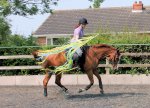
My old horse would buck when excited, but would do so with back raised (not just hind legs LOL), within the pace, here, I will post a photo where he was slightly too alert (due to the fact I was cantering round whilst holding a fly curtain) and you can see that he is still in a correct form. The extra injection of energy is shown in a raised back, more engagement, but all in the correct frame.

I would say look at a video of your test, you should see circles of energy, as in if everything is correct there should be virtual circles of energy, energy recycling.

In a tense horse that is not going correctly, the topline will be shortened and the legs may be higher but it is with a sharper, choppier feel, and that is absolutely incorrect.

BTW, this was a previously sharp and tense horse, undergoing training so he would not be scared of banners etc. So he would not be tense at competitions (but only after a LOT of hand/ground work to teach the "seek" reflex to softly seek the bit, even when under stress (in fact especially then).gymnastics.jpg
 
You seem to want a black and white answer when in fact there are numerous shades of grey, the "excited novice" may be being forced and in discomfort by being held back to remain in the arena, it certainly will not be comfortable going in a way it is not used to, the lazy one may be ridden by a person with little experience who is kicking but with very little effect and the horse may well be oblivious, neither is correct and neither will make any meaningful progress until the basics are in place but on the day of the test the lazy one probably showed more correct movements than the tense one.

It all comes back to training, a horse that has a correct start, is relaxed and confident will be easier to train, a lazy horse will usually, with some good training, be able to show improvement fairly quickly and be able to move on to the next level without too much effort, whereas the tense one may revert if it finds new movements difficult and time needs to be spent ironing out the reason for their tension, if it is purely because they find new places exciting and there is generally no tension in their work then a few more outings should fix that to a degree and they should be ready to go out and get far better scores.
 
Top
