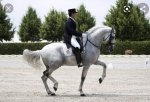
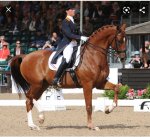
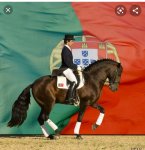
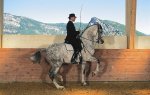
Dressage What does a £1.5million dressage 4 year old look like? This!

They could maybe adopt some hi-tech stuff? You know, put electronic ‘markers’ on the horse and then film them, like those lameness test things. Shouldn’t be too hard to work out the optimum range and correct movement for any given conformation......!

Take the human eye/bias out of it.

Actually I think that would be really sad and probably the death of dressage tbh. Although we are all wittering away about subjectivity in marking etc there is virtually no point in totally objective marking as the passion, committment etc etc in any horse sport is almost entirely subjective. Notions of beauty and harmony are human constructs so for me, making any marking of the horse-human interaction entirly objective would be really reductive. That is a more philosophical point of view and probably it works for me because I don't really have a problem with not being able to compete effectively with horses and riders of this calibre! I have made my peace with what may be realistically achieved and for me that is still quite an amazing aspiration. I don't really care that there are infinitely better trained and more talented riders on gazillion dollar horses that have aeons of breeding behind them; life isn't 'equal' or fair. In fact I am spurred on to improve, to train and keep going by the idea that I might sneak in and do better on my common horse with my lack of inspirational training than some of the 'big' competitors - that may not be realistic but I do think the fact that it is possible keeps ambition and passion alive. :) :)
 
^ this

I sat with 2 different judges at E on Monday and they pointed out what they could see that the M or C judge wouldn't be able to catch.

do people have examples of where style over substance is being rewarded or is it just a hunch? I'm interested because often people complain about stuff with dressage *in general* but when you break down where the marks can be gained it's more complex than whatever hang up each individual person might have. you can end up with a result that is not what you expected because of the way the numbers work, coefficients for example.

eta to add to this, in case people think I'm 100% behind the status quo and can see no wrong, which seems to be what comes across to the folk on the other side of the fence ;)
I'd take Adelinde/Parzival as a combination I often did not enjoy watching. But she could ride a correct test, and delivering the movements correctly delivers a big dump of the marks. I've just looked at his FEI results and the straight test GP was typically a mid 70s score. which translates to between fairly good and good. Not excellent, not even very good. they happened to be at the top of the pile sometimes but that placing is only dependent on who turns up on the day and not really a reflection of their performance objectively. (see related debate on the thread about non-tb racehorses and the coloured horse that placed 3rd by default - but was still "placed")
Parzival bugged me as he got such high marks for his piaffe and it was as far from a piaffe as you could get but it looked bouncy and active. For me most of what Totillas got too, all in the front nothing in the back (which is against the FEI directives), and this maybe a controversial one but Isabelles Werth's piaffe always with a dipped back and no sit.
 
Parzival bugged me as he got such high marks for his piaffe and it was as far from a piaffe as you could get but it looked bouncy and active.
but I'd bet, it was in the right place and the right number of steps, and a few other positives ;)

I tried to look at the CRC dressage tests mentioned by sbloom but you have to pay for them, but it said it was placing a lower importance on accuracy than way of going. whereas I think in "normal" competition dressage you have do bring both to get the top scores. if you do 9 steps of piaffe some way off the marker then it's not enough for a high mark even if it's a really good technical piaffe.
 
but I'd bet, it was in the right place and the right number of steps, and a few other positives ;)

I tried to look at the CRC dressage tests mentioned by sbloom but you have to pay for them, but it said it was placing a lower importance on accuracy than way of going. whereas I think in "normal" competition dressage you have do bring both to get the top scores. if you do 9 steps of piaffe some way off the marker then it's not enough for a high mark even if it's a really good technical piaffe.

It's all about how severely each error is seen and marked, in a CRC test a technically incorrect piaffe at the marker would generally score lower than a correct one a little away from the marker. In competitive dressage accuracy (and to a certain extent, therefore, submission) has been rewarded relatively higher than purity of gaits and fulfilling the requirement for the nose to be in front of the vertical.
 
I would be interested to look at the CRC tests too but whilst the 'way of going' is really important what is the point of having a great way of going if the rider can't do 'accuracy' which in itself is indicative of some of the more important elements of training, communication and harmony between rider surely? I am definatly interested in the classical methods so don't want to sound negative at all btw.
 
It's all about how severely each error is seen and marked, in a CRC test a technically incorrect piaffe at the marker would generally score lower than a correct one a little away from the marker. In competitive dressage accuracy (and to a certain extent, therefore, submission) has been rewarded relatively higher than purity of gaits and fulfilling the requirement for the nose to be in front of the vertical.
thanks for the explanation.
I think I don't understand why one is better than the other?
if the CRC offered this and it appeals to people more than what they currently see why hasn't it taken off?

(I think both accuracy and correctness should be, and probably are, of equal importance, I find it slightly odd to specify that it's acceptable not to ride the test as prescribed because part of whether you're really riding the correctness of training is that it should be possible to place your movements where you want them not "sort of" where they should be ;) )

eta otherwise it's a freestyle test.
 
  • Like
Reactions: TPO
but I'd bet, it was in the right place and the right number of steps, and a few other positives ;)

I tried to look at the CRC dressage tests mentioned by sbloom but you have to pay for them, but it said it was placing a lower importance on accuracy than way of going. whereas I think in "normal" competition dressage you have do bring both to get the top scores. if you do 9 steps of piaffe some way off the marker then it's not enough for a high mark even if it's a really good technical piaffe.
But for me it wasn't actually a piaffe so it didn't matter if it was on the spot or had the correct steps as fundamentally she hadn't performed the movement.
 
But for me it wasn't actually a piaffe so it didn't matter if it was on the spot or had the correct steps as fundamentally she hadn't performed the movement.
i'm interested to explore this if you are willing to just for my own understanding of the issue. is it because of the bouncing (rather than lowering behind)? referring back to the FEI guidelines you can score a 7 for a piaffe that lacks lowering behind (I mean, assuming there aren't other big issues). so I wonder if this is again a bit of an expectations of classical riders vs FEI guidelines issue?
 
i'm interested to explore this if you are willing to just for my own understanding of the issue. is it because of the bouncing (rather than lowering behind)? referring back to the FEI guidelines you can score a 7 for a piaffe that lacks lowering behind (I mean, assuming there aren't other big issues). so I wonder if this is again a bit of an expectations of classical riders vs FEI guidelines issue?
I am a bit more classical I guess as I trained in Portugal which is very different to here, but the piaffe is an ultimate collection movement and while you may get a 7 for a lack of lowering there should at least be some and there should be collection. Percival was bum high and showed little collection I can't fathom why a judge or the FEI would like that.
 
no I understand the difference
i would guess, and it's only been my POV throughout obv, but because there are other elements that are judged in the competitive dressage and so it's not as simple to judge as "that's not collection" vs " that is". you can be straight and active and regular, horse accepting the contact (... and do the right number of steps in the right place) so all those things will be marks gathered - or at least, marks not lost.

I would also say that often horses are shown even at GP that are a work in progress at the level - do you give the green horse a 0 because it's not lowered its quarters but has met the other requirements, or do you say, it's getting there in a fairly good way? I think I accept the latter because I'm a pragmatist on these matters!
 
no I understand the difference
i would guess, and it's only been my POV throughout obv, but because there are other elements that are judged in the competitive dressage and so it's not as simple to judge as "that's not collection" vs " that is". you can be straight and active and regular, horse accepting the contact (... and do the right number of steps in the right place) so all those things will be marks gathered - or at least, marks not lost.

I would also say that often horses are shown even at GP that are a work in progress at the level - do you give the green horse a 0 because it's not lowered its quarters but has met the other requirements, or do you say, it's getting there in a fairly good way? I think I accept the latter because I'm a pragmatist on these matters!
I wouldn't necessarily give a zero but for Parzival probably a 5, but I believe she used to get 10s for her piaffe. That would probably be the same for a green horse too, if a judge is giving 7 or 8 for a 'work in progress' piaffe there is probably not that much impetus to go further or that then kind of becomes the norm if you know what I mean?
 
Now Fuego could chuck in a nice Levade I'm sure. Look at the difference in fetlock drop on that front leg. For me I don't think Parzival is actually performing piaffe. He's trotting on the spot.
 
I do remember being incredibly struck by the different "types" (for want of a better word) of piaffe when watching the dressage at London 2012. A lot of the big warmbloods technically did the movement and it looked fine, but then that cracking Lusitano (Rubi?) came in and it just looked like something else entirely. He was/ is a stunning horse.
 
I do remember being incredibly struck by the different "types" (for want of a better word) of piaffe when watching the dressage at London 2012. A lot of the big warmbloods technically did the movement and it looked fine, but then that cracking Lusitano (Rubi?) came in and it just looked like something else entirely. He was/ is a stunning horse.
For interest Rubi AR piaffe:) 20200820_135109.jpg
 
Nope, judges at different places see different things eg a judge at C will see if a halt is square at the front, on the centre line but won't see if the back legs are under and square or not, whereas a judge on the long side will see this but won't know if the horse is on the centre line and straight.

Thank you for this.
I was thinking more of panels of 7 judges rather than 3 and the whole Hi Lo Drop debacle where it was argued that medal placings were being affected by such discrepancies.
 
i used to find the judging very difficult to understand as horses that i thought did a nice clean test with no mistakes were behind the flashier horses who made mistakes. once i started writing for the higher judges i realised that i had been wrong as the quality of marks when flashier horse performed them well were quite a bit higher than the ordinary horse. i used to love watching parcival but the last couple of years that he competed i thought he looked a very unhappy horse. his piaffe was never completely correct even when i loved watching him. if you look at something like strictly or dancing on ice, some of them might do the dance well but then you get a talented person and they give a much better show and deserve to win IMO..
 
Just our of interest and as a bit of an aside, today's H&H pages 52/53 Dressage report features several winning horses that are not your typical dressage horse. 70.92% at Inter 1 for a TB, two wins at medium for a cob x Han, Jayne Turney mentioned as scoring 70%+ at Inter 1 and PSG on the pony Cruz 111 and a list 1 judge singing the praises of a cob in the article "I Owe It To".
 
It's all about how severely each error is seen and marked, in a CRC test a technically incorrect piaffe at the marker would generally score lower than a correct one a little away from the marker. In competitive dressage accuracy (and to a certain extent, therefore, submission) has been rewarded relatively higher than purity of gaits and fulfilling the requirement for the nose to be in front of the vertical.


did nt realize crc tests were like that, thanks, never took the time to look
why unbalance and dissapoint a horse for the sake of accuracy alone, its a dilemma when horses are not machines, i always wait for the right moment, if its not right i wait until it is to set the horse up to succeed, when schooling, its almost the most important thing.

i absolutely love sylvia loch, her way, her kindness and knowledge, and would l love have seen here ride the stallion this thread is about
 
my horse bimbled around the dressage ring and could have been quite good if i had known what i was doing all those years ago,, i am sure if charlotte had got on her she would have been pretty good... a good rider on an ordinary horse can go far and that is part of the fascination of dressage for me as we can all aspire to be the best..it is a little late for my body to improve but i am still interested and enjoy being part of the sport, although am climbing the walls at the moment as i cant go to any comps unless i groom :D
 
did nt realize crc tests were like that, thanks, never took the time to look
why unbalance and dissapoint a horse for the sake of accuracy alone, its a dilemma when horses are not machines, i always wait for the right moment, if its not right i wait until it is to set the horse up to succeed, when schooling, its almost the most important thing.

i absolutely love sylvia loch, her way, her kindness and knowledge, and would l love have seen here ride the stallion this thread is about

They have two sets of marks for horse's way of going etc and rider (down to a mark even for hands I think); an initial assessment, then another at the end, many sections to each, and then possibly a collective for accuracy etc, and many more collectives, if I remember correctly. I have a few somewhere but Lord knows where, was many years ago I competed!
 
One thing that stands out to me is that those who tuck under, go base narrow, compared to those that bounce. I have seen base narrow also used as a negative though?

The horse should lower the back end by bending the joints of the hind legs more and bringing the hind feet closer to the front - the negative base narrow is when the front feet move closer to the hind feet and sometimes bring the front feet back a bit and bring the hind feet forward a bit so you get a kind of triangle - those are faults that mean the horse is on the forehand - usually (but not alwyas) accompanied by the poll not being the highest point and / or btv.

a moment in time photo of a slightly forward travelling piaffe will also show the triangle base narrowing. either a forward travelling piaffe or a piaffe on the forehand will show that the landed foreleg will not be vertical
 
Last edited:
The horse should lower the back end by bending the joints of the hind legs more and bringing the hind feet closer to the front - the negative base narrow is when the front feet move closer to the hind feet and sometimes bring the front feet back a bit and bring the hind feet forward a bit so you get a kind of triangle - those are faults that mean the horse is on the forehand - usually (but not alwyas) accompanied by the poll not being the highest point and / or btv.

a moment in time photo of a slightly forward travelling piaffe will also show the triangle base narrowing. either a forward travelling piaffe or a piaffe on the forehand will show that the landed foreleg will not be vertical
Interesting, so if you look at the pic of Rubi AR, it does appear that the front feet have come towards to the hind end so he is negative base narrow? Perhaps this is why he is BTV. Always learning stuff on here!
 
Interesting, so if you look at the pic of Rubi AR, it does appear that the front feet have come towards to the hind end so he is negative base narrow? Perhaps this is why he is BTV. Always learning stuff on here!

Yes, I've seen better pics of Rubi although can't seem to find one at the minute!
 
If you compare the pic of rubi to this of Philippe Karl - you can see that this horse has shortened his base but by bringing the hind legs underneath and bending more, the loins are full, poll high and no overbening - front static leg is just about vertical and you can easily see that the horse could take this through to levadePK.jpg
 
Top