Calling Barefoot experts

Laminitis is usually diet and metabolic induced, unless Cushings is involved. Whole different ball game, for Cushings, but if you consider people packing too much food away, and not exercising, then type 2 diabetes is on the horizon. People with diabetic issues often have lower limb circulation problems - I have wondered whether this is human laminitis?
Horses that have been badly shod, so that the tubules are pulled out of shape and the heels are everywhere bar where they should be will struggle to have strong laminae.
Navicular changes can successfully be reversed with enough time and patience. The entire inner workings of the hoof have to remodel, the pedal bones have to realign in some cases, and the heels and frogs have to start working again, and there will be stress on the laminae as the horse starts to bear weight on areas that have not worked properly for ages. If you rush this stage, then you risk tendon injury.
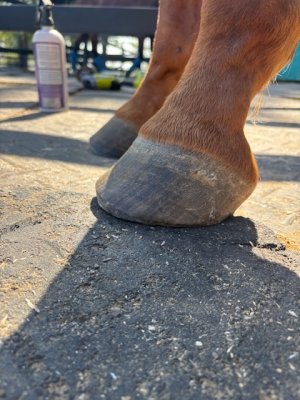
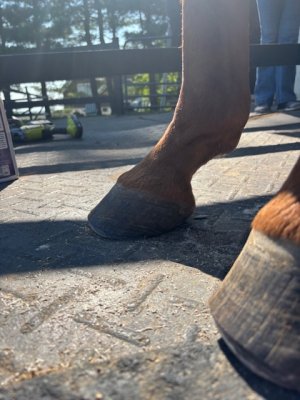
The photographs being posted by OP show good new growth coming in from the coronet band, and once that reaches the ground, a better assessment of future soundness can be made. It's a slow job,
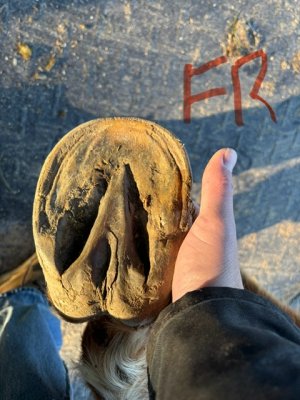
 
Apparently I'm the only one, but I don't like the development of the sole or rather that there's almost no improvement at all.

It's been more than four months now since the shoes were taken off, with the right strategy plenty of time for improvement, yet the soles appear as thin as before. Therefore, I suggest you read this article by Pete Ramey (https://www.hoofrehab.com/DistalDescent.htm) and consider trimming as explained there. From my own experience this trim works fabulously and if you decide to give it a go you should see significant improvement after just a few weeks.
no you are not the only one.
I agree that is a very good article of Pete's and gives a good trim

I too am in favour of bringing the heels back, based on experience not on what it says on the internet. It is a case of knowing when and how far and how quickly you can do that.


By the time the strong laminae are grown down far enough to encounter leverage at the toe, not only will the toe already be shortened but the laminate will also be strong enough to withstand the leverage. It's strong laminae at the top which suck the pedal bone up in the hoof capsule, not trimming at the bottom.
.

in theory

Exactly my explanation! But the "bottom trim" is what initiates the rebuilding of the strong lamina at the top - if you decide to trim.


Patience is a good thing but not always the best and only option. If there are ways to bring quick relief from pain, they should be at least thoroughly considered.

however I have found in practise that bottom trimming is beneficial

if it takes around 9 months to grow a foot down then I want the best foot possible emerging after that time. Anything and everything I can do in that time by trimming to produce that better quality foot is, to my mind, well worth doing.

It isn't.

It's proper feeding that creates the strong laminae at the top. Most barefoot rehabs also have their feed regime adjusted. Weak laminae at the coronet are not caused by damaged laminae at the bottom.
.
Do you think that all damages to the lamina are always caused by a poor diet or metabolic issues? Do you think that a perfect diet makes the lamina so strong that it can withstand all mechanical wear and tear unharmed?


I think that lamina and indeed whole foot strength comes from the metabolism but that in some horses that can be extremely difficult to get right.
diet is important to a point although I am not as convinced as many (not talking about EMS/IR cases here)
to my mind trimming is far more important than it is given credit for. It is very high on my list. That is based on actual horses that I have trimmed or have deliberately left to see how they correct themselves and I spent a very long time doing both.. I have always found the trimmed ones improved more.

In this instance for this OP then I think you need a trimmer trimming your feet on a 3 weekly cycle and for them to be telling you exactly where to "touch up" on a weekly (or even less) basis. There is a lot to be done but I don't think you can work that out via the internet. You need an experienced trimmer there to show you what to do and how to "feel" the foot.
 
no you are not the only one.
I agree that is a very good article of Pete's and gives a good trim

I too am in favour of bringing the heels back, based on experience not on what it says on the internet. It is a case of knowing when and how far and how quickly you can do that.


in theory


however I have found in practise that bottom trimming is beneficial

if it takes around 9 months to grow a foot down then I want the best foot possible emerging after that time. Anything and everything I can do in that time by trimming to produce that better quality foot is, to my mind, well worth doing.


diet is important to a point although I am not as convinced as many (not talking about EMS/IR cases here)
to my mind trimming is far more important than it is given credit for. It is very high on my list. That is based on actual horses that I have trimmed or have deliberately left to see how they correct themselves and I spent a very long time doing both.. I have always found the trimmed ones improved more.

In this instance for this OP then I think you need a trimmer trimming your feet on a 3 weekly cycle and for them to be telling you exactly where to "touch up" on a weekly (or even less) basis. There is a lot to be done but I don't think you can work that out via the internet. You need an experienced trimmer there to show you what to do and how to "feel" the foot.
I have been touching up on a 7-10 day basis myself, following Ramey's barefoot trim. He was professionally trimmed on March 9th but the farrier carved the frog out a little too much and took too much sole at the toe out for my liking. Since then, I have been touching up on 7 day schedule following Pete Ramey's barefoot trim protocols.
I have been leaving 1/16 inch of depth on the hoof walls, and about 1-2 cm of water line around the hoof.
I haven't been really taking too much off, just enough to make sure it doesn't get over grown. He has been getting access to abrasive surfaces with good movement throughout the day to self trim as well.

I will likely take more pictures tonight!
 
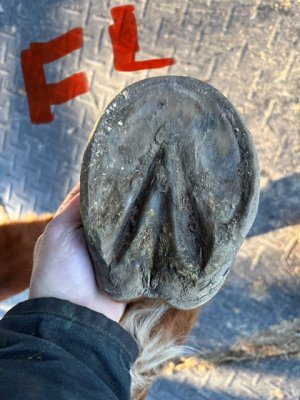
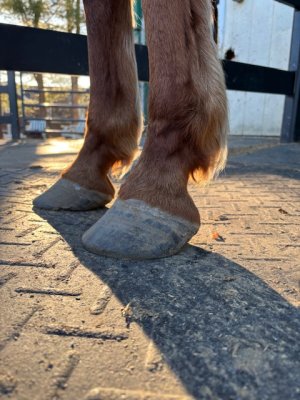
Toe seems long on the FR but not sure how much I can take off.
 

Attachments

  • IMG_5073.jpeg
    IMG_5073.jpeg
    113.3 KB · Views: 76
  • IMG_5071.jpeg
    IMG_5071.jpeg
    110.4 KB · Views: 50
  • IMG_5070.jpeg
    IMG_5070.jpeg
    177.6 KB · Views: 46
It depends whose advice you want to listen to, there are so many schools of thought now all over the Internet.

If he was mine I would make it non ground bearing from 10 to 2 back to the white line without thinning the hoof wall any higher up than that. You do that by bevelling the hoof wall from underneath. It's not far off as it is now, by the look of it.
 
If he was mine I would rasp the entire underneath very very lightly flat just so that I could see everything. That is not to remove anything very much but so that the inner, outer walls and WL are very clear. For me that lets me see where I am going :D:D

I would trim both the heels and the toe. For the heels I would pull the rasp back over each heel a couple of times. You are not removing a great deal but you are establishing the heels.

Working only from underneath I would reduce the wall height between 8 - 11 and 1 - 4. Using a clock face with the toe as 12.00. For accuracy mark the clock face on your hoof with a felt tip.

then I would trim between 10 and 2 per YCBM. by bevelling. We use a lot of terms and assume that everyone understands them. Do you understand what is meant by bevelling? That is going to be the most important thing that you do. Do you understand pulling the rasp back over the heels? Sorry, not trying to be rude here. :) Have a look online for pics. of bevelled toes. I'm sure there are lots on Pete's site.

do this for both feet. They are both very long. The LF is coming down at a better angle from the coronary band, the RF isn't. Each time you have trimmed take him for a short walk in hand and make sure he is happy with your work.

I would repeat this every 3 days. A swipe back on both heels and a bevel around the toe. Your initial bevelling will be more, the 3 day one will just be reinforcing what you have already done.

I have been touching up on a 7-10 day basis myself, following Ramey's barefoot trim. He was professionally trimmed on March 9th but the farrier carved the frog out a little too much and took too much sole at the toe out for my liking. Since then, I have been touching up on 7 day schedule following Pete Ramey's barefoot trim protocols.
I have been leaving 1/16 inch of depth on the hoof walls, and about 1-2 cm of water line around the hoof.
I haven't been really taking too much off, just enough to make sure it doesn't get over grown. He has been getting access to abrasive surfaces with good movement throughout the day to self trim as well.

I will likely take more pictures tonight!
you say he took too much sole at the toe but I wonder if in fact he was simply taking the wall.

It is not a case here of making sure it doesn't get overgrown for which it would just be a case of taking the growth down a mixture of the horse walking on abrasive surfaces and your rasp. You are correcting the foot. That is different. You are trying to get the new foot as it grows down back under the horse not way out in front.
 
Thank you both for explaining your views @ycbm and @Highmileagecob. While I don't agree with everything, I think I can now understand a little better where you're coming from and respect that your experiences are different than mine.
 
It's a tough call when rehabilitating feet. One over enthusiastic trim can set things back, but on the other hand, some horses need that first few swipes of the rasp to start things off. I prefer to see how the horse is moving and then help things along if necessary. Above all, check where the weight bearing is occurring and go easy.
 
Wanted to provide an update:
I know I may jinx myself by saying this - but he seems to have no head bob at the trot and has been much more active in the past week or so. Lots of cantering and trotting with his buddy. I still am having trouble with growing sole on his front right (non navicular). But, his angle looks better in that hoof as he grows out old poor growth.
 

Attachments

  • IMG_5135.jpeg
    IMG_5135.jpeg
    163.5 KB · Views: 29
  • IMG_5134.jpeg
    IMG_5134.jpeg
    168 KB · Views: 25
  • IMG_5133.jpeg
    IMG_5133.jpeg
    172.1 KB · Views: 34
He’s making good progress.
We have fairly consistent heel first landings barefoot on a straight line he has no head bob. I give him a weekly trim, then a professional comes out once every 8 weeks to just make sure he’s on track.
He is still turned out on the track about 12 hours a day.
Hoping saddle him up in the next week or two to start walking him around.
 

Attachments

  • IMG_5649.png
    IMG_5649.png
    319.5 KB · Views: 23
  • IMG_5646.jpeg
    IMG_5646.jpeg
    131.6 KB · Views: 21
  • IMG_5645.jpeg
    IMG_5645.jpeg
    187.7 KB · Views: 40
I want to provide one more quick update. Lunged him today for the first time since he’s been shut down. Mainly walk and trot on a large circle. He appeared completely sound, and forward.
He was wearing cavallo sport boots with pads as extra comfort but it was definitely good to see!
 
After my two rides in the past two days, I didn’t get shot to the moon! When I first jumped on him before getting the MRI and he was still in shoes, but had 4 months of box rest - he went bananas and tossed me. Had lots of pent up energy. He’s so much more comfortable and calm now that he’s been on the track since the winter.

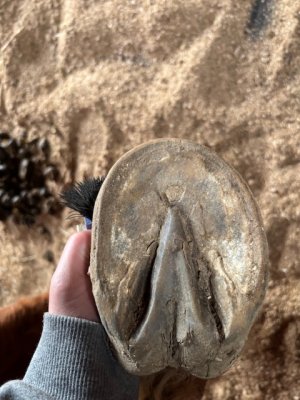
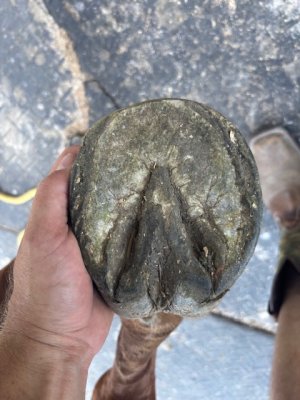
I want to talk about the back hooves for a second. I personally really like the look of them. Good wear and I haven’t really touched them much in 4 months. Maybe a light touch up every couple weeks. What do you all think?
 

Attachments

  • IMG_5659.jpeg
    IMG_5659.jpeg
    163.2 KB · Views: 28
  • IMG_5661.jpeg
    IMG_5661.jpeg
    150.9 KB · Views: 27
  • IMG_5663.jpeg
    IMG_5663.jpeg
    172.6 KB · Views: 53
Apologies for the spelling mistake in my last post. Should be 'heal' not 'heel.' Edit button has disappeared.

Back feet look very healthy. I would bevel/mustang roll the edges, and trim off the over laid bars. There is thrush in the heel of photo 2; compare to photo 1 - do you see the heel bulbs starting to close up instead of being nice and wide? Once you start to get him regularly exercised you will be able to check the wear pattern on the hoof and ensure he is weight bearing on the back third of the foot. Good luck! I hope he continues to remain sound.
 
Hi all,
Wanted to provide an update.
I had a PHCP come and trim them for the first time (I moved away from the farrier that trimmed them before).
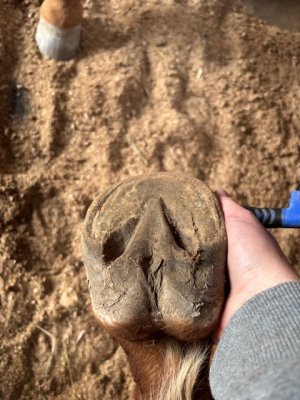
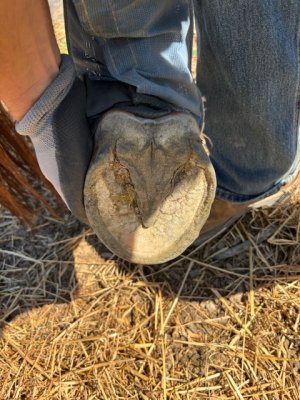
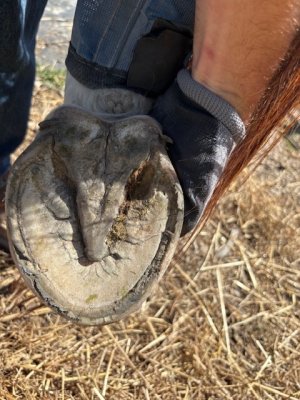
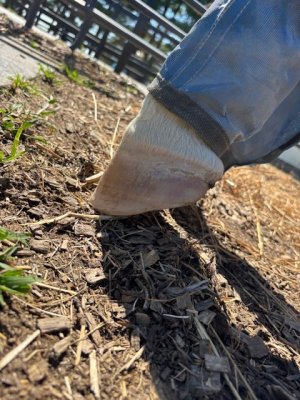
She was very knowledgeable and didn’t touch much EXCEPT she chopped the heck out of the toes on both my guys on all four. I honestly did not think the toes were long.
After that, they were moving definitely a little more uncomfortable, especially my guy Rusty.

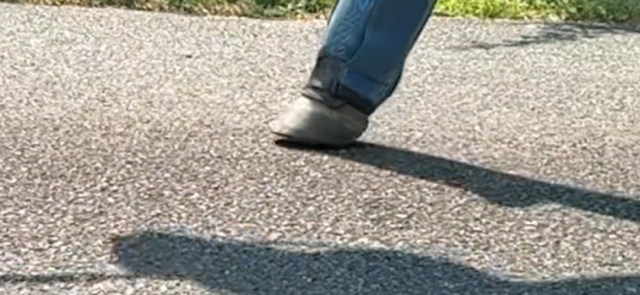
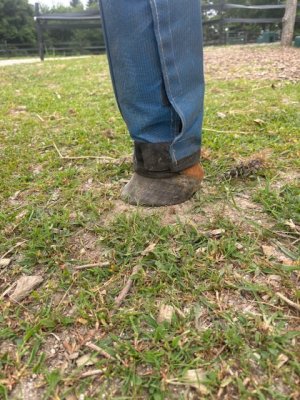
I know some very well known hoof professionals recommend going into the white line on trims but I’m going almost two weeks without great improvement in movement. He just looks uncomfortable and his landings look worse.
 

Attachments

  • IMG_5676.jpeg
    IMG_5676.jpeg
    116.3 KB · Views: 41
  • IMG_5674.jpeg
    IMG_5674.jpeg
    139 KB · Views: 40
  • IMG_5675.jpeg
    IMG_5675.jpeg
    110.3 KB · Views: 33
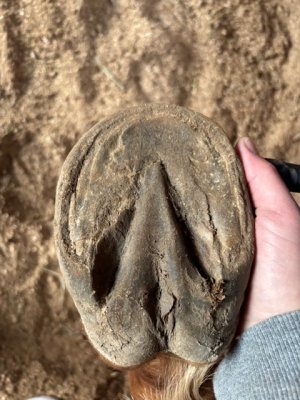
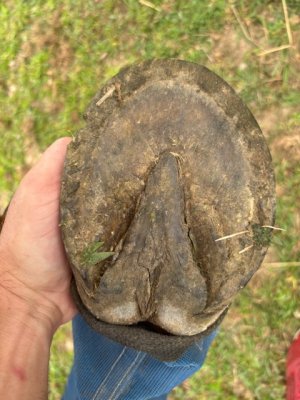
Hi, looking at those photos, I think that the toes probably were a bit long, however... I would not have chopped them back so much in one go! The underside photo shows how far back she cut them, and it is off at an angle too.

When the toes have to come back some, it is done stage by stage, so the foot can re-form. I find it fascinating how plastic, for want of a better word, feet can be at re-shaping.

When I do a rehab, I take a full set of proper photos every months, so I can see if we are going in the right direction. The phone needs to be actually on the ground, and then the photos can be compared.

I find it strange that she has gone so far back at the toes yet has left so much laterally. My bevel looks as steep as yours, but the feet are re-formed and it does not go back to the white line. Because I've taken time, the walls are simply thicker so take more bevel. My bevel goes further back towards the heel, becoming less nearer the heel.

I would probably simply trim yourself now, as the horse seems to have been more comfortable with that, with full reference photos every month, which you can ask advice on.

A horse should never move worse after a trim, if the trim was done correctly.

I think a lot of trimmers think that they have to do more if the horse is only trimmed every 6 weeks. Mine are trimmed weekly, so only a smidge each time.

I trim my own but am not a pro in any way.
 
Yes, it does look a bit extreme. She has trimmed a pretty foot, instead of the foot the horse needs at this stage. Your horse will be weight bearing on the frog, as the concavity is still forming, and hasn't pulled the frog into it's optimum working position. Cavallo's Barefoot Trim video online is a good visual aid, if you need one.
 
She has removed ALL the weight bearing wall at the front, which is not something I'd ever do. Can you boot until the wall grows down a bit, and obvs let her know about this outcome so she doesn't do it again?
 
Thank you all for the responses. I have been definitely trimming more on the conservative side with leaving wall. I can make sure nothing gets too overgrown but I guess she really wanted to shorten the toe. Her explanation was to eliminate the stretched white line. My understanding was as the hoof grows the WL will become healthier on it's own. She knows I manage his feet on my own (his last trim was in the springtime so for her only touching the toe it makes is obvious that I am handling everything else correctly).

Definitely multiple schools of thought but I would like to really only just trim partially into the water line. I haven't touched the sole really at all and haven't needed to exfoliate it at all on any of his hooves. Goal is sole depth. She also didn't like the shape of the hoof before and wanted it more square in the front which I thought was interesting especially after looking at wild horses hooves. One thing I am going to take note of is recently I have been keeping the heels down to the HSP instead of slightly above the frog level. It is possible it is making his landings a little more sore. Something to keep an eye on.
I have been rotating in boots 4 days a week to increase his comfort.
 
That is a bit aggressive and I probably would've cleaned up the bars a bit too, but I know opinions on that can vary. I'm fine with a good bevel, but that one is not quite how I'd do it. I'm also not an expert or a professional though.

On my horse that I had to bring the toe back on, I just did some rasping every 5 to 7 days. Just kept going little by little vs a dramatic change.

I'm not sure that I'd want squared off toes.
 
Top