
RANT. Pink and fluffy would be Parelli- ites should not be allowed to ...

Precisely. I got him as a little handled two year old, and I treated him in the way that his mother would have treated him whenever he offered behaviour that was unacceptable around humans, and I have a Shetland that people who HATE Shetlands swoon all over when they visit me and who is safe alone with the smallest child. He tried to bite me once. I smacked his nose so quick and so hard he's never forgotten it. He has never offered to bite anyone since. Is it kinder to have told him off with my voice, waited for him to do it again and told him off again, and so on until he finally, (if he ever did, being a Shetland with all the strong will that goes with the package), got the message that it is not OK to bite people?
No, I would say that was very effective punishment. I certainly wouldn't condemn you for what you did.

Meanwhile, there will be a whole bunch of people on this forum thinking or saying that it is cruel and unnecessary to hit horses in training them,
I would say it is largely unnecessary, and can be cruel if overdone or done unfairly. Wouldn't rule it out as an option though.

whose horses are taking a chunk out of their backsides and rifling their pockets for their clicker treat at every opportunity.
I'm not a clicker trainer myself but have put the technique to good use on several occasions. However, I think your comment betrays a misunderstanding of how it works when done properly (i.e. horse taught, very easily, not to mug for treats).

Horses speak the language of a quick physical reprimand and then immediate reward for desired behaviour. If its good enough for them its good enough for me.
Yet one doesn't need to reprimand very often, surely?
 
But this just isn't true in the wild, is it?
Depends which "wild" herd one studies. One would be forgiven for thinking that aggression is a major part of herd life if National Geographic documentaries were your main source of information. Naturally, they focus on the "interesting" bits of behaviour. However, if you look at the published studies - for example Stephanie Tyler's of New Forest ponies, or Joel Berger's of Great Basin horses, or Lucy Rees' of Pottoka ponies - you will find plenty of evidence to show that, at least in some herds, aggression plays a very minor role indeed in herd life when one looks at the whole picture.

Every year a colt will get old enough to think it can challenge the stallion and there will be at least one violent fight, probably at least one for the year of birth of a group of colts from the bachelor herd.
I accept there is considerable aggression associated with challenges over mare 'ownership'. However, I would question the applicability to our interactions with horses.

Every year each mare will drive off last year's foal so this year's can have her milk and care. Sometimes that will be violent.
Ditto this.

Every foal will get playful and be put in its place by either its mother or another mare with threats of bites and kicks, which will be real bites and kicks if it does not pack it in.
This is much more relevant in that youngsters may try this kind of behaviour on with humans. They need to be taught it is not acceptable behaviour. We don't need to resort to violence to do this though.

Every time food is short, the more dominant horses will drive the lower ones off the best bits of food by threatening, and if they are more equal in rank, actually kicking and biting. The same will happen if water is short.
Ditto above.

Life in a normal horse herd is full of threats of violence, and sometimes actual violence, its how horses get what they want. They can't sit down and negotiate over a bottle of Suavignon Blanc, can they :)?
I think "full of" is a bit of an exaggeration to say the least!

But, you know, this argument about herd dynamics is all rather academic given that we already know we don't need to use violence or threats of violence to get what we want with horses. Some people do, and are quite successful in spite of it, but that doesn't mean it is mandatory!
 
Of course there is violence and aggression within a herd environment. Whatever horses do between themselves is fine, the question is where and how do we best fit in.

It's like the riding without a bit section of this thread. People got wound up about that and missed my point which was, yes you can ride in a bit, but surely you should be able to control your horse in walk trot and canter without one first.

If you can't either you cannot ride or your horse is not trained well enough to be ridden in a bit.
 
However, if you look at the published studies - for example Stephanie Tyler's of New Forest ponies, or Joel Berger's of Great Basin horses, or Lucy Rees' of Pottoka ponies - you will find plenty of evidence to show that, at least in some herds, aggression plays a very minor role indeed in herd life when one looks at the whole picture.
Oh no I am going to get into this. :o I'm currently (still, keep getting distracted by other books.) reading Joel Berger's study of horses of the Great Basin and am getting a very different picture than I got from reading the Pottoka article. Berger's study isn't focussed on individual interaction and dynamic in the herd though so that may well be why. The stallion influence on the herd seems much more evident and important than I imagined from reading other stuff, the rest of herd interaction seems almost incidental and based on pure survival rather than any other social process. I've a lot more to read and digest though so may be very off the mark here. :o

Incidentally, Berger's book is really interesting and well written imo. It is very expensive so order it from a library if anyone wants to read it. So far it's the most convincing study book on horses I've read.
 
Oh no I am going to get into this. :o I'm currently (still, keep getting distracted by other books.) reading Joel Berger's study of horses of the Great Basin and am getting a very different picture than I got from reading the Pottoka article. Berger's study isn't focussed on individual interaction and dynamic in the herd though so that may well be why. The stallion influence on the herd seems much more evident and important than I imagined from reading other stuff, the rest of herd interaction seems almost incidental and based on pure survival rather than any other social process. I've a lot more to read and digest though so may be very off the mark here. :o
No, you're quite right - they are different, highlighting the importance of environmental factors in determining behaviour. Unless I have misremembered (I will check again tonight), Berger does include figures for time budgets for various classes of behaviour which shows that the frequency of aggression was low.
 
I'm not a clicker trainer myself but have put the technique to good use on several occasions. However, I think your comment betrays a misunderstanding of how it works when done properly (i.e. horse taught, very easily, not to mug for treats).
It's not my misunderstanding. It's the people who I see whose horses are constantly at them for treats who have misunderstood. I don't need a clicker, I just use a voice full of praise

Yet one doesn't need to reprimand very often, surely?

No, that's the point. Done properly at the right time it is VERY quick to teach the horse he has overstepped the boundaries, and quite often never needs a repeat. I wold generally only use it when the response has to be VERY quick to that the horse can connect his behaviour directly with the result, like when my tiddler bit me. Or when there is danger in the horse's behaviour and for safety it MUST get its attention focussed back on its handler.
 
This is much more relevant in that youngsters may try this kind of behaviour on with humans. They need to be taught it is not acceptable behaviour. We don't need to resort to violence to do this though.

I'm genuinely interested. You have a two year old whose mouth is in mid-flight to sink his teeth into part of your clothing or anatomy. What do you do that will teach him that this behaviour is incorrect, which will work in one lesson and end the problem for good?
 
Depends which "wild" herd one studies. One would be forgiven for thinking that aggression is a major part of herd life if National Geographic documentaries were your main source of information.

My main source of information is to look out of my lounge window at the interactions between my own horses, and to see my friends and neighbours horses as I pass by or visit.

Tonight I had a wild playfight going on with a nine year old, eight year old and five year old, plus tiny pony, hurtling up and down the field, kicking out when someone got too close, biting when they could get a purchase, and although these are play bites they draw blood from time to time. This often happpens as dusk falls in the spring. From what I see with my own eyes, casual violence is a normal part of horse life.

I am not advocating routine physical abuse of horses, but I am fed up with the minority but growing group who think it is wrong to ever hit a horse.
 
It's not my misunderstanding. It's the people who I see whose horses are constantly at them for treats who have misunderstood.
Then I respectfully submit you are not seeing the clicker trainers who know what they are doing; rather, you are seeing people who feed randomly and inadvertently reward nuisance behaviour.

I don't need a clicker, I just use a voice full of praise
Sometimes the extra motivation provided by a food reward makes all the difference.

No, that's the point. Done properly at the right time it is VERY quick to teach the horse he has overstepped the boundaries, and quite often never needs a repeat. I wold generally only use it when the response has to be VERY quick to that the horse can connect his behaviour directly with the result, like when my tiddler bit me. Or when there is danger in the horse's behaviour and for safety it MUST get its attention focussed back on its handler.
I have no problem with that at all. Unfortunately, one sees physical reprimands being used inappropriately, ineffectively and/or with unwelcome knock-on effects all too often.

I'm genuinely interested. You have a two year old whose mouth is in mid-flight to sink his teeth into part of your clothing or anatomy. What do you do that will teach him that this behaviour is incorrect, which will work in one lesson and end the problem for good?
Mouthiness in colts is a perennial problem. My response would depend on whether the biting is at the nibbling/nipping stage or whether it has progressed to lunge-biting (sometimes due to the horse being smacked on the mouth/face and thus learning to get his head in and away again quickly so as to avoid the smack). Obviously it's best to nip any mouthiness in the bud as soon as it appears, at the foal stage if possible.

With nibbling/nipping, I make it uncomfortable enough for the horse (but without hurting or scaring him) that he learns that it's not worth the effort and stops. I have a favourite technique based on sticking my finger into the roof of the horse's mouth the instant he starts to nibble and holding it there for 2-3 seconds while he tries to spit it out which I have found to be 100% effective in dozens of horses now. Although I have never been hurt doing this, it may be criticized on the grounds of safety. It also requires a certain deftness and being ready to intercept any oral approaches. Anyway, it's what I do (which is what you asked for); I don't expect others to do it. It typically works in 2 or 3 short lessons and has the advantage that there is no risk at all of creating bad feeling towards the handler, because the horse thinks the discomfort is self-inflicted. The same cannot be said for hitting/slapping.

With lunge-biting, which sounds more like what you have, I would allow the horse to run into a hard bit of anatomy - an elbow, knee or even a fist (though I prefer the first two) - so that he clunks himself hard enough to punish the attempt to bite. As above, the important thing (for me) is to avoid it appearing to the horse that I have responded personally to his action; I don't particularly wish to be seen as an aggressor. Using the horse's own movement as part of the punisher ensures optimal timing, i.e. it occurs exactly the same time as the bite attempt. The disadvantage of this method is that it demands alertness and anticipation. On the other hand, it only needs to be done 2 or 3 times (sometimes just once) to produce a lasting change in behaviour.

If you're in a position to reward behaviours incompatible with biting, that is definitely worth doing.

I am not advocating routine physical abuse of horses, but I am fed up with the minority but growing group who think it is wrong to ever hit a horse.
As you will have gathered by now, I am not in that group. However, it's something I haven't done for many years now. I would certainly feel that I had failed if I found myself resorting to hitting in anger, as I believe anger has no place in horsemanship.
 
Berger's study isn't focussed on individual interaction and dynamic in the herd though so that may well be why. The stallion influence on the herd seems much more evident and important than I imagined from reading other stuff, the rest of herd interaction seems almost incidental and based on pure survival rather than any other social process.
I looked at Berger's "Wild Horses of the Great Basin" last night and it has a lot to say about both aggressive behaviour and dominance. I would like to quote from it liberally but I'm not sure that is appropriate here. However, the gist of it is that stallions are pretty aggressive towards each other, occasionally inflicting dreadful injuries on rivals, but even then "This does not imply that aggression was rampant; more than 98% of a stallion's annual time budget was spent in non-aggressive activities. As in zebras [...], bands of horses often graze adjacently without aggression or perceptible concern regarding others." (Here Berger is talking about interband encounters.)

Regarding the mares: "Classically, it has been thought that through aggressiveness individuals may achieve high rank and access to limited food resources [...]. This did not seem to be the case among Granite Range females. Mares were not often aggressive to those with who they were familiar (e.g. band mates of either sex). Intraband variation in aggression was considerable, but even in early spring when food was most limited and new vegetative growth had not begun, few feeding displacements occurred. The most food-related supplantations observed in an hour was nine, but this was exceptional. On the average less than one individual per three hours of observation would be involved in food-related aggression during the most stressful season. [...] Aggression among band females was detectable in two other broadly defined situations; those concerned water and infants. In winter when water sources froze or in summer when they sometimes slowed to a trickle, females (infrequently) congregated for access to water. When doing so, they invariably kicked and pushed their bodies at one another. Most intraband aggression occurred, however, when individuals approached too close to a newborn foal. Aggression was also observed when weaned yearlings annoyed their mothers and attempted to suckle."

Finally (for this post, which is already becoming too long!), Berger makes an interesting comment about domestic vs feral horses: "In domestic horses, aggression and combat among males is less frequent and among females is more frequent than in feral populations [...]." One reason for the male difference is obvious (gelding); the reasons for the female difference are less clear, but Berger seems to be implying that reduced availability of space in many domestic situations is a factor.

Fascinating stuff!
 
Last edited:
Finally (for this post, which is already becoming too long!), Berger makes an interesting comment about domestic vs feral horses: "In domestic horses, aggression and combat among males is less frequent and among females is more frequent than in feral populations [...]." One reason for the male difference is obvious (gelding); the reasons for the female difference are less clear, but Berger seems to be implying that reduced availability of space in many domestic situations is a factor.

Fascinating stuff!
Thanks fburton, I'm still taking in the information I've read and it takes me a long time to process it.

In my observations of aggression and overt moving of others between horses in my herd I have noticed that space is the factor that has the most effect on this behaviour. I have a large yard with double access to a barn which I thought was big enough. This year I have opened my other yard as well so they have twice the space. The mare I have who is the most active and assertive with others has been extremely chilled and I have seen very little aggressive behaviour from her at all. The only times I have observed it is when I am late with a hay round (diets) and they are hungry.
I have come to realize that for my herd at least 'space' is critical to their feeling of peace and security (I use these terms based on my observations of their interactions). I'm begining to tie this in with personal space and access to survival resources in my head but not being a scientist and enough knowledge of others research it is only my thinking.
I remember bing a bit shocked when I first read Marthe Kylie Worthingtons thoughts that much of domestic horse behaviour may well be abberant (hope I haven't misrepresented her here, this is my understanding) but the more I thought about it, observed my herd I think I may well agree.

Yes it is all very fascinating. :)
 
Great discussion.

I am just squirming in envy at Cptrayes "My main source of information is to look out of my lounge window at the interactions between my own horses..."

Oh, if only!
 
I am just squirming in envy at Cptrayes "My main source of information is to look out of my lounge window at the interactions between my own horses..."

Oh, if only!
I'm another lucky enough to have mine outside my back door. It is a real privelage and so interesting. I have my tea breaks often with them and if I need a chill or fancy some company I just go out and sit with them. :) I am so very lucky.
 
Treats and misunderstandings?

So you're standing in front of a vending machine, you know it's full of goodies. You insert a coin, IN YOUR MIND you've done as much as you need to do to get the goods. The goods don't arrive. Bummer. You give the machine a nudge, nothing happens. You give a bigger nudge, no sweets. Finally in frustration you kick it.
This is not rational behaviour for a problem solving human being is it? So how do you expect a horse not to get confused with clicker training? YOU'RE A HUMAN VENDING MACHINE and he will run through his gamut of remembered tricks in the hope of a reward (not necessarily in the right sequence!)

'Timing has a lot to do with the outcome of a raindance'. This couldn't be more true when applied to horses:)
 
Fellewell, couldn't agree more, this sort of training is a long way from NH in my view, I know some claim to have great success with it but I think s lot depends on the mindset of the horse you have.

I also agree with Berger's conclusion that space is the most influencing factor regarding aggression within the domestic 'herd'. Male aggression being somewhat thwarted in the domestic setting.

I know we think of ten or twenty acre fields as big, but this is nothing compared to the range of a wild herd.
 
Then I respectfully submit you are not seeing the clicker trainers who know what they are doing; rather, you are seeing people who feed randomly and inadvertently reward nuisance behaviour.

I know that. But many of these people whose horses nibble at their pockets constantly will criticise me for hitting one of my horses. That's what pees me off!

With lunge-biting, which sounds more like what you have

I don't "have" anything. No horse of mine has ever tried to bite me a second time. I was interested in how you would achieve the same result, not looking for advice as to how I should do it.

If you're in a position to reward behaviours incompatible with biting, that is definitely worth doing.

I reward all desireable behaviour with approval. I never use titbits, I find them unnecessary to start with and counterproductive later. My latest horse would not move off the leg until it had been given the titbit for "allowing" its rider to get on. I just taught him to stand still to be mounted.

I believe anger has no place in horsemanship.

I agree with you completely, but I have no fear of my horses perceiving me as an occasional aggressor. I don't see or experience any conflict in the occasional use of physical correction of a horse and they never seem to love me any the less for it. I am still followed everywhere I go if I am out doing some work in field. I never tie a horse up to tack up, groom, worm, rasp feet or anything else. I don't think they perceive me as anything but a force for good, and yet I have, at times, hit all of them.


PS Tinypony I know! I am SO lucky. I wasn't born to it and I worked hard to get it, as well as having some luck. I hope you'll be as lucky one day.
 
Ok I can't find the reason why clicker training was first mentioned, but I'd just like to pipe up that I had a wonderfully fun afternoon this week, teaching a horse who has never done it before to raise a named leg, touch a target, bow and do his stretches when asked by me pointing to his flank.

He didn't, and still doesn't, mug for treats. ;) He tries to anticipate the click, and sometimes he gets caught up in the moment and can't for the life of him work out what he did work out and repeat 3 times in a row, but he gets there again eventually.

My own experiences of clicker training (not always me training) have mostly been very positive, and resulted in horses who will try their heart out to figure out what you want from them. Of course I don't believe it can be used in all situations with all horses, and indeed my less than brilliant experiences when I was learning were down to my inexperience at the time, and working with horses who got completely over-excited by the prospect of treats. At the opposite end of the scale I have a friend who tried it and her horse just isn't food oriented.

Regarding the human vending machine, my success with this week's horse was due to being able to guide him (okay, and he is a very intelligent horse too!). When I clicker train I don't leave a horse to work out what he has to do by himself, unless there is a high probability of him accidentally exhibiting a behaviour which I can reward.

Is it strictly necessary? No, probably not, there are often many and varied ways of training things, and indeed the things I have been training don't even need to be done. But its good fun for both horse and human. ;)
 
Last edited:
I know that. But many of these people whose horses nibble at their pockets constantly will criticise me for hitting one of my horses. That's what pees me off!
I really dislike horses nuzzling for treats as well even though I am an anti hitting horses. I must say hand on heart that if a horse did bite me I can't say I wouldn't slap in the moment.

Luckily I haven't been bitten or kicked by any of mine.

I am not a clicker trainer but I do believe one of the first things to teach is no mugging so if the human has studied the theory and carries it out 'correctly' then mugging/searching for treats shouldn't be a problem.
Problems with food and treats imo come from ad hoc trreating that as fburton says inadvertantly reward mugging/nuzzling behaviour. Small ponies and Shetlands are notoriously known for mugging and biting but they are also very cute and I think people forget to have rules with them. They are after all little horses and behave and learn the same.
 
Last edited by a moderator:
Treats and misunderstandings?

So you're standing in front of a vending machine, you know it's full of goodies. You insert a coin, IN YOUR MIND you've done as much as you need to do to get the goods. The goods don't arrive. Bummer. You give the machine a nudge, nothing happens. You give a bigger nudge, no sweets. Finally in frustration you kick it.
This is not rational behaviour for a problem solving human being is it? So how do you expect a horse not to get confused with clicker training? YOU'RE A HUMAN VENDING MACHINE and he will run through his gamut of remembered tricks in the hope of a reward (not necessarily in the right sequence!)

'Timing has a lot to do with the outcome of a raindance'. This couldn't be more true when applied to horses:)

well you do have a point Fellewell ..... many CT horses will indeed offer familiar behaviours when you are trying to train a new one and when they are new to the work they have not learned that they just need to retry.

this is my horse doing that ......... but she does not kick the "vending machine" or walk away in disgust ... she just tries again ;) ( btw I amalgamated the offered behaviours in the vid , they were not offered all together like that.)


http://s17.photobucket.com/albums/b89/tazzle22/?action=view&current=vendingmachine.mp4


however I would ask you to consider that all training methods involve trial and error on behalf of the horse. No horse automatically knows what to do in order to release pressure for example to a particular area...... it might generalise also when you are trying something new. It might have learnt that two legs applying pressure means walk forward but when you change that to one leg on the girth he does not know you want lateral work or behind the girth moves haunches, he has to work it out and will offer other stuff. Some horses get frustrated at this too.


All training "factions" also do have learners and experienced practitioners . and every stage in between...... we cant judge a method only by the "poorer" examples we have seen. I for example have people local to me that are "traditional" / bhs whos horses cannot back up, cannot sidepass into small spaces to let lorries pass, cannot pass tractors, cannot be trusted to keep in the pace they are in when the contact is dropped etc... yet my mainly CT horse is rather good at all the above :D. I do not blame the method for the practioners less than perfect knowlege or skills (or mistakes cos we all make them :p ) ...... most methods applied correctly and sympathetically and fairly will produce a balanced, polite well trained horse;)
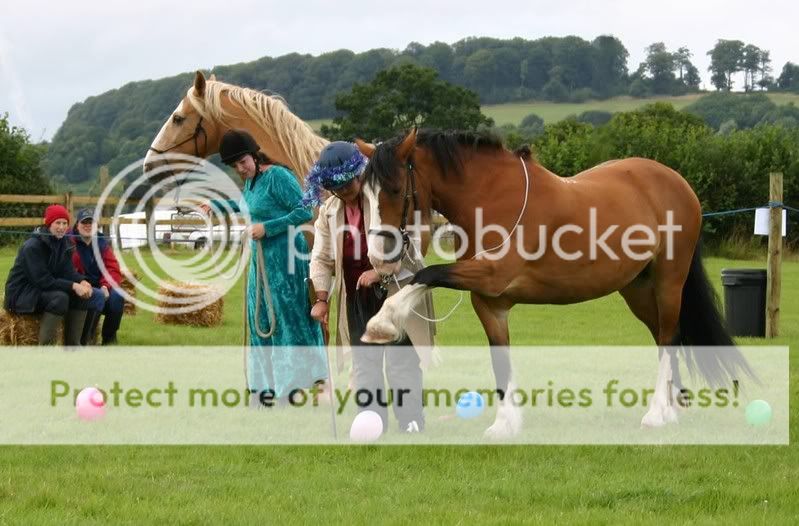


I dont think we fall into the more negative sterotyped Nh / CT image ..... well we do do groundwork ..... and well Taz does do tricks I suppose


laurarescuedpics1130.jpg


but she also does other things too


img124.jpg


06fef510.jpg


she is also so gentle and sensitive that we do work with people with special needs .. some in wheelchails, most with learning / physical difficulties and some with challenging behaviours.

No way I could have a horse doing this that was demanding of treats . I watched a young man recently with learning difficulties and in a wheelchair ask Taz to pick up her feet for him while she was practicaly in his lap he was asking her to be so close. He was using a cue unfamiliar to her but asking for a known behaviour ....and not rewarding her. She had to work out what he wanted. This was a situation like the intial quote as being a situation where a CTd horse would get frustrated and "kick the vending machine" ....

errrmm please could I ask critics of the method to reconsider when you have seen a more experienced partnership .... not that I am an expert by any means :rolleyes: . there are more experiencesdpractitioner than me out there !!!
 
I have 'met' Tazzle on other forums in the past and have always had a huge amount of respect for her achievements especially as her horse was a 'problem' horse.
Another very balanced and thought provoking post as usual Tazzle. :)
 
No disrespect Tazzle, but the behaviour of your dog told me more about the relationship you have with that horse than your post did.
So far no one has been able to make a case for the defence of conditional training. Even in the original studies scientists noted that when the treats dried up so did the behaviour. As for mounted work; when you back a horse properly, with time and patience, the training stays for life. The prosecution rests.
 
Hi Tazzle (waves)
Tazzle's horse is a beautifully trained riding horse. I've seen her casually riding around on one rein, doing lateral work with the head bent towards and away from the rein. Lovely stuff.
 
Felewell, do you speak of classical and operant conditioning? In which case there is plenty of anecdotal evidence that once reward stops behaviour continues (if trained well), in all sorts of schools of training. Does everybody reward their horse when picking out his feet every day? I confess I do praise that behaviour out of old habit, but plenty of people would say that since it is a known cue and response, the behaviour shouldnt be rewarded, and so 1000s of horses up and down the country who were initially conditioned via reward to pick up their feet, now never receive a reward for it but still perform the behaviour.

Some heartening vids on you tube too, of clicker trained horses who are advanced in their training and are performing advanced sequences to only the click as reward, and sometimes a 10 min long performance with only one click at the end.
 
Feck Parelli, everyone should be watching Monty Roberts!! <3 <3 <3

Felewell - you are wrong. Dorey was clicker trained years ago and then went to stud for three years. Upon returning she remembered she had me trained to give clicks when she did certain things and started to repeat what she had learnt. She does it for clicks, not treats (often her reward is a scratch on her itchy spot!) and often she gets ignored, but she never gives up.
Thats not just mere conditioning, thats a horse who understands why I've taught her what she knows. She tells me when she wants something without barging, kicking or being rude and if it's the right time, she gets it.

Parelli assumes horses are eejits and humans have all the brains. People need to realise the horses are the ones with the brains and we're not.

They work out oh so quickly they get what they want from us if they do the right things. It's calling human training. It's just some humans respond better to being kicked and bitten than anything else.

FTR - I encourage everyone with problems catching to chase the horse away. You run, fine, I shall keep you running. You want to graze, you're going to have to do it whilst I'm approaching you. But you shouldn't be chasing unless they're running away anyway!
 
Fellewell, I clicker trained a long sequence of behaviours into my dog step by step years ago (a formal retrieve, which involves a number of distinct phases). He had to be taught each step in sequence - touch the dummy, then go to the dummy, the go the dummy and pick up the dummy, then bring the dummy to me, then hold the dummy, then hold and sit with the dummy in front of me, give the dummy to my hand, wait for the send away without running in, watch me for direction - every step taught one at a time and built into a chain. He still does it - only I now rarely reward the behaviour with a treat although it is always incentivised in some way. Nor do I need to reinforce every step now, the chain of behaviours is fully established in his mind and he carries each one out in sequence in order to bring the dummy (or bird) back to me. Does he need an incentive to work? Of course he does, how many people would carry on showing up at the office every day if their paypackets stopped? But the chain of behaviours is indeed ingrained and conditioned in him.

Oh, and ALL animal training is conditioning IMO, the difference is in the enforcement used. You condition a horse that legs on mean forward etc.
 
They work out oh so quickly they get what they want from us if they do the right things. It's calling human training. It's just some humans respond better to being kicked and bitten than anything else.

So true! This was the point I was trying to make ages ago when people were debating if a horse can fake lameness. Of course they can, if the horse links limping with a positive response (cessation of work, removal of an annoying stimulus or pain...). ;)
 
No disrespect Tazzle, but the behaviour of your dog told me more about the relationship you have with that horse than your post did.
So far no one has been able to make a case for the defence of conditional training. Even in the original studies scientists noted that when the treats dried up so did the behaviour. As for mounted work; when you back a horse properly, with time and patience, the training stays for life. The prosecution rests.

I would truly be interested in reading your thoughts about the dog / horse behaviour Fellewell ;)

hmmmmmmmm I wonder what scientists noted the behaviour drying up when the treats dried up ..... one the behaviour is on cue it stays there whether the treats are there or not.. if I treated for every single behaviour I have even "taught" Taz I would never get on her and ride , drive or anything ...... I could never have done an endurance ride of 20 miles or a driving trials course / dressage / trec stopping to reward behaviours. :rolleyes:

Taz is now 16 and there are behaviours still intact that I have not rewarded in 10 years !

I dont treat her now for lifting up her feet or a myriad of other behaviours....ridden /driven or on the ground ... only new or being improved behaviours are rewarded... she would also be the size of a house :rolleyes:

If you found out more about positive reinforcement you would realise that the treat aspect can be very quickly phased out ....... the behaviour I was trying to establish in that clip is a small part of what is actually a larger one I am working on and involves something that few horses would tolerate, its been done as a special project.


I did the time and patience to back my horse properly :rolleyes: ....... one that someone with less respect for horses had so ruined she was dangerous ..... terrified of tack, whips and people. So I had to undo all that garbage and change her perception of being trained before I re backed her.

You will note I have not disrepected any other person / training method ....... and if I had used other methods they would probably have worked too ( I incorpotrate some NH) ........ but I know that rewarding is horse is not just operant conditioning, its building a relationship.

The prosecution rests

I find that phrase rather telling imo ;)


Thank you very much for the positive comments about Taz from others...... much appreciated


:D re the barefoot ...... thanks for comments .......... We were rare in doing endurance barefoot then and had to bring a letter from our farrier to let the event farrier know I had not just pulled them the day before as if she had cast a shoe ... ermmm dont shoes leave holes for quite a while :D

we did take boots with us but never needed them ;) we also drove miles on the road and never been lame, never needed shoes.... boots very occasionally if she was wearing feet down faster then growing.
 
Top