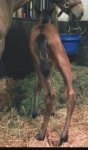
Trimming to these x rays.

ycbm

Overwhelmed
Joined
30 January 2015
Messages
61,638
Visit site
Yes i will be consulting a farrier.

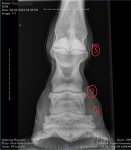
This is Ludo's pastern x ray. The long bone is measurably longer on the left hand side than the right hand side. As a result, joint 1 is level, joint 2 is level and joint 3 is anything but level. This hasn't, as I would have expected, caused problems with the pastern joint or above. It has caused soft tissue injuries inside the foot, as he blocks to the foot only and with absolutely nothing amiss on the x rays. Given that he is and always has been very lightly worked, his unsoundness is very worrying and I am not now very hopeful that he will ever stand up to being ridden.

The vet wants me to remove the flare you can see on the right hand side. I am very reluctant to do that, as it's obvious to me that he puts it there to support the lean in that direction of the pastern bone. It might ease pressure on the for bit only at the expense of destabilising the fetlock.

He has a flare to the same side of the foot on the right hind, and my assumption is that bone is the same, and that he was born a sway windswept foal and nobody trimmed his feet to stop the uneven loading. The growth plates in that bone, I think, close at 6 months. If someone had just done some simple trimming when he was a baby, he wouldn't now be a crocked horse. I'm so angry I can barely keep it in control.

I'm sharing mostly just for people's interest but if anyone has any bright suggestions please fire away.
.
Screenshot_20230216_163804_Chrome.jpg
 
Last edited:
I mean, if it wasn't your horse, it's a fascinating x-ray.

I tend to agree with you about the flare, it's there for a reason, it's counterbalancing the wonky joint. No I'm not a vet or a farrier but I keep two unshod and one flares in a similar way, and while I've not had her x-rayed, I allow the flare within reason because that's the way it wants to grow and she is absolutely rock crunchingly sound on them (fingers crossed and all that).
 
That’s quite a difference and I can see why you don’t want to alter the flare. I know he’s not your Farrier but could you send them to Mark and ask if you could pay him as a consultant as to the best way forward. You would be getting the very best advice possible from somebody you know and trust and who is passionate about not just feet but the whole horse. The worst that can happen is he says no.
 
I don't have any bright ideas, but I just wanted to ask if the vet considers the flare to be a contributing factor to the soft tissue damage, or does he want the hoof in balance because that's ' normal ' ?
I hope you can find some way to bring him sound.
 
A good remedial farrier might be the way to go. You definitely need to know whether trimming to correct will cause further imbalance.
I am rubbish at interpreting X-rays, but notice a tiny difference on the spur like projection on the opposite side to the flare. The frog is not as developed on the flare side either. Is there any history of injury, or anything that may make you suspect an early closure of a growth plate?
 
My opinion on the flare is different. A large proportion of the weight is being carried through the left hand steeper side of the hoof and the horse is probably landing that side first.This is causing the frog to be more developed and the wall steeper. The flare side isn't carrying as much weight so is not wearing as much and this is allowing the flare to develop.
I would be a little suspicious what is happening at the hock joint too to cause this action.
 
I don't have any bright ideas, but I just wanted to ask if the vet considers the flare to be a contributing factor to the soft tissue damage, or does he want the hoof in balance because that's ' normal ' ?
I hope you can find some way to bring him sound.

She is of the opinion that the flare may be causing pressure in the hoof. But she is open to my suggestion that cutting it off will create more pressure by putting the weight into a smaller area, that it will destabilise the fetlock and that there is no evidence in a disturbed hair line that there is any unequal pressure at the coronet.
.
 
My opinion on the flare is different. A large proportion of the weight is being carried through the left hand steeper side of the hoof and the horse is probably landing that side first.This is causing the frog to be more developed and the wall steeper. The flare side isn't carrying as much weight so is not wearing as much and this is allowing the flare to develop.
I would be a little suspicious what is happening at the hock joint too to cause this action.

He lands flat laterally, it's another reason why I don't want to remove it. He blocks sound at the hock joint and apart from "insignificant" (vet's description) bone spurs.
.
 
Hmmm that flare will just come back unless the vet thinks something else can change. Do they think the soft tissue damage has been building up slowly over time?

It comes back in about a week if it's removed, I've tested it many times as he has matured.

We are all of the opinion that the soft tissue damage is repetitive strain injury, not as a result of a specific incident.
.
 
A good remedial farrier might be the way to go. You definitely need to know whether trimming to correct will cause further imbalance.
I am rubbish at interpreting X-rays, but notice a tiny difference on the spur like projection on the opposite side to the flare. The frog is not as developed on the flare side either. Is there any history of injury, or anything that may make you suspect an early closure of a growth plate?

He's grown flares since I bought him at two. Because both feet lean the same way, to the right (and the flare is much worse in the other one, that he is less unsound on) I believe he was a sway windswept foal and not corrected. Otherwise I would have expected the legs to be a mirror image of each other, but they aren't.
.
 
Last edited:
I've just got back from giving him a 1km walk and he has stopped shivering when I pick out his feet. This is at least hopeful. He hasn't been ridden for 2 weeks. I plan to take him for a drive and see if he stops repeatedly picking up his back feet, (the left about 3 times as often as the right). When he returns to the quiet traveller he used to be, I'll ride on straight lines. Meanwhile, I figure that taking him for a drive will also act as a theraplate!

The only other way to know if he is sound is to block out a foot, but he and I have both had enough of investigations and needles for the moment. I don't begrudge it for a moment but the bill so far is nearly £2k.
.
 
That’s quite a difference and I can see why you don’t want to alter the flare. I know he’s not your Farrier but could you send them to Mark and ask if you could pay him as a consultant as to the best way forward. You would be getting the very best advice possible from somebody you know and trust and who is passionate about not just feet but the whole horse. The worst that can happen is he says no.

Mark Johnson?

Also the progressive equine / lowly farrier Wayne Turner offers consultation services - think he'd be interesting person to consult - https://www.progressiveequineservices.com.au/about
 
Have you seen the examples on Nic Barker / Rockley website about the horses that needed flares to stay sound? Part of the blog entries I think.
 
This x-ray reminds me of a post I saw shared by a bodyworker called Celeste-Leilani Lazaris about a horse with quite a significant flare on the one hoof. The whole joint was visibly asymmetrical. Within about 6 months, it was corrected through 20 minutes of rehab work a day by the owner on the ground to strengthen the thoracic sling. I think there was also some remedial trimming, but the bodywork was the main factor. It sounds too good to be true, but the before and after photos are impressive. Maybe worth looking into. I know that @sbloom is a big fan of Celeste's work.

https://www.facebook.com/cherokee87...Xvht7ZdcGtN7bhZ35c2GnBTSbe91v9ZqCsNcstbTb794l
 
I'm also not an expert, but I see differences in all my pony's feet, for different reasons.
I'm with you on the flare, I went to a clinic with Nic Barker and she brought a local lady to the clinic who evented with a small horse whose hooves were flared but like she said, he grows the hoof he needs. Horse was sound
Edited to add; would be interested to hear what someone like Mark Johnson would suggest
 
This x-ray reminds me of a post I saw shared by a bodyworker called Celeste-Leilani Lazaris about a horse with quite a significant flare on the one hoof. The whole joint was visibly asymmetrical. Within about 6 months, it was corrected through 20 minutes of rehab work a day by the owner on the ground to strengthen the thoracic sling. I think there was also some remedial trimming, but the bodywork was the main factor. It sounds too good to be true, but the before and after photos are impressive. Maybe worth looking into. I know that @sbloom is a big fan of Celeste's work.

https://www.facebook.com/cherokee87...Xvht7ZdcGtN7bhZ35c2GnBTSbe91v9ZqCsNcstbTb794l


Nobody can change the fact that the bone is longer on one side than the other. The only way to bring that bone upright is to put greater forces on one side of all his leg joints than the other and make the joint spaces narrower on one side. That would seem to me to be asking for trouble.
.
 
If he's blocking to the foot an MRI might be useful to help you know how bad it is but obviously is very expensive . If the wonky joint isn't the bit he blocks to it may be 'normal' for him and not related. Tough times - always frustrating to see not perfect x-rays of your own horse and it can be very worrying until you see how it all shakes out - hope he comes sound.
 
Nobody can change the fact that the bone is longer on one side than the other. The only way to bring that bone upright is to put greater forces on one side of all his leg joints than the other and make the joint spaces narrower on one side. That would seem to me to be asking for trouble.
.

So tricky. And so sad that it could have been corrected when he was a foal, as you say. I hope you find some sort of solution.
 
If he's blocking to the foot an MRI might be useful to help you know how bad it is but obviously is very expensive . If the wonky joint isn't the bit he blocks to it may be 'normal' for him and not related. Tough times - always frustrating to see not perfect x-rays of your own horse and it can be very worrying until you see how it all shakes out - hope he comes sound.

The practice has MRI on site. The vet is confident that the bone is the cause of the issues. She advised me that an MRI won't change her treatment recommendation and she would prescribe it only if I am one of those people who are desperate to know exactly which structures are damaged. I'm not.
.
 
The joint might not be level, but the joint spacing is even. Nothing you do is going to change the unevenness in the bone. Like you, I’d be reluctant to do anything too drastic.

If he were mine I’d likely avoid doing too much on hard ground/ harder surfaces. And possibly pop on boots and pads if there is less give in the ground. Let them take some of the concussion and uneven wear instead of his feet.
 
I think you’re right, nothing is going to change the bone but Barbs is inherently wonky too and we are achieving a really good level of consistent soundness at the moment through supportive care.

Very regular but minor trimming has meant that we bringing everything back to a more normal shape consistently but not with any drastic change which could unsettle the foot. And we’ve done lots of stretching and balancing to support her thoracic sling. And then our physio is using this on her https://hofmagtherapy.eu/

We are working on the basis of overall strengthening, balance and wellness and hoping that this alleviates any excess strain on the weak bits. So far so good.

I do keep reminding myself that we have a very high standard of soundness for horses. I’m not saying that’s wrong but it’s probably a bit unrealistic when one compares to how wonky people are. Or zebras.
 
on the x ray the joint 3 angle is the same as the canon bone rising out above, which also appears to be out of line with joints one and two

the hoof coronet is curiously larger, bulging on the right than the left side, the flare is significant to the right, makes me wonder if the upward pressures of the flare and distorted coronet band are adding to the problem

personally i would trim the flare to normalize the weight bearing surface overall of the whole leg, the coronary band is another story, but perhaps will adapt in time

perhaps the when the loading is increased by the weight of the rider and combined with the flare it has pushed the misaligned joint over the edge, and the added loading when he ridden on a circle

if he was mine i would take off the flare over say one month and rest to allow it all to settle, when its gone i would test for lameness if he was improved i would walk in hand on the road for 15 mins to see if he can stand the angles of the straighter wall and take it from there

if its inflamed perhaps there is swelling in the joint all of which could be making it a sore thing to walk on which might be the lameness, personally i would not ride him for a month minimum

dunno really, poor boy, but one has to start somewhere with a plan
 
The joint might not be level, but the joint spacing is even. Nothing you do is going to change the unevenness in the bone. Like you, I’d be reluctant to do anything too drastic.

If he were mine I’d likely avoid doing too much on hard ground/ harder surfaces. And possibly pop on boots and pads if there is less give in the ground. Let them take some of the concussion and uneven wear instead of his feet.


The even joint spacing is very key, to me. Changing that could be disastrous. It may well bring him sound short term but then give him an osteo condition in future which would be a devil of a sight harder to fix than a soft tissue injury.

I certainly want to try getting him sound on straight lines before doing anything to modify the forces on the joints.

I have no off road hacking except almost equally hard paths. Your point about boots is a good one.
.
 
For a soft tissue injury I would want to rehab in walk on firm, even surfaces. Any slip or trip or strain from deeper ground will just tear the tissue again.

Regarding the flare, could be to balance the physical structure, could be as a response to the injury and the horse loading the hoof differently to protect the damaged area. Do you have old photos of his feet you can compare it to? If always been there I would leave it.
 
Top