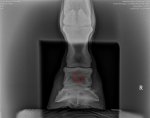
Trimming to these x rays.

I’d second contacting someone like Mark Johnson or similar for advice but my instinct would be the same as yours re leaving the flare alone as the actual joint spacing is even and trying to fiddle with the balance of one thing may cause more issues elsewhere. I’d offer to send you my trimmer’s details but I think you’re way out of any area he travels to & don’t think he gives advice on anything he’s not seen in person these days.

Would also second having a play with boots and seeing if them absorbing some of the concussion works for him (not clued up enough to recommend a particular brand for this issue but would assume the least clumpy ones that are least going to affect breakover & how he lands)
 
I kinda think, you've left the flare alone and he's lame. Not much to lose by trying something else? Can always let it grow back if it doesn't improve things.

This is my view as well

BTW my horse H has chronic soft tissue damage in his OF left to his own devices he flares on the outside the injury is on the inside .
we laser the foot on the inside regularly he’s in work and has has been for three years since the we worked out what is wrong .
 
For a soft tissue injury I would want to rehab in walk on firm, even surfaces. Any slip or trip or strain from deeper ground will just tear the tissue again.

Regarding the flare, could be to balance the physical structure, could be as a response to the injury and the horse loading the hoof differently to protect the damaged area. Do you have old photos of his feet you can compare it to? If always been there I would leave it.

It's been there for the entire 5 years I've owned him since I bought him as a 2 year old.

The plan is exactly that rehab and luckily his turnout is flat and on sandy soil with no mud.
.
 
I kinda think, you've left the flare alone and he's lame. Not much to lose by trying something else? Can always let it grow back if it doesn't improve things.


That's completely logical M, and I understand it. But now I've seen the bones I'm never going to put him under the pressure of schooling cricles again. One of his tells, the shiver when his feet are picked out when standing on his straw bed, has disappeared with just 2 weeks rest.

The plan now is to use his other tell, constant picking up of his back feet when travelling, to tell us when all the discomfort is gone, before seeing whether he can stay sound hacking. The OH is going to drive us 5 miles around the block every week while I watch him on camera and count foot stamps.
.
 
I wasn’t suggesting you school again, just that you may as well try something else to improve his soundness

That's completely logical M, and I understand it. But now I've seen the bones I'm never going to put him under the pressure of schooling cricles again. One of his tells, the shiver when his feet are picked out when standing on his straw bed, has disappeared with just 2 weeks rest.

The plan now is to use his other tell, constant picking up of his back feet when travelling, to tell us when all the discomfort is gone, before seeing whether he can stay sound hacking. The OH is going to drive us 5 miles around the block every week while I watch him on camera and count foot stamps.
.
 
What about building up that area that you know is unbalanced with an epoxy (something like Vettec super fast) to try to level that foot?
As you suspect the flare is happening to compensate for the unevenness, if you could level it down below you might be able to balance things out. I think your intuition is spot on, removing the flare entirely (without having anything to compensate the difference) seems problematic. Especially as it's really from the x-rays he's growing the flare for a reason.
 
What about building up that area that you know is unbalanced with an epoxy (something like Vettec super fast) to try to level that foot?
As you suspect the flare is happening to compensate for the unevenness, if you could level it down below you might be able to balance things out. I think your intuition is spot on, removing the flare entirely (without having anything to compensate the difference) seems problematic. Especially as it's really from the x-rays he's growing the flare for a reason.

The foot is in perfect balance.
.
 
I wasn’t suggesting you school again, just that you may as well try something else to improve his soundness

But it seems to have been a specific thing (working on a sticky surface) that has caused the soft tissue damage, so removing that, plus having all the additional diagnostics of what is actually a conformational arrangement of the limbs, plus gentle rehab in straight lines, seems to me to be the sensible first step in getting him back to where he was before the move.

I wouldn't be radically changing his feet (which have been like that all along, and with the joint spacing as it is) unless step one doesn't work.
 
If you suspect that a long bone has grown unevenly, as in the case of a early partial closure of a growth plate, then the only way to correct it would be through surgery, in a procedure called cuniform osteotomy. This is where a tiny wedge of bone is taken out of the long side to enable the bone to be brought into perfect alignment. I have assisted with operations on large dogs, but am really not sure whether it would be viable option for a horse. Are you aware of any mis-alignments higher up the leg, pelvis or spine?
 
I kinda think, you've left the flare alone and he's lame. Not much to lose by trying something else? Can always let it grow back if it doesn't improve things.

it will grow back very quickly if left to is one thing i have found

i would trim the flair and keep the horse on a soft surface, ie matting, decent ground in the day time, i did this with a horse that came here, the inside of the hind hoof, solar view, was worn right down , the sole was very flat , no dome.

the outside had medium flare, i trimmed the flare every two weeks, kept him at grass day time, night time, in a yarded stable, yard covered in rubber mats, stable eva matting, to reduce the wear to the hoof as he slightly screws the hoof if his stifle catches.

this has gone on for 6 months, 2 days ago i could see the sole has a good dome, the outside wall is the same depth all around the hoof, before it looked deformed now it looks normal.

one thing i would not do in winter is turn out on frozen rutted ground.

ycmb`s horse is probably still growing, his movement has deteriorated from 5 to 7 years old, she has done everything to give the horse a decent start.

it could be he will go sound, but perhaps it is an injury, however his action has deteriorated over a period of two years, taking off the flare would be my first go to, in fact the hoof capsule looks distorted above the flare to me.

our farrier, a million years ago, once commented that certain flare is man made, ie in certain bloodlines, but perhaps not in this case.
 
His feet are beautifully concave, he's rock crunching, he's 8 and probably fully grown and the x ray doesn't show everything that can be felt, or the level hair lines. In fact there is flare on both sides.

He is also bilaterally unsound but it can only be seen if you nerve block.

Nothing about the progress of the problem suggests any specific incident. The vet and I both believe it's RSI.
.
 
Last edited:
no help whatsoever to you .. but was wondering if Have you any photos of him as a foal ? Just curious to see how windswept he was ? It could be that he was quite bad and they did treat him and get him to where he is. Or as you say he was only slightly wonky and they did nothing.
It makes my blood boil when breeders dont do the right thing. I was given a windswept yearling a few years ago as a companion for my weanling. She didnt look too bad , vet checked her out and said shed seen worse, and that it was entirely possible she could lead a normal life as a happy hacker.
 
no help whatsoever to you .. but was wondering if Have you any photos of him as a foal ? Just curious to see how windswept he was ? It could be that he was quite bad and they did treat him and get him to where he is. Or as you say he was only slightly wonky and they did nothing.
It makes my blood boil when breeders dont do the right thing. I was given a windswept yearling a few years ago as a companion for my weanling. She didnt look too bad , vet checked her out and said shed seen worse, and that she it was entirely possible she could lead a normal life as a happy hacker.

My vet is of the same opinion but I'm feeling very negative right now, he's never worked longer than an hour at a time or more that 4 hours a week in his whiole life.
 
ETA I have one photo and he is standing very wonky and splayed out, but he's in straw so you can't tell much.
.
 
It must be so frustrating for you to think that all this could have been avoided if only he had been correctly trimmed as a foal!
I think we are all wonky, and some horses and people seem to stay sound and do amazing things despite being wonky.
Are you thinking that it is only the recent riding that had brought on the unsoundness? How long do you think it has been brewing for? In my head I am trying to pin point the cause of the lameness, assuming that he wouldn't be lame with that conformation if he wasn't ridden.
 
My latest project I bought as an unbacked 6 year-old just over a year ago. He had very poor feet when he arrived (spent the previous 6 years conservation grazing) and it soon became obvious that his one of his front feet is twisted. My trimmer has suggested that if he had been younger, it could have been easily corrected before setting as they are now and he is too old to change it. He is going lightly under saddle now and I am praying that he is going to be one of those wonky-but-sound ponies, but will not know for a while yet.
 
My vet is of the same opinion but I'm feeling very negative right now, he's never worked longer than an hour at a time or more that 4 hours a week in his whiole life.

lets look at the positives. You are not big/heavy so wont be putting much strain on him. Hes a sweet soul, and you adore him. The vet seems positive. You have done everything possible, and found this issue when others wouldnt. Its possible with his wonky confo that its a strain, waxed surfaces arent great for everyday riding.. youve eliminated that. the rehab could work. Chin up, kick on and hopefully by summer you will be out hacking.
 
It must be so frustrating for you to think that all this could have been avoided if only he had been correctly trimmed as a foal!
I think we are all wonky, and some horses and people seem to stay sound and do amazing things despite being wonky.
Are you thinking that it is only the recent riding that had brought on the unsoundness? How long do you think it has been brewing for? In my head I am trying to pin point the cause of the lameness, assuming that he wouldn't be lame with that conformation if he wasn't ridden.

I first started backing off what I was training him for at 6. My gut was telling me he wouldn't last if I didn't.
.
 
Forgive my ignorance on this, I appreciate there are people out there far more knowledgeable than me, you included, but is it possible that the soft tissue injury has been cause by something else or at the very least that some external factor has aggravated something he was dealing with before? As far as I can recall, he's been pretty sound until now and he's not doing any more now, it's just where he's been doing it that's changed? I suppose it could be something that has been building very slowly since he started work and he's now reached the critical point but from a logical point of view it does suggest a correlation with the move? I wonder if that means you can be hopeful of him being able to cope well with hacking at least in future?
 
Forgive my ignorance on this, I appreciate there are people out there far more knowledgeable than me, you included, but is it possible that the soft tissue injury has been cause by something else or at the very least that some external factor has aggravated something he was dealing with before? As far as I can recall, he's been pretty sound until now and he's not doing any more now, it's just where he's been doing it that's changed? I suppose it could be something that has been building very slowly since he started work and he's now reached the critical point but from a logical point of view it does suggest a correlation with the move? I wonder if that means you can be hopeful of him being able to cope well with hacking at least in future?


We think that while he was working on waxed surfaces for 7 months last year the feet were developing internal issues. At the end of that time i knew things weren't right and in spite of the fact that the hospital couldn't make him unsound I asked for scans and x rays of the hocks and stifles. Minor bone spurs were found, which i thought answered my concerns.

I moved him to get him longer turnout in a bigger field. His work improved a lot when he went back to sand/rubber arenas, so of course my reaction to that was to increase what I was asking him to do, and he learnt a proper flying change.

Then over the winter he bulked up as he approached his 8th birthday, and he is a much more solid horse now than he was 6 months ago. We think that extra weight pushed him over the edge of what his feet could stand. Two weeks ago he bucked in canter and that is just so unlike him that I took him back to the hospital to see the senior orthopedic surgeon and we managed to get him to show lame, just, on flexion this time round and the response to nerve blocks was unmistakable.

Throughout all of this he's had a soft back every time I tack up (I test it nearly every time) and he overtracks equally by a big distance in both walk and trot, I check his footprints in sand and mud when I ride or lead him.

The question now is whether his feet can stand hacking, but the forces when circling must be 10 or more times what they are in straight lines, so we have to cross our fingers and hope.
.
 
No advice but find the images and thread fascinating. My little cob had very ‘wonky fetlocks’ according to the vet about 8 years ago, he also had some hock arthritis the vet said may be compensatory to it, but negative to flexion so we didn’t inject them. Sadly don’t have a copy of the images.

Really hope it all works out.
 
We think that while he was working on waxed surfaces for 7 months last year the feet were developing internal issues. At the end of that time i knew things weren't right and in spite of the fact that the hospital couldn't make him unsound I asked for scans and x rays of the hocks and stifles. Minor bone spurs were found, which i thought answered my concerns.

I moved him to get him longer turnout in a bigger field. His work improved a lot when he went back to sand/rubber arenas, so of course my reaction to that was to increase what I was asking him to do, and he learnt a proper flying change.

Then over the winter he bulked up as he approached his 8th birthday, and he is a much more solid horse now than he was 6 months ago. We think that extra weight pushed him over the edge of what his feet could stand. Two weeks ago he bucked in canter and that is just so unlike him that I took him back to the hospital to see the senior orthopedic surgeon and we managed to get him to show lame, just, on flexion this time round and the response to nerve blocks was unmistakable.

Throughout all of this he's had a soft back every time I tack up (I test it nearly every time) and he overtracks equally by a big distance in both walk and trot, I check his footprints in sand and mud when I ride or lead him.

The question now is whether his feet can stand hacking, but the forces when circling must be 10 or more times what they are in straight lines, so we have to cross our fingers and hope.
.
Arch had foot problems - soft tissue at first, coffin joint arthritis eventually - from the age of 11. He's a bit wonky too. When he first had issues the vet told me that jumping would shorten his career massively but he might stand up to some low level schooling. We stopped jumping there and then (other than the odd small log out hacking and my self-imposed limit of 5 jumps per fun ride - about 6 a year) and because he never really enjoyed the school we did very little of it, maybe once or twice a month if I wanted to remind him of some manners.

He became my happy hacker and he did that until the age of 24 (ish, we suspect his passport isn't very accurate). He had steroid injections followed by 3 month field rest and rehab when he was first diagnosed, then was fine for 10 years. He had more x-rays when he started showing signs of lameness again which showed the arthritis. He was injected again at that point and was great for another 18 months before being injected again that gave him another 6 months but the next set of injections didn't do much to help him and he retired. 3 years on he's still happy and other than the odd day when it's very cold (for which he has a danilon) totally sound on no painkillers in the field.
 
Top