Hollylee1989
Well-Known Member
Sadly your guys joint spaces aren't even. Is he sound?
He is yes

Sadly your guys joint spaces aren't even. Is he sound?

Does your vet have an understanding of how common this kind of conformational issue is@ycbm? I only ask because, although it seems logical, that may be a red herring. My 5y/o appy x arab showed a range of minor anomalies on xray - all of which could have been responsible for his then lameness. That included some minor conformational issues around the joints & joint spaces. He is now 17 and has done all manner of work under saddle with no other lameness than an abcess or 5 (the reason for the original 5 y/o xrays). The thing is, with horses, it seems that if we go looking for something we will invariably find it...even if that is not the actual problem. An RSI with the amount of work your horse has done seems possibly a stretch to me but I am no expert of course and you have a decent vet advising you.
Arch had foot problems - soft tissue at first, coffin joint arthritis eventually - from the age of 11. He's a bit wonky too. When he first had issues the vet told me that jumping would shorten his career massively but he might stand up to some low level schooling. We stopped jumping there and then (other than the odd small log out hacking and my self-imposed limit of 5 jumps per fun ride - about 6 a year) and because he never really enjoyed the school we did very little of it, maybe once or twice a month if I wanted to remind him of some manners.
He became my happy hacker and he did that until the age of 24 (ish, we suspect his passport isn't very accurate). He had steroid injections followed by 3 month field rest and rehab when he was first diagnosed, then was fine for 10 years. He had more x-rays when he started showing signs of lameness again which showed the arthritis. He was injected again at that point and was great for another 18 months before being injected again that gave him another 6 months but the next set of injections didn't do much to help him and he retired. 3 years on he's still happy and other than the odd day when it's very cold (for which he has a danilon) totally sound on no painkillers in the field.


Sounds very positive and very much like RSI due to the wax surfaces. Hoping you guys can enjoy hacking and having fun for many years!

 .
.


Forgive my ignorance on this, I appreciate there are people out there far more knowledgeable than me, you included, but is it possible that the soft tissue injury has been cause by something else or at the very least that some external factor has aggravated something he was dealing with before? As far as I can recall, he's been pretty sound until now and he's not doing any more now, it's just where he's been doing it that's changed? I suppose it could be something that has been building very slowly since he started work and he's now reached the critical point but from a logical point of view it does suggest a correlation with the move? I wonder if that means you can be hopeful of him being able to cope well with hacking at least in future?
ETA i know he's barely done any work in his life compared to many 8 year olds. But i do low level weight training for half an hour a week and it's completely removed the pain of a "permanent" rotator cuff injury in 2 months. So if that level of the right work once a week can fix a problem, then I can easily believe that the wrong work twice a week can create one.

good news and I am mentally adding this to the many reasons i will only ever have sand and fibre or sand and rubber surfaces at home for ever.
onwards and upwards from here, fingers crossed.
H there was no doubt at all that wax was an issue for him. The moment I moved him back to sand/rubber, he pretty much stopped "falling off" one or other of his hind legs, usually the right one.
I think wax may be OK for the "perfect" horse, but how many of us actually own one?
.

I am so happy for you both.Today's test run in the van was even more surprising. I was praying for him not to be worse than last week, I hadn't expected improvement. But he was rock solid except on corners and no different from his he used to be before it all went to pot.
We took him for a much longer journey, to see if he got tired and started to stamp, but he didn't. And he came off the van as cool as a cucumber, no stress about the journey at all.
I now have "changes in traveling behaviour" logged as a major diagnostic tool for all horses. I don't feel that I will need to go back to the vet to block out a foot to check for soundness. I'll just throw him in the van and go for a drive and he'll soon tell me. It was 4 months before we managed to prove he was lame when he first changed how he was traveling, it's a good pre-warning that he's doing too much.
His feet look like they are changing shape a bit, too, which can only be a good sign. And he went off for a trot round when I went out to catch him and he was bouncing in a way I haven't seen him do in a long time. The mud free, flat turnout where he is stabled is a godsend. They were in a total of 3 days this winter, once because the rain was so torrential the roads were flooding and twice because of lying snow, but even then they were out for a roll and to say hi to their friends.
Instead of increasing from a mile in hand this week I'm going to ride him for the mile every other day, and then drive him out again on Saturday to check progress. Fingers crossed.
.
 I was trying not to watch, but he did look magnificent
  !
! 
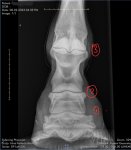
Random thought & I’m sure you’ve considered it but just in case… this is labelled as a DP view of the LH although annoyingly I can’t see a left / right positioning marker.
If the image hasn’t been flipped by the vet in their imaging software (& sometimes they will for certain reasons) that should mean that the beam would hit the front of the foot first & then pass through the back. I think that might make what is on the left hand side of the image be the right hand side of the foot & vice versa? Please note this is based on how I’d expect a dog limb to look if I xrayed in that view & so may be wrong but just a thought if you’re thinking the flare seems to appear on the wrong side on X-ray as I’d expect the shape of the outer wall visually to correspond pretty well with how the outline of the foot appears on X-ray
I agree it looks confusing but think the flare is where it needs to be.
My reasoning is that the leg, on my screen, bends over to the right as it goes up. So, the weight will be more over to the right of the foot than centre. The flare is also on the right, moving the centre of the foot to under where the weight will be. Hence, re-balancing naturally the surface area to under the centre of gravity.
no help whatsoever to you .. but was wondering if Have you any photos of him as a foal ? Just curious to see how windswept he was ? It could be that he was quite bad and they did treat him and get him to where he is. Or as you say he was only slightly wonky and they did nothing.
It makes my blood boil when breeders dont do the right thing. I was given a windswept yearling a few years ago as a companion for my weanling. She didnt look too bad , vet checked her out and said shed seen worse, and that it was entirely possible she could lead a normal life as a happy hacker.