Trimming to these x rays.

Does your vet have an understanding of how common this kind of conformational issue is@ycbm? I only ask because, although it seems logical, that may be a red herring. My 5y/o appy x arab showed a range of minor anomalies on xray - all of which could have been responsible for his then lameness. That included some minor conformational issues around the joints & joint spaces. He is now 17 and has done all manner of work under saddle with no other lameness than an abcess or 5 (the reason for the original 5 y/o xrays). The thing is, with horses, it seems that if we go looking for something we will invariably find it...even if that is not the actual problem. An RSI with the amount of work your horse has done seems possibly a stretch to me but I am no expert of course and you have a decent vet advising you.
 
Does your vet have an understanding of how common this kind of conformational issue is@ycbm? I only ask because, although it seems logical, that may be a red herring. My 5y/o appy x arab showed a range of minor anomalies on xray - all of which could have been responsible for his then lameness. That included some minor conformational issues around the joints & joint spaces. He is now 17 and has done all manner of work under saddle with no other lameness than an abcess or 5 (the reason for the original 5 y/o xrays). The thing is, with horses, it seems that if we go looking for something we will invariably find it...even if that is not the actual problem. An RSI with the amount of work your horse has done seems possibly a stretch to me but I am no expert of course and you have a decent vet advising you.


The horse is lame in a way which can be explained by a known progression of events and a bone anomaly that a senior orthopedic surgeon finds disturbing and conclusive. The whole of the back legs have been scanned and x rayed and are clean. There are no signs whatsoever of sacroiliac dysfunction. The horse nerve blocks clearly to the back feet yet is rock crushingly sound over stones.

If it quacks like a duck ......
.
 
Arch had foot problems - soft tissue at first, coffin joint arthritis eventually - from the age of 11. He's a bit wonky too. When he first had issues the vet told me that jumping would shorten his career massively but he might stand up to some low level schooling. We stopped jumping there and then (other than the odd small log out hacking and my self-imposed limit of 5 jumps per fun ride - about 6 a year) and because he never really enjoyed the school we did very little of it, maybe once or twice a month if I wanted to remind him of some manners.

He became my happy hacker and he did that until the age of 24 (ish, we suspect his passport isn't very accurate). He had steroid injections followed by 3 month field rest and rehab when he was first diagnosed, then was fine for 10 years. He had more x-rays when he started showing signs of lameness again which showed the arthritis. He was injected again at that point and was great for another 18 months before being injected again that gave him another 6 months but the next set of injections didn't do much to help him and he retired. 3 years on he's still happy and other than the odd day when it's very cold (for which he has a danilon) totally sound on no painkillers in the field.


Just what I need d to hear, thank you.
 
As of today, 18 days rested, he has already passed the three tests that I had for putting him back under saddle. The first was that he had to stand willingly with his full weight square on both hind feet. The second was that he had to stop shivering when I pick out his hind feet and he is not stood on a firm surface.

The third is travelling. He was always quite a good traveller. At the end of his time in the centre with waxed surfaces, he was a dreadful traveller and made a lot of noise. That carried on with every trip out to hack and every visit to the vet. Stamp, stamp, stamp, constant.

My rehab plan included a weekly 6 mile round trip in the van. Firstly to test how well he is travelling, with work under saddle held off until he travelled like he used to. The second for it to act as a "theraplate" type therapy.

The first trip was this morning, and the result was stunning. He is travelling just like he always used to. The difference was remarkable.

So here's a turnup for the books!

All this time we've been working under the assumption that Ludo is a stoic horse who only complained when things finally got too much for him. That never quite matched with his cuddly character, which I've always found before goes with being a bit of a wuss, but it fits with never being able to show him as lame before now.

My "gut feel" that he wasn't right was probably generated by the mechanical forces of those bones being the wrong shape and not by anything but fleeting pain.

On the information that we have right now (which could change at any time), it looks like his injuries are very minor and his reaction to them was that of a very sensitive horse.

This would be fabulous news for 2 reasons. The first that if the injuries were minor there is every chance he will stand up to hacking. The second being that we can feel confident that he will let us know if he's in pain.

I'm not rushing into riding him, I want several good journeys in a row to prove that today wasn't a one off. Meanwhile I'm walking him a mile on a flat rough track most afternoons which is trimming his feet nicely.

Feeling pretty happy today.
 
Last edited:
Sounds very positive and very much like RSI due to the wax surfaces. Hoping you guys can enjoy hacking and having fun for many years!

That's what we think. The vet was pretty anti wax, she says it's too sticky. I guess he needed his feet to wiggle a bit to stay comfortable and when they wouldn't his tendons and ligaments had to instead.

I've wracked my brains to think of any one incident that would have damaged both hind feet but left him rock crunching on stones but I can't place one. It all fits with a gradual degradation which progressed from fleeting pain into a proper injury.

In any case, I can't unsee what I've seen. I can't unknow that he's got bones that don't properly support his weight. I would be devastated if I got him fixed and carried on schooling him to carry more weight on his back legs, only to find in a year or two, or any time before his late teens, that I'd caused him permanent damage.
.
 
ETA i know he's barely done any work in his life compared to many 8 year olds. But i do low level weight training for half an hour a week and it's completely removed the pain of a "permanent" rotator cuff injury in 2 months. So if that level of the right work once a week can fix a problem, then I can easily believe that the wrong work twice a week can create one.
 
Last edited:
Not sure how helpful this is but Finn also has wonky front legs and a flare on his left fore. For him it’s also conformational as his bones aren’t straight from the knee. Vet advised not to try and correct it as it would put pressure on the leg which was growing the hoof it needed. He’s 13 now, been in full work throughout since 5yo and never had an issue with it, inc being blocked on a full performance work up. (He does have some stiffness hence that work up but we worked out it was due to melanoma impacting his way of going rather than limb lameness, so I’ve adjusted his work but the wonky leg itself wasn’t the issue).
 
Forgive my ignorance on this, I appreciate there are people out there far more knowledgeable than me, you included, but is it possible that the soft tissue injury has been cause by something else or at the very least that some external factor has aggravated something he was dealing with before? As far as I can recall, he's been pretty sound until now and he's not doing any more now, it's just where he's been doing it that's changed? I suppose it could be something that has been building very slowly since he started work and he's now reached the critical point but from a logical point of view it does suggest a correlation with the move? I wonder if that means you can be hopeful of him being able to cope well with hacking at least in future?

To quote Gillian Higgins "the vast majority of injuries to horses are the result of RSI" so just a small compensatory movement pattern over even a shortish period of time, but certainly in the long term, can lead to an apparent "sudden" injury.

ETA i know he's barely done any work in his life compared to many 8 year olds. But i do low level weight training for half an hour a week and it's completely removed the pain of a "permanent" rotator cuff injury in 2 months. So if that level of the right work once a week can fix a problem, then I can easily believe that the wrong work twice a week can create one.

More and more I see the value in just doing the correct work - if the warm up, the relaxation, the "whatever", is dysfunctional then it can do harm. Perfect practice makes perfect. The BTMM show results in many horses in 2-3 sessions of 5 minutes a week (would highly recommend, even just being in the group brings access to a superb group of professionals including feet etc).
 
good news and I am mentally adding this to the many reasons i will only ever have sand and fibre or sand and rubber surfaces at home for ever.

onwards and upwards from here, fingers crossed.
 
good news and I am mentally adding this to the many reasons i will only ever have sand and fibre or sand and rubber surfaces at home for ever.

onwards and upwards from here, fingers crossed.

H there was no doubt at all that wax was an issue for him. The moment I moved him back to sand/rubber, he pretty much stopped "falling off" one or other of his hind legs, usually the right one.

I think wax may be OK for the "perfect" horse, but how many of us actually own one?
.
 
H there was no doubt at all that wax was an issue for him. The moment I moved him back to sand/rubber, he pretty much stopped "falling off" one or other of his hind legs, usually the right one.

I think wax may be OK for the "perfect" horse, but how many of us actually own one?
.

I don’t have a single pony who likes a wax surface. Not one, and I have quite a few of them! They move like they are in mud. Horrible stuff and I will always take a pony’s opinion on whether a surface is good - their feet, they know! We never hire schools with wax surfaces now.
 
Today's test run in the van was even more surprising. I was praying for him not to be worse than last week, I hadn't expected improvement. But he was rock solid except on corners and no different from his he used to be before it all went to pot.

We took him for a much longer journey, to see if he got tired and started to stamp, but he didn't. And he came off the van as cool as a cucumber, no stress about the journey at all.

I now have "changes in traveling behaviour" logged as a major diagnostic tool for all horses. I don't feel that I will need to go back to the vet to block out a foot to check for soundness. I'll just throw him in the van and go for a drive and he'll soon tell me. It was 4 months before we managed to prove he was lame when he first changed how he was traveling, it's a good pre-warning that he's doing too much.

His feet look like they are changing shape a bit, too, which can only be a good sign. And he went off for a trot round when I went out to catch him and he was bouncing in a way I haven't seen him do in a long time. The mud free, flat turnout where he is stabled is a godsend. They were in a total of 3 days this winter, once because the rain was so torrential the roads were flooding and twice because of lying snow, but even then they were out for a roll and to say hi to their friends.

Instead of increasing from a mile in hand this week I'm going to ride him for the mile every other day, and then drive him out again on Saturday to check progress. Fingers crossed.

.
 
Today's test run in the van was even more surprising. I was praying for him not to be worse than last week, I hadn't expected improvement. But he was rock solid except on corners and no different from his he used to be before it all went to pot.

We took him for a much longer journey, to see if he got tired and started to stamp, but he didn't. And he came off the van as cool as a cucumber, no stress about the journey at all.

I now have "changes in traveling behaviour" logged as a major diagnostic tool for all horses. I don't feel that I will need to go back to the vet to block out a foot to check for soundness. I'll just throw him in the van and go for a drive and he'll soon tell me. It was 4 months before we managed to prove he was lame when he first changed how he was traveling, it's a good pre-warning that he's doing too much.

His feet look like they are changing shape a bit, too, which can only be a good sign. And he went off for a trot round when I went out to catch him and he was bouncing in a way I haven't seen him do in a long time. The mud free, flat turnout where he is stabled is a godsend. They were in a total of 3 days this winter, once because the rain was so torrential the roads were flooding and twice because of lying snow, but even then they were out for a roll and to say hi to their friends.

Instead of increasing from a mile in hand this week I'm going to ride him for the mile every other day, and then drive him out again on Saturday to check progress. Fingers crossed.

.
I am so happy for you both.
 
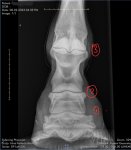
Coming back to this xray.

Screenshot_20230216_163804_Chrome.jpg


It is completely unrepresentative of the outer foot capsule. I couldn't get it straight in my head so went to take photos today. I was convinced they had actually xrayed the wrong foot! There is NO flare on the right, the right wall is very upright. What the x ray is showing is, think, a twist in his foot capsule towards the front. There is very significant flare on the LEFT, very much as there appears to be on the right.

So, the actual flare is on the side opposite from the lean. It isn't supporting the lean. So what's it doing?

I'm waiting on a callback from a farrier I trust. But meanwhile, it seems to me that the weight is concentrated over the right hand, upright, wall, and that the flare on the left side is because it isn't getting the same level of wear and is spreading out rather than growing higher, so preventing unbalancing the foot. The other foot is a mirror image with an outside flare.

I'm now of a mind to chop that flare off like the surgeon who diagnosed him advised. I don't think it's harmful but it is unsightly and it might just do something.

Meanwhile, when I went to catch him yesterday he went for a 5 minute canter round and round the field racing another horse. There's obviously spring grass coming through, he was a bit on his toes on Monday when I rode after a month break 🤠 I was trying not to watch, but he did look magnificent 🫣 !
.
 
Last edited:
Random thought & I’m sure you’ve considered it but just in case… this is labelled as a DP view of the LH although annoyingly I can’t see a left / right positioning marker.

If the image hasn’t been flipped by the vet in their imaging software (& sometimes they will for certain reasons) that should mean that the beam would hit the front of the foot first & then pass through the back. I think that might make what is on the left hand side of the image be the right hand side of the foot & vice versa? Please note this is based on how I’d expect a dog limb to look if I xrayed in that view & so may be wrong but just a thought if you’re thinking the flare seems to appear on the wrong side on X-ray as I’d expect the shape of the outer wall visually to correspond pretty well with how the outline of the foot appears on X-ray
 
I’ve seen the phenomenon described by Boulty happen surprisingly regularly and the vets themselves don’t always clock it has happened.

To the point that many vets do mark the lateral side, so it’s obvious it’s happened.

It’s more obvious in the LM shot, because then the foot is facing the wrong way. In the DP view you just end up with a confusing mirror image.
 
I agree it looks confusing but think the flare is where it needs to be.

My reasoning is that the leg, on my screen, bends over to the right as it goes up. So, the weight will be more over to the right of the foot than centre. The flare is also on the right, moving the centre of the foot to under where the weight will be. Hence, re-balancing naturally the surface area to under the centre of gravity.
 
To add to my previous post:- not that I think trimming the flare would be all bad, as it would tickle my curiosity as to why the vet suggested it when the flare has grown under the centre of gravity. I would only trim a bit at a time though, while he is in no or very light work - just to be on the safe side.

I dislike doing anything fast with feet as the foot may then look better, but the joints and ligaments can then get a strain - as you already know.
 
Random thought & I’m sure you’ve considered it but just in case… this is labelled as a DP view of the LH although annoyingly I can’t see a left / right positioning marker.

If the image hasn’t been flipped by the vet in their imaging software (& sometimes they will for certain reasons) that should mean that the beam would hit the front of the foot first & then pass through the back. I think that might make what is on the left hand side of the image be the right hand side of the foot & vice versa? Please note this is based on how I’d expect a dog limb to look if I xrayed in that view & so may be wrong but just a thought if you’re thinking the flare seems to appear on the wrong side on X-ray as I’d expect the shape of the outer wall visually to correspond pretty well with how the outline of the foot appears on X-ray

Well that would explain it, I'll contact the vet and ask.
 
Last edited:
I agree it looks confusing but think the flare is where it needs to be.

My reasoning is that the leg, on my screen, bends over to the right as it goes up. So, the weight will be more over to the right of the foot than centre. The flare is also on the right, moving the centre of the foot to under where the weight will be. Hence, re-balancing naturally the surface area to under the centre of gravity.


There is, literally NO flare where the x ray appears to show flare but a lot of flare on the other side where the x ray appears to show none. The reversed image would explain that, I guess.

You're right, the bottom of the hoof is directly in the centre of the point of balance of the tilted joint, I've just measured it. He obviously grows it for that reason.

ETA I've emailed the vet.
.
 
Last edited:
no help whatsoever to you .. but was wondering if Have you any photos of him as a foal ? Just curious to see how windswept he was ? It could be that he was quite bad and they did treat him and get him to where he is. Or as you say he was only slightly wonky and they did nothing.
It makes my blood boil when breeders dont do the right thing. I was given a windswept yearling a few years ago as a companion for my weanling. She didnt look too bad , vet checked her out and said shed seen worse, and that it was entirely possible she could lead a normal life as a happy hacker.

What’s the right thing though? I have a home bred who was born with issues that (despite early treatment and involvement from specialist vets) could not be be corrected. He is now a happy but wonky trainee lawnmower.
 
Top
